


 Shkruar nga Pamfleti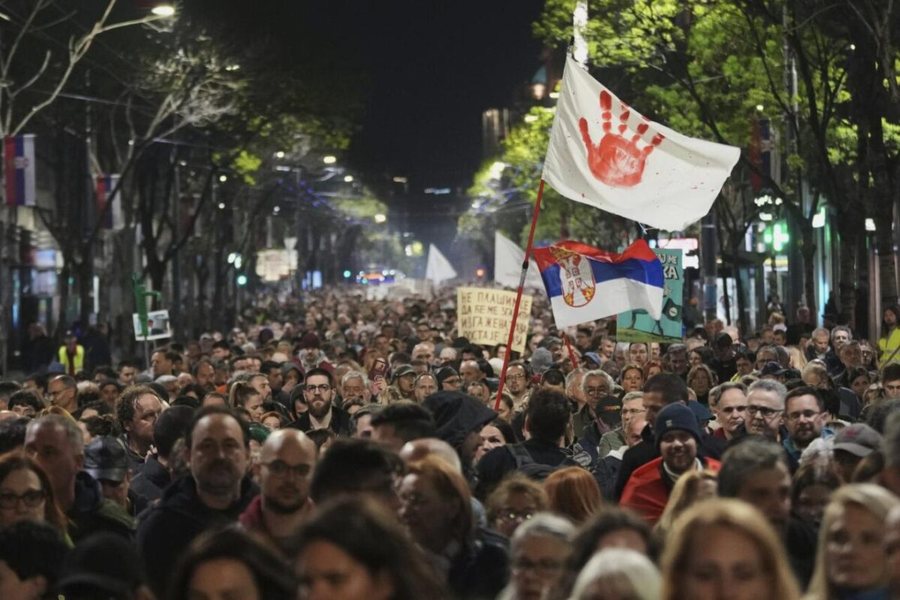
On November 1st of last year, the collapse of a train station reawakened the anger of a nation oppressed by an autocratic regime. Amidst fear, loneliness, and student resistance, the Serbian diaspora across the continent seeks to become a spokesperson for the denied democracy.
Novi Sad, November 1, 2024. At 11:52 am, within a few seconds, sixteen people lose their lives. An entire city comes to a standstill, gathering around the families who suffered this tragedy, caused by an evil autocratic regime and its systematic corruption. The train station was built by two Chinese companies as part of the Belgrade-Budapest railway project.
Today, because of that episode, an entire country is stuck. Because we Serbs, a Slavic and Balkan people, are like this: when we are angry and oppressed, we never remain silent, but rather we shout even louder and demand our salvation. And every generation has had to save itself in some way, like my parents and like the diaspora, who had to leave the country to build a life from scratch somewhere in the West, learn a new language, overcome bureaucracy to gain legal status, and build a family where their children have all the opportunities they never had.
Those who remain today, young people my age, who are beaten in the streets by a paramilitary group under the direct control of the autocrat Aleksandar Vučić, do so not only out of Serbian resentment (pride), but because that collapse made people feel lonely, unheard, divided and without prospects for the future. But the truth is that until that tragedy, living in Serbia, from the outside, seemed almost normal: it is true, there were sometimes violent demonstrations in the streets, there were often rigged elections and politics was a total disaster, but in reality, on the streets, people seemed apathetic, but it was as if they were simply living by different standards than those we are used to. But after all that smoke in the taverns, after the alcohol, coffee and cigarettes, after the worry, the final hammer blow was being delivered to the coffin of Serbian democracy. And behind those apathetic eyes lies a great anger, fear, and sadness towards an authoritarian regime that takes everything for itself and fails to protect its citizens.
When the shelter collapsed, an entire population was awakened from their stupor, drawn by the brave university students. The air changed, the smoke cleared, but the government noticed and reacted. It mobilized the poorest Serbs, those who had no access to opposition media, and in exchange for a small sum of money (and some releases from prison), turned them into Vučić’s soldiers. They were there to protect the parliament, almost as if they had appeared as “good citizens,” functional illiterates who, under the guise of “being students who want to study,” had been living for months in Belgrade’s Pioneer Park, with government-paid housing and food, thanks in part to extensive and generous police protection.
This summer I attended a protest, before it turned violent, and what you feel when you're there at first is the anger of a people. But you also feel the fear and the great loneliness that accompanies that anger. You feel so far from Europe, even though you're on the border, and you feel persecuted and controlled, even when you're not actively protesting, because you're in a country without rights and you're afraid of being arrested and publicly insulted at any moment. I felt like someone was strangling me, and I couldn't wait to come back to the surface, across the border, to breathe.
But I wonder why there is such a lack of interest in this issue here in Europe. Are we really so indifferent and privileged that we have no empathy or understanding of what is really happening beyond our borders? And not to realize that this issue could have catastrophic consequences for us too?
What about us in the diaspora? We who are in the middle? We mourn. Because the pain is inevitable and we know that, whether we like it or not, that land will always be a home. We try to talk about it with everyone we can, but we too, like me as I write this article, are afraid because there is always the risk of never returning to that land. We see students from Serbia running and cycling towards European institutions and we feel that the European Union is not doing enough. And we feel a little useless and a little discouraged./ Adapted from "Pamphlet" by "Linkiesta"


Lini një Përgjigje