


 Shkruar nga Pamfleti
From the United States to China, from Israel to Europe, a generation of operating systems is being deployed everywhere...
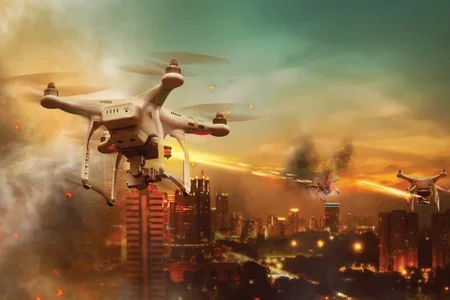
The laser war has begun. After six decades of experimentation, laser blasts have moved from the realm of science fiction to the battlefield. From the United States to China, from Israel to Europe, a new generation of operating systems is being deployed everywhere. Soon, the destructive power of cannons will no longer be measured in calibers but in kilowatts, and collisions will be characterized by ghastly sparks reminiscent of Star Wars duels.
In reality, not all of the technical problems of directed energy weapons have been overcome. However, here too, the rapid spread of flying drones has accelerated the development of lasers. One of their limitations is the need to keep a fixed beam on the target long enough to cause damage. Keeping up with fast-flying missiles is difficult, while slow remote-controlled aircraft, which do not exceed 200 km/h, are perfect prey. The distortion of light caused by clouds, fog and general humidity must also be taken into account, but these are calculations that artificial intelligence immediately completes. And there is a clear advantage: lasers allow you to shoot down low-cost drones at a negligible cost, between three and five euros per "shot".
In the early days of the Gulf conflict, the scene was repeated with American Patriot missiles, each costing more than three million euros, launched by Gulf countries in their hundreds to stop Iranian Shahed missiles, which cost less than thirty thousand euros. Not only that, replacing worn-out surface-to-air missiles is a long process, as it takes two years to build a single one. Lasers, on the other hand, run on electricity; simply recharge the batteries and they are back in action.
Batteries are another limitation. Large batteries are needed to store energy and have a lot of bullets available: about the size of a shipping container. This drawback has so far led to a preference for ships, where space and weight are not an issue: real laser cannons can be carried.
Currently, eight US Navy fighter jets are equipped with these weapons, but their number is expected to grow rapidly. Seven are low-power Odin systems: they can disable infrared sensors and cameras that guide drones or naval vessels. Meanwhile, the 60-kilowatt-hour Helios system can destroy the wings and fuselages of aircraft or the hulls of attack ships, burning everything inside. Lockheed Martin is currently developing a 150-kilowatt version.
The US Navy wants to deploy a 300-500 kilowatt maxi cannon, capable of stopping even cruise missiles: it will be the pride of the "Donald Trump" class supercarriers.
The US military, on the other hand, is focusing on Locust, a 20-kilowatt modular system that can also be mounted on Stryker armored vehicles and off-road vehicles. It has been demonstrated that it can shoot down three quadcopters in rapid succession and has a total price tag of eight million dollars, far less than self-propelled vehicles equipped with surface-to-air missiles. The Pentagon has also deployed it domestically, as part of the White House’s effort to prevent migrants from entering from Mexico: human traffickers use drones to identify unmanned border crossings. And so lasers seemed like the solution, but they were implemented in a haphazard manner.
In Texas, they shot at a decorative balloon that had been floating in the air after a party, causing a panic that paralyzed the El Paso airport. Then they managed to electrocute a spy quadcopter, but it belonged to the Border Patrol.
Israel, as usual, seems to be ahead of the curve and is using Iron Beam, a laser version of Iron Dome. Its development took over ten years, involving two giants of military electronics, Elbit and Rafael. It is a heavy system, housed in a fixed container, which, thanks to 100 kilowatts of power, can strike ten kilometers away. There is also a mobile version, mounted on the back of a truck, and a mini installed in jeeps. However, the Jewish state wants to go further and has commissioned research into lasers to arm fighter jets and helicopters.
Everyone is convinced that Beijing is investing heavily in these devices and displayed several of them, all self-propelled on wheeled vehicles, during last year’s grand parade. The Chinese seem eager to test them in combat: they sent some to the Russian province of Kursk in the summer of 2024, and a few weeks ago, a battery appeared at Dubai International Airport to protect against Pasdaran raids.
Finally, the Europeans, who are also failing to cooperate in this area. There are four national initiatives, entrusted to branches of the same groups: a paradoxical situation, with a waste of resources and expertise. The most advanced is the British DragonFire, developed by Leonardo UK and MBDA UK: the Royal Navy will have it ready for combat in 2027. However, in Italy, Leonardo and MBDA have also launched an ambitious laser project, with MBDA opening a development laboratory in Turin and planning to enter the operational phase by 2028. In Germany, Rheinmetall, again with MBDA, has already shot the prototype installed on a frigate a hundred times. In France, MBDA, again with Thales, is developing a similar one. Why don't they join forces? Every government is jealous and unwilling to share high-tech patents: a common European defense remains a mirage.
The laser war has begun. But we don't know where it will lead. Because humans are slower than drones, and against them, beams of light can have terrible effects. A fraction of a second is enough to burn the retina. This has already happened, transforming the sights that guide bombs and missiles to their targets into blinding weapons. In the 1980s, the British did this in the Falkland Islands to protect their fleet from Argentine fighter jets, and then the Iraqis did it to stop waves of Iranian foot soldiers bent on martyrdom. Since then, more than a hundred countries have signed a UN convention banning these cruel instruments, but today their cruelty knows no bounds./ Adapted from "Pamphlet" by "La Repubblica"







Lini një Përgjigje