


 Shkruar nga Andrea Fioravanti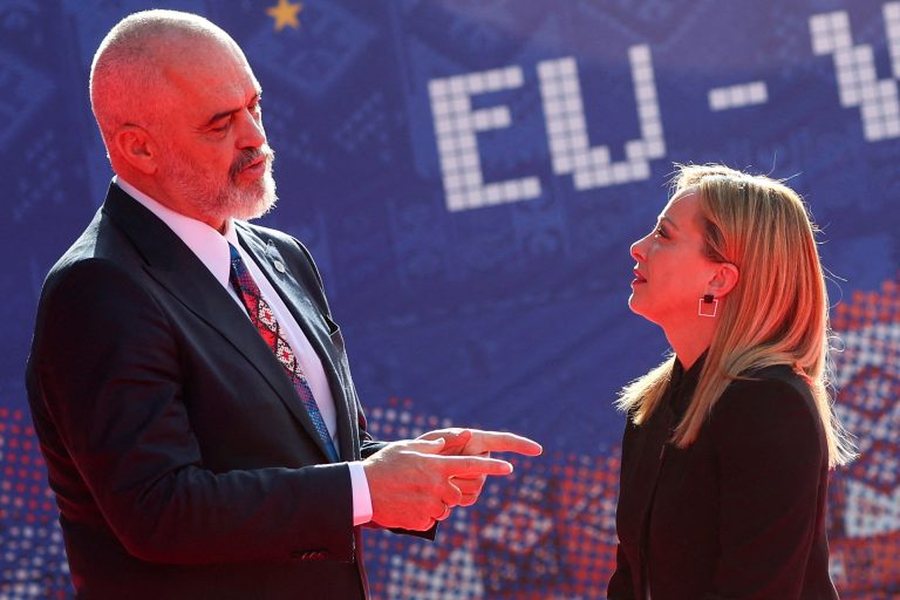
She has returned to attacking the politically perfect enemy that faces everything calmly: the European Union...
For four years, Giorgia Meloni has governed a country ranked last in economic growth and first in public debt, where industrial production has fallen by 4 percent since she took office. But instead of explaining to Italians why her government is unable to finance measures to limit the damage from the energy crisis, she has returned to attacking the politically perfect enemy that faces everything calmly: the European Union.
Meloni would like an additional five to nine billion euros to cut excise taxes and utility bills. The European Commission has responded that the means already exist, without increasing the deficit: by using the funds left over from the National Recovery and Resilience Plan (NRRP) and by reprogramming cohesion funds. Rome, on the other hand, is demanding that the fiscal flexibility granted exceptionally for defense be extended to interventions against the energy crisis. Brussels fears that this would set a dangerous precedent: every emergency would become an exception, every crisis a reason to widen the deficit. All this while calling for a new breach of the Stability Pact, which the Meloni government helped reform less than two years ago, and which the Prime Minister herself described at the time as a “sound compromise”, with rules that were “less rigid and more realistic” than in the past.
Having still not managed to break the political deadlock, Meloni has reverted to the same lazy slogans from her opposition days. Speaking to Confindustria business leaders, she declared that the EU is “a bureaucratic giant that has too often sacrificed competitiveness, growth and strategic vision on the altar of ideological and technocratic approaches, helping to push the continent towards progressive economic and geopolitical decline.”
No one in the audience raised their hand to ask why the same European Union was so respectful just a month ago, when it released 12.8 billion euros for the ninth and penultimate tranche of the National Recovery and Resilience Plan (NRRP). This plan did not deliver the promised recovery, but it showed extraordinary resilience in postponing the country’s structural problems. When billions arrive, the European Union is fine; when it remembers that there are limits on deficit and debt, it turns into a bureaucratic giant.
Just as no one asked why Italy will grow by 0.5 percent this year and 0.6 percent in 2027, despite the 166 billion euros allocated so far by Brussels for this blessed NRPP. Meloni said that “ we can claim with some pride that we were up to the task ”, and one might be tempted to believe him out of pure conviction. But then we look at the Court of Auditors reports and we see that the government has performed admirably in collecting its payments, but has been unable to transform the spending into productivity and improved public services.
Formally, Italy has met all the formal conditions set by Brussels: adopting a reform, publishing a call for proposals, allocating funds, opening a platform and filling out a certain number of applications. And for this, it has received nine tranches from the very evil EU. But receiving an tranche does not mean that it has transformed that money into growth. The Parliamentary Budget Office reports that a significant part of the Plan has been shifted to measures that will generate spending even after the natural expiration date. We are talking about 23.8 billion euros beyond August, while in January, less than 2.3 billion euros had been spent on the same measures. When actual implementation became difficult, the government often adjusted the timing and scope of interventions.
But a funded kindergarten is not an open kindergarten. A school that gets tablets and digital whiteboards does not automatically become a better school if the teachers are not trained, the connection is poor and these devices end up locked in a closet. A municipality that has allocated funds to renovate a road, a canteen or a sports facility achieves nothing if it lacks technicians to draw up plans and supervise construction sites. A justice reform approved by Parliament will not shorten trials if it lacks magistrates and clerks capable of using that software. And an unemployed person registered by an employment center or sent to a refresher course will not magically transform into a worker if the labor market is chronically depressed.
"Europe must focus on what member states cannot do on their own, not on what member states can do better on their own ," Meloni told Confindustria. Given the management of the plan, we expect a special administration from moment to moment.
The NRRP was supposed to be the driving force of growth, but it turned out to be a damaged parachute. So far, everything has gone well for Meloni, because the problem is not the fall, but the descent. Future generations will pay for the fall, when we will probably only remember her government for its record longevity and political defeat in the referendum on justice.
And before any brave person claims that the government is absolved of its responsibilities, the Prime Minister chooses the easiest path: to open a polemic with the European Union, which is not a single person, but a collection of politicians and institutions. They receive, whenever and if they receive, the echo of Italian insults. And they do not even have much interest in responding, because their job is not to participate in the permanent talk show of Italian politics, but to implement the treaties discussed, approved and signed, including by Italy, a founding member of the Union.
And these obstacles are not a punitive behavior by Brussels. They are also one of the main reasons why creditors continue to trust a country with one of the highest public debt-to-GDP ratios in Europe: 138 percent. This means that for every 100 euros of wealth produced in a year, the Italian state has 138 euros in debt. This year, we will surpass Greece, which has truly experienced the debt crisis and is still suffering the consequences.
When “Europe asks us for this”, this is not good. But when we ask for money, flexibility, shields and exemptions, then Europe suddenly becomes useful. It is sovereignism in debt: seeking autonomy when it comes to respecting the rules, calling for solidarity when the bill comes./ Adapted from “Pamphlet” by “Linkiesta”


Lini një Përgjigje