


 Shkruar nga Pamfleti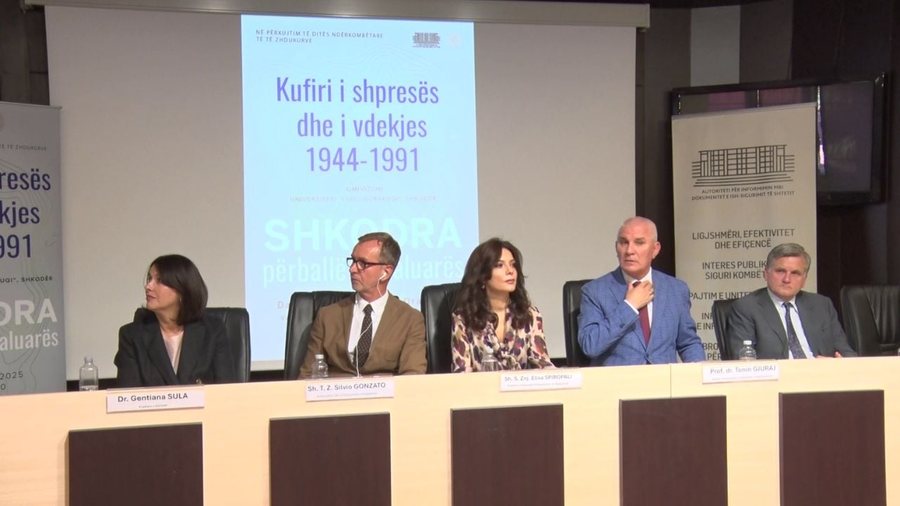
In Shkodra, one of the areas most affected by the violence of the communist regime, the scientific symposium "The Border of Hope and Death 1944–1991 - Shkodra Facing the Past" was held, in commemoration of August 30, the International Day of Missing Persons.
The capital of the North, due to its proximity to the Montenegrin border, was during the dictatorship one of the most militarized points in the country, where many Albanians lost their lives trying to escape the regime. The event was attended by representatives of the diplomatic corps, scholars, former political prisoners, families of victims, as well as local and university authorities.
Also present was the rector of the University of Shkodra, Prof. Dr. Tonin Gjuraj, who in his speech said that this symposium is more than an academic activity, it is a space of collective memory:
“Shkodra, the city of culture and resistance, has felt more deeply than anyone the border transformed into a death line. Hundreds of lives lost, shot and disappeared without a trace, remind us that the border was not just a geographical division, but a division between hope and tragedy. Memory is not just for the past; it is for the future. Forgetting is a second form of death, and we must not allow it.”
The Rector thanked the collaborating institutions, including the Authority for Information on Documents of the Former State Security, the Municipality of Shkodra, the Associations of the Politically Persecuted and the Museum of Memory, emphasizing that the past cannot be hidden, but must be recognized and faced with courage.
Rector Gjuraj's speech
It is an honor and responsibility for "Luigj Gurakuqi" University to host this symposium today, on the International Day of the Disappeared, dedicated to one of the most painful wounds of our recent history.
Shkodra, the city of culture and resistance, has felt more deeply than anyone the border transformed into a death line. Hundreds of lives lost, shot and disappeared without a trace, remind us that the border was not just a geographical division, but a division between hope and tragedy.
This symposium is not simply an academic event, but a space of collective memory. We are here to bow respectfully to the victims, to give voice to those who could not speak, and to restore to our collective conscience the price of freedom.
Our university sees as its duty not only the commemoration, but also the careful scientific study of the events: to research documents, to analyze the evidence, to reconstruct with historical and social methods the reality of that time and to turn this knowledge into part of the national consciousness and university education. The program of this symposium has also been built in this spirit, where the papers address different ways in which witnesses, citizens and researchers will examine and further the study of this part of the history of Albania and Shkodra, giving memory a living academic dimension, endurance and reflection. Only in this way will memory not remain trapped in pain, but become a continuous process of research, learning, reflection and awareness for the generations to come, because forgetting is a second form of death — and we must not allow it.
Memory, then, is not just for the past; it is for the future. By confronting history, we learn that freedom is not given once and for all, but a value that must be preserved and protected every day. This is the message that we, as a university and as a city, must convey to the new generations: that the memory of pain be turned into strength to build a more just and humane society.
I would like to thank the Authority for Information on Documents of the Former State Security, the Municipality of Shkodra, the Associations of the Politically Persecuted and of Murders at the Border, the Museum of Memory, the ICMP and all those who have contributed to this activity.
Let this day be a testament that the past is not hidden, but acknowledged and faced with courage; a memory for the victims, a comfort for the families, and a bequest to us all: to build a future on the foundations of truth and freedom.



Lini një Përgjigje