


 Shkruar nga Pamfleti
The Albanian government aims to close 10 of the 33 chapters of negotiations with the European Union within this year, and although the process seems to be at a standstill pending a response from member states that assesses its progress so far, a decision-making that, according to the government, has no timeframe for when it might happen.
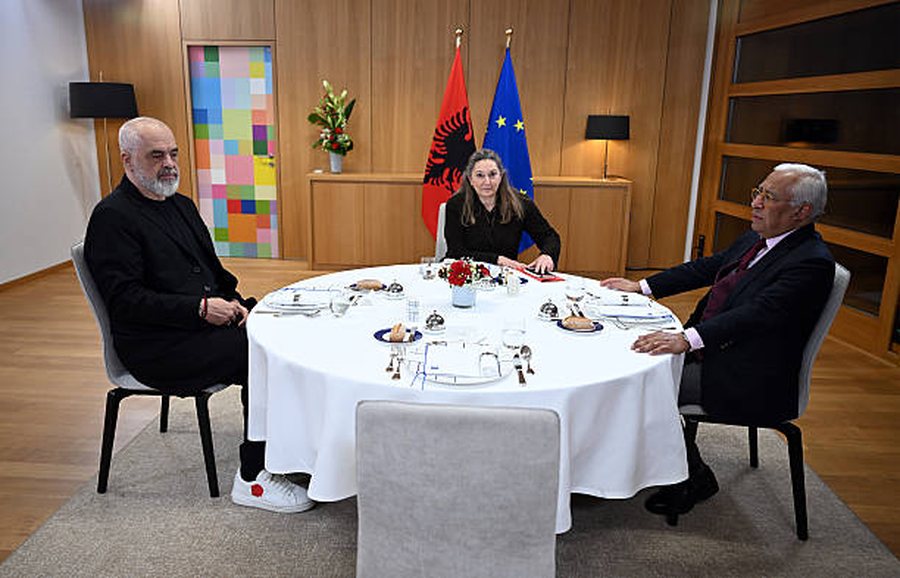
The President of the European Council, Antonio Costa, will conduct a diplomatic tour of the six Western Balkan countries on the eve of the EU-Western Balkans Summit, including Albania.
Through a post on the social network X, Costa says his visit is intended to send a clear signal to the Western Balkan countries.
COSA demands concrete results from countries that wish to integrate into the union, an aspiration of the Albanian government for 2030.
“This week, I will visit our six Western Balkan partners. My visit to the region sends a clear signal: our commitment to the Western Balkans is real; and so is the opportunity for enlargement. The moment is here. Now is the time to deliver,” Costa writes in X.
This week, I will visit our six Western Balkans partners.
— António Costa (@eucopresident) May 31, 2026
My visit to the region sends a clear signal: our commitment to the Western Balkans is real; and so is the opportunity of enlargement.
The momentum is there. Now is the time to deliver. pic.twitter.com/yCZ2BqEMFD
Costa's visit comes as part of his tour of the Western Balkans ahead of the EU-Western Balkans Summit.
This summit will be held on June 5 in Tivat and represents a historic moment, as it is being organized for the first time in Montenegro, considered together with Albania as vanguard countries of the enlargement process.
The program includes two main sessions: a plenary meeting and a working lunch.
The plenary meeting will be dedicated to progress in the rapprochement and integration of the Western Balkans into the EU and the Growth Agenda, while strengthening regional stability, connectivity and sustainability.
The working lunch will focus on enlargement policy, key challenges and opportunities, as well as on approximation with European policies and standards, confirming that enlargement remains one of the main strategic issues of the European Union.
Where is Albania so far in the integration process?
The Albanian government aims to close 10 of the 33 chapters of negotiations with the European Union within this year, and although the process seems to be at a standstill pending a response from member states that assesses its progress so far, a decision-making that, according to the government, has no timeframe for when it might happen.
Meanwhile, Montenegro has closed 14 of the 33 chapters that must be completed before membership, while Albania continues to grapple with the most delicate phase of the process, that of the "Foundations", where Brussels needs to see the real functioning of the rule of law, justice and democratic institutions.
Enlargement Commissioner Marta Kos urged Montenegro to continue reforms, keeping its focus on the rule of law, while in Albania this very standard has become the main source of European skepticism.
In this sense, Montenegro’s progress towards Europe is also an embarrassing reflection for Tirana. Podgorica became a candidate country in 2010, just four years after separating from Serbia, and opened negotiations in 2012. Today, it is not only discussing an accession treaty, but has turned 2028 into a concrete state objective, so much so that the national airline carries the slogan “28 in 28.”
Meanwhile in Albania, the year 2027 was used as an electoral slogan for Edi Rama's fourth term. But a few days ago, Rama was forced to publicly admit that the promised deadline may not be met and that negotiations may be postponed until mid-2028.


Lini një Përgjigje