


 Shkruar nga Pamfleti
The contest, which was created to promote European harmony and cultural exchange, is now facing the biggest boycott in its history. However, controversy is nothing new to Eurovision.
A music competition intended to unite Europe has devolved into a fierce debate over human rights, war and international politics. The boycott dominates the headlines, while artists continue to defend the idea that art should stand above politics.
It may seem like this year's situation, but a similar clash occurred in 1969. Back then, Austria refused to participate in the Eurovision Song Contest held in Spain, due to the dictatorial regime of Francisco Franco. Over five decades later, several countries are boycotting the Vienna edition due to Israel's participation, while the war in Gaza continues.
As ABBA sang in "Waterloo", the winning song of 1974: "History repeats itself."
However, many analysts believe that this year's tension and division run deeper than previous controversies.
" Many people deride Eurovision as irrelevant or just a kitsch spectacle, but this reaction shows otherwise ," says William Lee Adams, a renowned Eurovision author and commentator.
" Today we have the biggest boycott that Eurovision has ever seen. And this directly damages its image, because the idea of the contest is to unite countries ," he added.
The 70th edition of Eurovision is being held in the Austrian capital without Spain, the Netherlands, Ireland, Slovenia and Iceland, which have withdrawn in protest at Israel's participation.
Spanish Prime Minister Pedro Sánchez declared: “ In the face of an illegal war and genocide, silence is not an option. We will not be in Vienna because we believe we are on the right side of history .”
Instead of broadcasting Eurovision, Spanish public broadcaster TVE is airing an alternative music program, while Slovenian broadcaster RTV has chosen documentaries about Gaza. In Ireland, national broadcaster RTÉ is bringing back a satirical episode of the series “Father Ted,” in which Catholic priests take part in a European song contest and receive “zero points.”
Increased security and political tension
The traditional Eurovision motto is "United through music," but the atmosphere this year is far from the usual celebration.
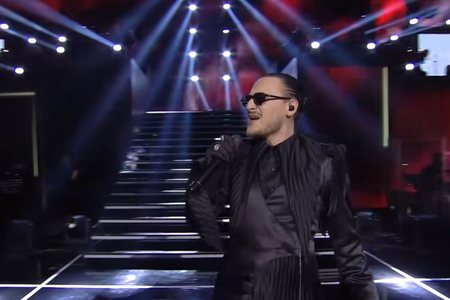
Austrian police have stepped up security measures as protests and political tensions have surrounded the semi-finals. During the performance of Israeli representative Noam Bettan, chants of " Stop the genocide " were heard in the hall.
Supporters of Israel consider the boycott anti-Semitism, while critics of the competition accuse the organizers of using art to "whitewash" military actions in Gaza.
From European harmony to political conflicts
Eurovision was created in 1956 by the European Broadcasting Union (EBU), initially as a project to bring European countries closer together after World War II.
Historian Chris West, author of the book "Eurovision: A History of Modern Europe Through the World's Greatest Song Contest," says the contest was born from the idea of "never again war."
Initially, politics remained off the stage. But this changed with the involvement of Spain and Portugal during the dictatorships of Franco and Salazar.
In 1964, a Danish activist took to the stage with a banner reading “Boycott Franco and Salazar.” A year later, Austria boycotted the competition in Madrid.
Over the decades, Eurovision has been used as a symbolic arena for conflicts and national identities:
-Greece and Turkey boycotted each other during the 1970s.
-Portugal used its Eurovision song as a signal to launch the 1974 revolution.
-Jordan interrupted the broadcast during Israel's performance in 1978.
-The wars in the former Yugoslavia brought one of the most dramatic moments of the competition, when Bosnian artist Muhamed Fazlagic managed to escape from besieged Sarajevo to represent Bosnia in Ireland.
-In recent years, the conflict between Russia and Ukraine has dominated the political scene at Eurovision. Russia was expelled in 2022 after its invasion of Ukraine.
According to Adams, Ukraine has used Eurovision as a diplomatic platform: “ They treat the singers as ambassadors who remind the world that Ukraine exists .”
Music, identity and politics
Eurovision has also been an important space for the LGBTQ+ community, especially since the late 1990s. Meanwhile, many Eastern European countries used the contest as a way to affirm European identity after the collapse of the Soviet Union.
“ Eurovision became a way of being European before countries joined NATO or the European Union ,” says Chris West.
Despite the controversy, boycott and tensions, he believes the competition still retains a symbolic value for Europe. / Adapted from "The Guardian"


E verteta është se Israeli është shtet Aziatik ne Azi e duhet të marre pjese ne aktivitete kulturale, artistike, sportive më fqinjet e vet. Pse ky privilegj për Izraelitet? Po Australia ç’pune ka që merr pjese ne Eurovision, të shkoje e të marre pjese ne Aziavision e ku di une. Ka pas qene nje shprehje, që kam lindur kerric e di, por nuk dua të vides gomar. Ç’jane keto gozhda Nastradini që ngulin ku tu jepet mundesia?