


 Shkruar nga Adri Nurellari
It's comfortable to watch the game from the couch with the remote control in hand and explain to the players how to win the final. He who does nothing certainly makes no mistakes, but that doesn't necessarily make him the best judge of those who are taking on the burden and consequences of their actions. Fortunately, history has never been changed by commentators, but by those who have entered the field...
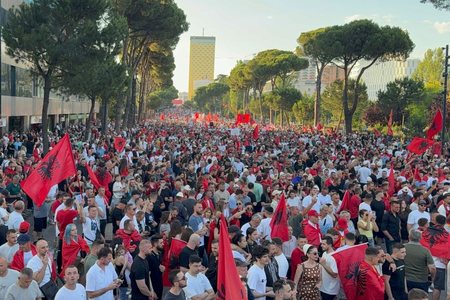
There is a category of people that amuses me immensely. They are those who have never taken part in any protest for any cause, have never raised their voices against those in power, or have suffered any personal cost, but have the highest standards in the universe for how this government should be overthrown by the 'Flamingo Revolution'.
Their repertoire begins: the protest is too small; then so many numbers are not enough, where do they have the Constitution and the five-year plan; where do they have the leader; where do they have the shadow government; why are they so soft; why are they so harsh; violence is needed; no, more creativity is needed. Then comes the masterpiece as a scientific conclusion: "Rama has not fallen yet, so the protest is worthless". And five minutes later: "But why are they calling us to get up from the coffee? Why are they embarrassing us? The foam on our macchiato disappeared while watching the live on Facebook".
That is, the protest must win… but without disturbing the spectators at all. In the end, it turns out that the hardest thing to do than confront the government is to pass the commentators' test. In fact, this kind of cynicism is not political analysis, but simply a self-defense mechanism. By declaring the protest 'failed' or 'imperfect' from the start, they give themselves moral permission to do nothing. It is more comfortable to say 'I'm not going because they don't convince me', than to admit 'I'm not going because I don't have the courage or the means'.
These people demand that the protest be perfect before they join. But no movement in history has been born perfect; it is matured and structured along the way, precisely by people’s participation. Demanding a perfect opposition or protest from the couch is like refusing to go to the gym until you have the body of an athlete. It is logical sabotage disguised as a demand for accountability. Of course, everyone has the right to choose how to engage, or even not to engage at all.
But it's hard not to smile when those who have never taken on the burden of action or confronting power demand perfection from those who do. This position guarantees something extraordinary: being right in every scenario. If the protest fails, they boast with the prediction: 'I told you it was in vain.' If the protest achieves something and brings about change, they are the first to benefit from freedom, democracy or the rights gained, without getting their feet wet.
It is political parasitism in its purest form. This is exactly what Theodore Roosevelt described in his famous “Man in the Field” speech delivered at the Sorbonne in 1910. “It is not the critic who counts; nor the one who points out where the strong man stumbled, or how the doer could have done things better. The credit belongs to the one who is in the arena; to the one whose face is covered with dust, sweat, and blood; who tries with all his heart; who errs, who fails now and then, for there is no effort without error and deficiency, but who goes on acting; who knows great enthusiasm and great devotion; who spends himself in a worthy cause; who, at best, in the end tastes the triumph of a high achievement; and, at worst, even if he fails, at least he fails with courage.
Thus, his place will never be among those cold and cowardly souls who know neither victory nor defeat.” This is why protesting means making mistakes, learning, being corrected, being attacked, having slandered, wasting time, energy, and peace, and incurring personal costs.
It's comfortable to watch the game from the couch with the remote control in hand and explain to the players how to win the final. He who does nothing certainly makes no mistakes, but that doesn't necessarily make him the best judge of those who are taking on the burden and consequences of their actions. Fortunately, history has never been changed by commentators, but by those who have entered the field.






Lini një Përgjigje