


 Shkruar nga Claudio Paudice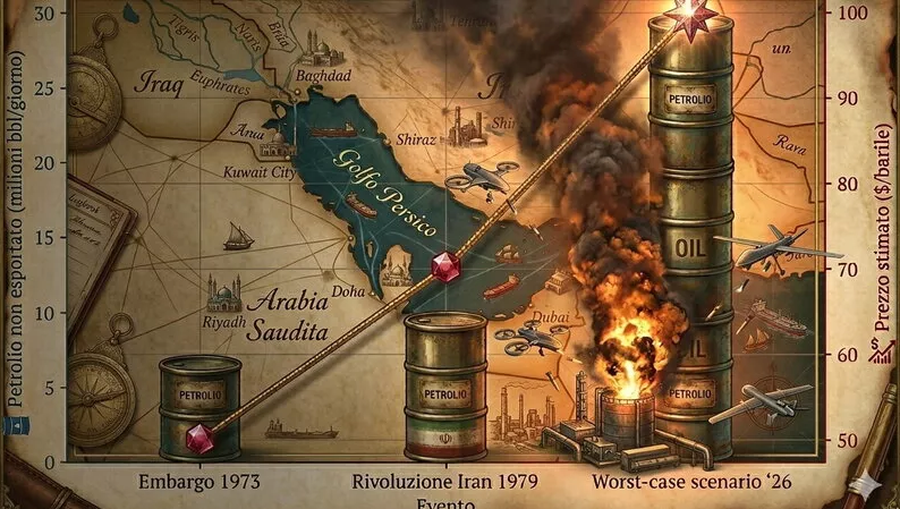
How the conflict in the Persian Gulf is dictating the exponential increase in oil prices and why experts predict a 3-digit price scenario that could bring the global economy to its knees...
To say this is a million-dollar question is a gross understatement; its real value is estimated to be in the thousands of trillions of dollars. The question that central banks, governments, sovereign wealth funds, and investors have been grappling with since the beginning of tensions with Iran remains unanswered: how severe and how long will the blockade of the Strait of Hormuz be?
For the first time in history, maritime traffic is being halted at the world's most strategic point for the movement of oil, liquefied natural gas (LNG) and fuels. Such a blockade had never occurred, not even during the famous crises of the 1970s.
Today we are in uncharted territory, where the potential impact could be three times greater in scale than the Arab embargo of 1973 or the supply problems in 1979 after the Iranian Revolution.
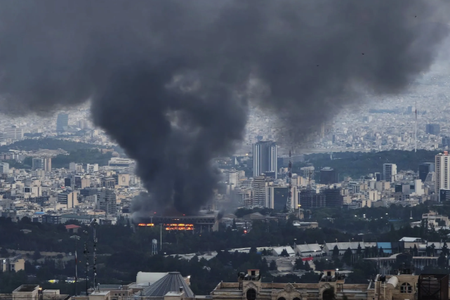
Currently, Iran's Revolutionary Guard Corps (IRGC) has blocked the passage of commercial ships through the Strait of Hormuz. Five oil tankers have already been targeted by Tehran's drones, while plants and refineries in Saudi Arabia and Qatar have been attacked.
Riyadh has closed the Ras Tanura refinery, which processes 500,000 barrels per day, while Doha has suspended production of LNG and its derivatives such as urea and polymers. Iraq has reduced crude oil production at the Rumaila field by 700,000 barrels per day and has announced that the decline in daily production will be amplified further if tankers cannot move freely.
Shipping giants MSC, Maersk, CMA CGM, Hapag-Lloyd and Cosco have suspended transit through the Persian Gulf until tensions ease. The main concern is not missiles but Iranian drones, which are harder to detect and destroy with anti-aircraft weapons.
The weight of this geopolitical point is staggering: 20 percent of global crude oil trade passes through Hormuz, along with a similar amount of liquefied natural gas. The main buyers are Asian markets, led by China.
For Europe, although only 9 percent of crude oil supplies pass through this bottleneck, the situation becomes critical for refined products, with 40 percent of the EU's oil and jet fuel imports directly dependent on this passage.
Rating agencies such as S&P and Moody's point out that a prolonged outage would not only stabilize the price above $100 per barrel, but would create enormous pressure on credit channels, fueling the risk of a global financial shock.
History reminds us that in 1973, the Arab OPEC states cut production in retaliation for American support for Israel, forcing US President Richard Nixon to implement rationing programs.
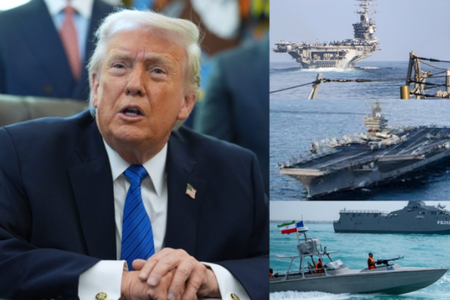
Something similar happened in 1979 with the Khomeini Revolution. However, never before has trade been completely blocked as it is happening today. Although Donald Trump has stated that the US Navy may escort the tankers, experts at the Wall Street Journal remain skeptical.
The Navy's capacity is limited in the face of the massive volume of ships, while federal insurance guarantees do not cover the full value of cargo, damages from delays, or costs of diversions.
Without a halt to Tehran's attacks on infrastructure, it is unlikely that refining and loading operations will resume at full capacity. As an alternative route, Riyadh is trying to use the East-West pipeline that ends in the Red Sea, but the failed attacks on the Ras Tanura refinery show that the heart of the Saudi energy system remains at risk.
Goldman Sachs analysts predict that if volumes remain unchanged for another five weeks, the price of Brent oil will immediately reach $100. JPMorgan strategists add that if the conflict lasts more than three weeks, producers will fill storage capacities and be forced to stop production, driving the price to $100-120.
Saul Kavonic, one of the world's leading energy experts, believes that a complete shutdown lasting several weeks could have an impact three times greater than the severe crises of the 1970s. He warns that over 100 million barrels could be cut off from markets, which would push prices into the triple digits.
Today, the oil market is global and highly funded. Volatility spreads with instantaneous speed at any moment, so even small supply shocks cause exponential price increases at the gas station.
With the US economy facing slow growth and high inflation, a total shutdown would mean a loss of 20 million barrels of oil per day, leading the world towards a new era of stagflation.
Ultimately, everything depends on the evolution of the conflict. Meanwhile, the tones from Tehran remain defiant. The Revolutionary Guard has declared full control over the Strait of Hormuz and predicts that the price of oil will soon reach $200.
They warn that any US move in the region will bring about the complete destruction of the military and economic infrastructure. The world remains in suspense, in a state of suspense between a manageable crisis and an energy catastrophe that could reshape the structure of the global economy within a few weeks./ Pamphlet from “Huffington Post Italia”





Lini një Përgjigje