


 Shkruar nga Gjergj Zefi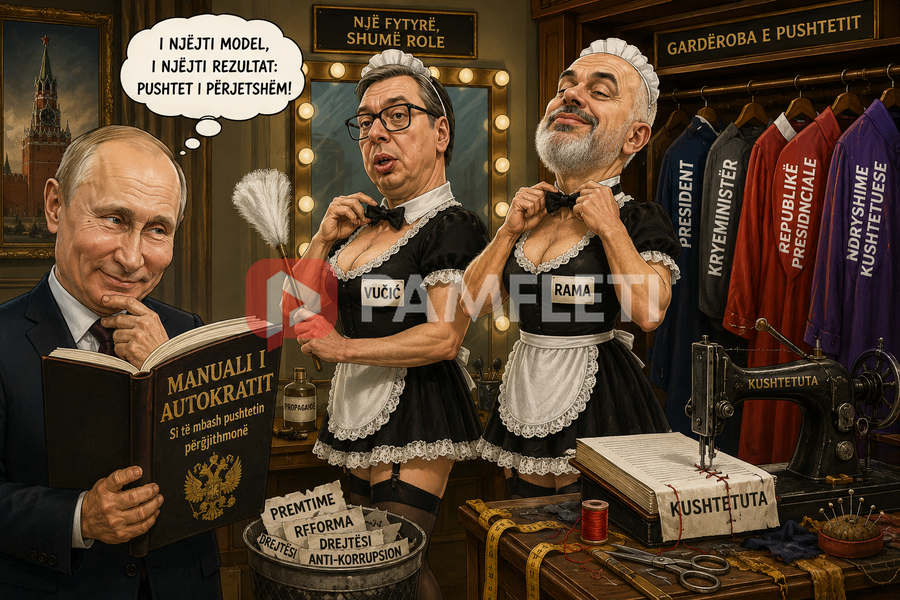
From Putin to Vučić and Rama, the model of eternal power is also knocking in the Balkans...
I'm referring to an old story from the height of the Greek financial crisis.
As the Athens government tried to convince European creditors to release the next tranche of financial aid, someone in the Prime Minister's office had a "brilliant" idea: to change the building's carpets and curtains, in the hope that the new environment would improve the atmosphere and, perhaps, the fate of the negotiations.
An elderly nurse, who had seen a lot in her life, couldn't help herself:
"I don't understand this logic," she said. "Even in the brothel where I once worked, when work was done, the owner wouldn't change the sheets... he would change the s*x."
The anecdote is brutal. But politics in the Balkans is transcending even black humor.
When a government consumes political capital, when institutions lose trust, when citizens tire of the same names and the same promises, democracy offers a simple solution: rotation.
Autocracy, on the contrary, seeks a different solution: Change the constitution!
The Balkans have historically been a laboratory of imported political models. In the 1990s, it imported extreme nationalism. Then it imported endless transitions. Today, it risks importing the model of "controlled democracy," where elections are held regularly, the opposition exists formally, but real rotation becomes almost impossible.
This is the model that was consolidated in Russia and that is now increasingly seen in the post-Soviet space. It is no longer a question of a coup or the overthrow of institutions. The formula is more elegant: the rules of the game are changed, while the player remains the same.
The most illustrative case is that of Vladimir Putin.
In 2008, after exhausting the constitutional limit on presidential terms, he did not step down. He moved to the post of prime minister, while Dmitry Medvedev took over the presidency. Although formally Russia had a different president, real power remained in the Kremlin, in the hands of Putin. Four years later he returned to the presidency and, through constitutional amendments in 2020, "reset to zero" the number of terms, creating the possibility of staying in power until 2036.
This model is no longer a Russian exception. It is emerging as an exportable formula for leaders who do not want to leave power.
So, in Serbia, Aleksandar Vučić seems to be following the same logic. If the presidency no longer allows another term, then the role is reversed. President today, prime minister tomorrow. If tomorrow that post also gets in the way, the institutional architecture can always be rewritten.
Because the problem is not the position. The problem is dependence on power.
The same spirit has begun to circulate in Albania. Discussions about a presidential republic, a bicameral parliament, a review of the constitutional system, and major institutional reforms are suddenly back.
No one explains which problem of Albanian democracy is solved by these changes.
Because Albania's problem is not that it lacks institutions.
The problem is that the institutions are not functioning.
A second chamber in parliament does not automatically produce more democracy. A president with more powers does not automatically produce more state. A new constitution does not automatically produce more justice.
If the actors remain the same and the political culture remains the same, only the decor changes.
It's like changing the paint on a building where the foundations are cracked.
Or, to return to the Greek sanitary...
...when it comes to work, there's no point in changing the sheets./ Pamphlet


Lini një Përgjigje