


 Shkruar nga Pamfleti
The Western Balkan countries are trying to move from traditional industries towards the "Green" and "Digital" model, but on the other hand, standards and investments in increasing the skills of the workforce are lacking, according to a study by the Regional Cooperation Council (RCC) "Monitoring and Evaluating Industrial Performance and Policy Impact in Six Western Balkan Countries".
The study assesses that industrial performance in the six Western Balkan countries (WB6) is not uniform. Serbia and North Macedonia are more advanced, Albania, Bosnia and Kosovo present more fragile developments, while Montenegro has a narrower base of the industrial sector in the economy.
In 2022, the manufacturing sector contributed 10% to the GDP of the WB6 region, almost at a similar level since 2010, compared to 12% in Croatia, 15% in the EU and 21% in Slovenia.
Despite developments, the industrial capacity of the Balkan region is very small compared to the EU. In Serbia and North Macedonia, which are closer to the EU average, industrial export capacity is only about a quarter of that of the EU, while in Albania it is about 98% lower.
Serbia with the most integrated industry in global markets
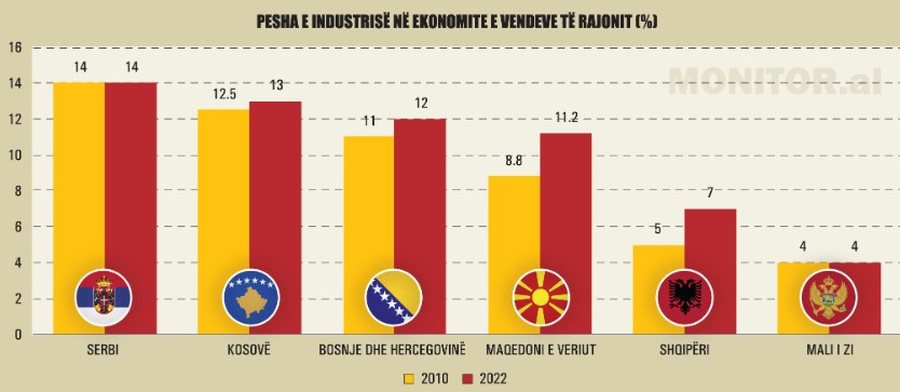
Serbia emerged as the economy with the strongest industrial base in the region. It has managed to absorb the largest share of Foreign Direct Investment (FDI) in the manufacturing sector (automobiles, rubber and plastics), leading the weight of industry in the economy to reach 14% in 2022, a level similar to 2010, but with a strong increase in value.
According to the report, Serbia has the highest indicators of technological intensity and a greater diversification of exports to the EU in industry. Serbia has the most integrated industrial policy in European chains, especially in the automotive and machinery sectors. The government is subsidizing the innovation and AI (Artificial Intelligence) sectors. The report emphasizes that Serbia is performing well in high-tech exports, but needs to accelerate environmental standards.
Macedonia enters the upper value chain
North Macedonia has shown positive progress through its Technological Industrial Development Zones (TIDZ). It has managed to integrate its companies into global value chains, especially in electrical components and car parts, increasing the weight of medium and high-tech industries. North Macedonia has not only increased the volume of industrial exports by 92% between 2010-2022, but has also achieved a qualitative transformation, with 65% of exports being high and medium-tech.
The country remains a regional model for attracting Foreign Direct Investment (FDI) through Technological Development Zones. The new policy aims to better connect foreign investors with local suppliers, promoting technology transfer and wage growth in the automotive parts manufacturing sector. The industrial sector in Macedonia accounts for 11.2% of GDP, up from 8.8% in 2010, but the country stands out for its increased production value and integration into the higher value chain.
Bosnia suffers from adaptation of industrial heritage
Bosnia and Herzegovina, although it has a long industrial tradition, especially in metallurgy and the wood industry, suffers from a lack of technological modernization. Political instability is also hindering the transition to a higher value-added industry. The share of industry in the Bosnian economy reached 12% in 2022 from 11% in 2010.
With a strong base in the wood and metal industries, Bosnia is working to harmonize policies between entities. The main focus is on modernizing existing factories and meeting the standards of the EU's Carbon Border Adjustment Mechanism (CBAM), to maintain access to the European market.
Albania, low-value industry
In Albania, industrialization remains concentrated in sectors with high labor intensity and low technological value (such as tailoring/textiles and footwear). However, there is growth in the extractive and energy industries, but the report highlights the urgent need for diversification towards more skill-intensive manufacturing sectors. Albania is aiming to diversify its industrial base.
The current policy is shifting from light industry (textiles and footwear) towards sectors with higher added value such as the automotive industry. The weight of industry in the country's GDP reached 7% in 2022 from 5% in 2010. The priority remains the integration of agro-processing with global value chains and the promotion of "blue" industry and sustainable tourism. The challenge remains increasing investment in research and development (R&D).
Kosovo, a leader in the region for the agro-processing industry
The RCC report notes that industry accounts for 13 percent of Kosovo’s economy. However, the sector is highly concentrated in a few products, while it is a leader in the Region in the development of the agro-processing industry. Among the economies of the Region, Kosovo has highly energy-efficient industries, where for every toe (ton of oil equivalent) of energy used, they generate approximately $4,000 in Value Added Production (VAP).
Kosovo's industry has the lowest integration outside the Region. Kosovo is positioned as a dynamically growing economy but with a still fragile industrial base. It lags behind Serbia and North Macedonia, Bosnia and Albania in terms of production volume and industrial exports, but shows high potential in industry-related service sectors and in the adoption of new regional policies.
Montenegro with a narrow industrial base
According to the study, Montenegro's economy is strongly oriented towards services and tourism. Industrialization has declined following the closure or downsizing of large metallurgical complexes (such as aluminum). The report notes that Montenegro has the narrowest industrial base.
Montenegro is leading with policies aimed at decarbonizing the industry. After the closure or restructuring of heavy metallurgical industries, the focus has shifted to smart specialization (S3 Strategy). The weight of industry in the country's economy remained at 4 percent in 2022, at the same level as in 2010. Renewable energy and innovation in services are the areas where Podgorica is investing the most to increase competitiveness./ Monitor




Lini një Përgjigje