


 Shkruar nga Pamfleti
Some categories, about thirty percent of American workers, have no exposure at all. These include chefs, mechanics, bartenders, and those generally working in physical labor...
For years, we thought that artificial intelligence would hit manual labor first, as happens with most technological innovations. A new report from Anthropic says just the opposite: those most at risk are educated, well-paid, career-oriented workers. The study, “ Impacts of AI on the Labor Market: A New Measure and Early Evidence ,” overturns years of rhetoric about artificial intelligence, arguing that it’s not so much about robots in warehouses or self-driving trucks, but about the people who write, analyze, and program computers.
The new metric introduced by the study is called "observed exposure" and is an empirical measure of what artificial intelligence is already doing today, within real-world workflows, based on millions of professional uses of Claude. The Anthropic team then analyzed tasks that are already automated or supported by next-generation technologies in professional contexts: the goal, the report's authors write, is to combine the theoretical capacity of language models and real-world usage data, giving more weight to automated and work-related uses.
This first helps to raise awareness of the fact that artificial intelligence is already an integral part of everyday life in many professions. But above all, it is being used incompletely, or not to its full potential. And here comes the first key finding: "Artificial intelligence is still far from reaching its theoretical capacity: current coverage remains a small fraction of what is possible ," the report says.
The image below helps explain this: on one side, the blue area, which is everything the models could do; on the other side, the red area, which is what they actually do. And the gap between the two is very large.
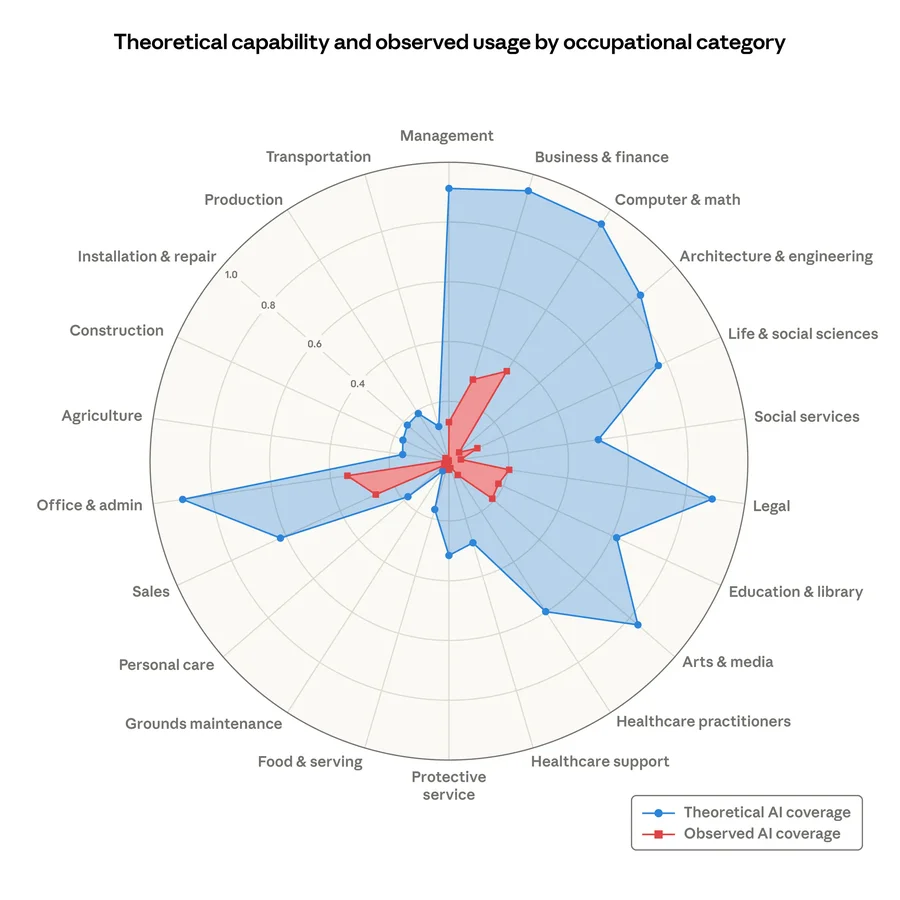
In the case of professions related to computer science and mathematics, artificial intelligence could theoretically handle almost all tasks, ninety-four percent, according to the Anthropic team. It currently covers about a third. In office and administrative jobs, the potential is about 90 percent, while actual use is currently about 40 percent.
"Të dhënat tregojnë se IA është ende larg arritjes së aftësive të saj teorike. Ndërsa aftësitë përparojnë dhe përvetësimi bëhet më i përhapur, zona e kuqe do të rritet derisa të mbivendoset me zonën blu", thuhet në raport.
Dhe ndoshta kjo është fjalia më e rëndësishme në të gjithë dokumentin. Sepse nënkupton që revolucioni nuk varet më aq shumë nga zbulimet e reja teknologjike, por nga përhapja e asaj që ekziston tashmë: pika e moskthimit është kaluar tashmë. Ne vetëm duhet të zbulojmë se kur dhe sa shpejt kompanitë e interesuara do të vendosin të shfrytëzojnë plotësisht potencialin e teknologjive të reja.
Një aspekt tjetër interesant ka të bëjë me demografinë e punëtorëve më të ekspozuar. Sipas të dhënave, këta janë njerëz që fitojnë dyzet e shtatë përqind më shumë se mesatarja, kanë shumë më tepër gjasa të kenë një diplomë kolegji ose një diplomë të avancuar, kanë më shumë gjasa të jenë gra dhe janë më të moshuar. Ata janë përgjithësisht të ashtuquajtur punëtorë të dijes, një kategori shumë e gjerë që përfshin studiues, menaxherë, inxhinierë, mësues, avokatë, analistë financiarë, zhvillues, specialistë të marketingut e kështu me radhë. Prandaj, automatizimi nuk eliminon punët manuale dhe ato me kualifikim të ulët. Në vend të fundit të punës manuale, duhet të kemi frikë nga transformimi i punës intelektuale.
E gjithë kjo, përsërit raporti disa herë, është llogaritur bazuar në të dhëna reale nga tregu i punës në SHBA. Disa kategori, rreth tridhjetë përqind e punëtorëve amerikanë, nuk kanë asnjë ekspozim. Këto përfshijnë shefa kuzhine, mekanikë, baristë dhe ata në përgjithësi që punojnë në punë fizike. Për këta punëtorë, inteligjenca artificiale aktualisht nuk përbën kërcënim për shkurtime vendesh pune.
Sidoqoftë, këto janë parashikime për të ardhmen, sepse për momentin "nuk shohim një rritje sistematike të papunësisë për punëtorët shumë të ekspozuar", raporton Anthropic. Megjithatë, të rinjtë tashmë po e paguajnë çmimin: "Ne gjejmë prova sugjestive se punësimi i punëtorëve më të rinj është ngadalësuar në profesionet e ekspozuara". Konkretisht, ka pasur një rënie prej katërmbëdhjetë përqind në normat e hyrjes në punë për 22-25-vjeçarët në rolet më të ekspozuara. Pasojat e kësaj situate ka të ngjarë të shihen së shpejti brenda kompanive: nëse vendet e punës në nivel fillestar bien, mekanizmi themelor i trajnimit të brendshëm profesional do të prishet.
It remains to be seen why Anthropic is publishing such a report. Dario Amodei's company, one of the most important in the sector, has published a study that highlights the concrete risks for skilled workers, emphasizing the urgency of these issues. In a way, this is going against the grain of OpenAI and other competitors. And it is not the first time. We saw this, for example, with the case of Mythos, the model that, according to the company itself, was capable of breaching confidential cybersecurity systems, when Anthropic blocked its publication and invited competitors to collaborate to limit the risks.
Amodei is perhaps the only “human” face in the sector, the only one trying to appear responsible and aware of the risks associated with new technologies. Therefore, he wants to break away from the narrative of a techno-predatory oligarchy that seems to be taking over the market only to destroy jobs, the economy and ultimately global democracy, a role in which the likes of Peter Thiel, Elon Musk, Sam Altman and his company seem to be playing a leading role. Whether conviction or strategy, the result is the same, for now: Anthropic is among the few companies in the sector that openly reveals who is really at risk. And what’s more, it’s not the workers we thought./ Adapted from “Pamphlet” by “Linkiesta”






Sipas Einsteinit, kur IA të arrijë perfeksionin, njerëzit do jenë një tufë lopësh. Sa më lopë të jesh aq më i dobishëm je. Ndërkohë po të jesh komplet debil (si Trampi, qoftë Elon Masku) aq më bari lopësh do jesh.
Kjo kohe ka ardhur qe kur. Beni nje video ne supermarkete ku njerezit presin ne rradha te gjata nu pulari e shitesit nxitojne si Charly Chaplin ne ate filmin duke punuar ne konvejer. Beni krahasimin e do qeshni qe jane shume identike.
Grafik i vitit qe kaloi!