


 Shkruar nga Pamfleti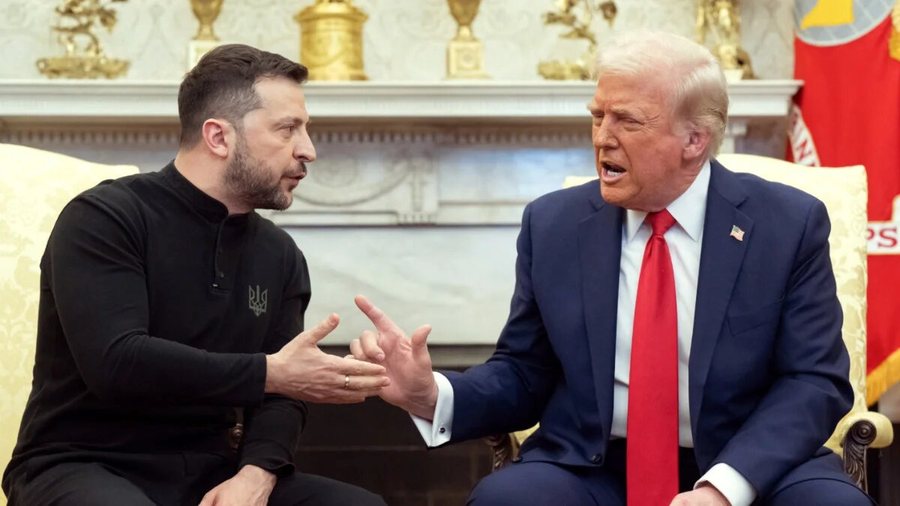
After the tense meeting at the White House, relations between Donald Trump and Volodymyr Zelensky have taken many twists and turns. While the war continues and the front remains largely unchanged, the diplomatic dynamic appears to be entering a new phase.
Things have changed significantly. The first meeting between Donald Trump and Volodymyr Zelensky remains unforgettable. On February 28 of last year, during a live-streamed meeting at the White House, Trump told the Ukrainian president: "You don't have the right papers." More than a diplomatic meeting, that moment was perceived as a planned confrontation.
There was no shortage of ironic commentary about Zelensky's appearance in that episode. One American official, speaking on condition of anonymity, described the situation as "an irreparable breakdown of relations," an assessment that seemed entirely reasonable at the time.
The circumstances were particularly difficult for Ukraine. Kiev was facing a lack of military intelligence support, which left it more exposed to air strikes, while international media constantly published analyses of the possibility of a new Russian offensive and the risk of the front line collapsing.
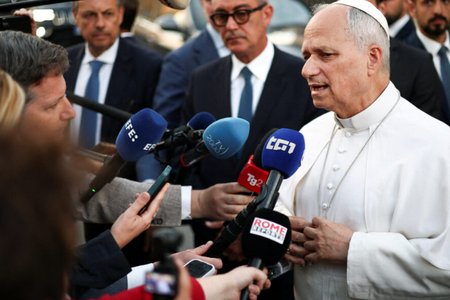
The two leaders met again on April 26, during the funeral of Pope Francis. Their conversation and photo op in St. Peter's Square were seen by many observers as a potentially historic moment. However, Trump's political instability has led many analysts to be cautious in their assessments.
At that time, while there was talk of a stalemate in the negotiations, Vladimir Putin declared a ceasefire for Easter, but at the same time Russia continued its attacks on Kiev. The bombings caused 12 deaths and about 100 injuries.
On June 25, on the sidelines of the NATO summit in The Hague, Trump and Zelensky held another meeting. Zelensky described it as "long and substantial," while Trump declared that "it couldn't have gone better."
Trump then hosted Russian President Vladimir Putin in Anchorage, where he was given a lavish reception. The meeting was seen by many observers as a sign of a new understanding between the two leaders, with the aim of reaching a peace agreement quickly. The discussions reportedly included the issue of the Donbas territories that remain under Ukrainian control.
However, one element has remained unchanged: Russian bombing and Moscow's terms for a ceasefire. While fighting on the ground continues, territorial changes have been minimal.
Today, Zelensky seems to have more opportunities to influence the negotiation process. One of Ukraine's main advantages is considered to be the development of drone technology, which has given Kiev the ability to strike targets even inside Russian territory. A recent example is the fire at an oil refinery near Moscow, which supplies fuel to the Russian capital's three main airports.
In this context, the new meeting in Evian, supported by European countries seeking a more active role in the diplomatic process, could take on particular importance. However, a dose of caution remains necessary, given Trump's frequent changes in positions.
If the US president truly supports a compromise similar to the Korean model – a long-term ceasefire based on freezing the current front line – then this could constitute a significant turning point in the conflict.
In Moscow, however, skepticism prevails. The Russian newspaper Moskovsky Komsomolets writes that, despite the rhetoric about peace, the US administration is mainly aiming to create the impression of progress in the negotiations, which, it says, may be enough for the American electorate.
Bogdan Bezpalko, a member of the Russian Presidential Council on Interethnic Relations, is also skeptical. According to him, the conflict will end for military, not diplomatic, reasons. He argues that each side will present the outcome according to its own narrative: Russia will talk about victory, Trump about his decisive role, the Europeans about their diplomatic influence, and Ukraine about the damage it has caused to Russia.
According to Bezpalko, this is the most likely scenario for how the conflict will end./Corriere della Sera



Ai turp qe u be atehere duke e poshteruar mikun e ftuar ne shtepi tregoi qe besa eshte nje nocion i panjohur e kuptueshem ne kete bote.