


 Shkruar nga Gjergj Zefi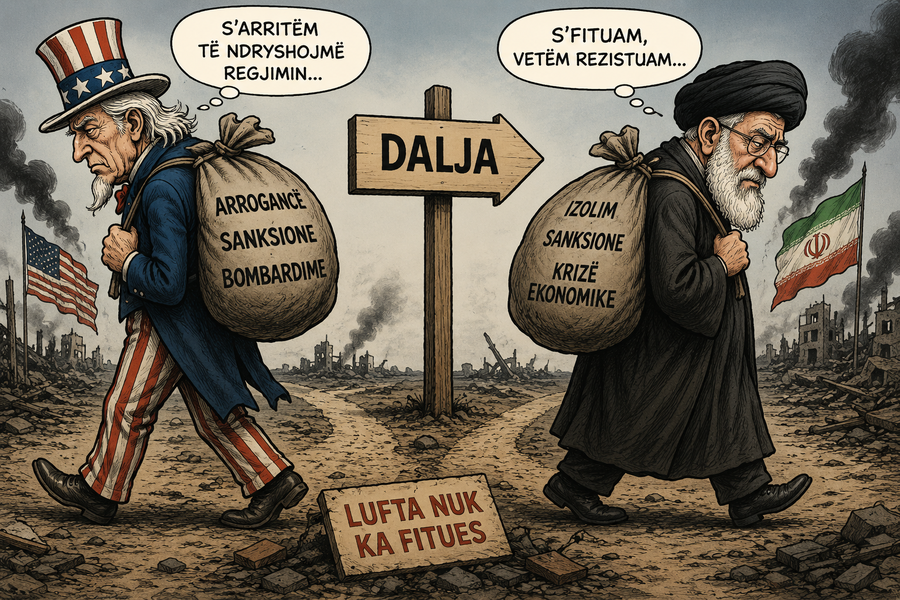
Neither Washington managed to impose its political will, nor Tehran to declare victory. The conflict proved that arrogance is not enough to win a war, and regimes are not overthrown by bombs, but by their people...
At the end of every war comes the moment of truth. Not the one written in the triumphant communiqués of governments, but the one read at the negotiating tables. And when both sides seek a way out, it becomes clear that no one has won as much as they claim.
The clash between the United States and Iran has produced precisely this unpleasant outcome for all protagonists. America failed to impose a political capitulation on the Islamic Republic, while Iran cannot claim to have emerged unscathed from the blows that shook its economy, infrastructure, and regional prestige.
The first lesson is as old as history itself, but it seems that great powers continue to forget it: no war is won with military superiority alone. Even less so when arrogance begins to replace strategy.
Washington entered this confrontation convinced that maximum pressure, precision strikes, and a show of force would force Tehran to accept American terms. But the history of the Middle East is a graveyard of similar illusions. From Afghanistan to Iraq, American military power has shown that it can topple armies, but not necessarily build political order.
In international politics, arrogance is often confused with strength. And whenever this happens, it is not only the opponents who pay the price, but also those who display it.
On the other hand, Tehran has no reason to celebrate. The Iranian regime may have survived, but survival is not victory. A state that is forced to mobilize all security mechanisms to maintain internal stability is not necessarily a strong state; it is a state that lives in fear of the day when control will no longer be enough.
Herein lies the second, perhaps most important, lesson. Authoritarian regimes are not toppled by foreign missiles. On the contrary, attacks from abroad often provide them with the ideal excuse to tighten control, suppress domestic opposition, and present themselves as national 'heroes'.
History has always proven this. Bombings do not produce democracy. They produce nationalism, fear, and, in many cases, a longer lifespan for the powers they were intended to overthrow.
Bloody regimes collapse only when their citizens decide that the cost of silence is greater than the cost of confrontation. Major political changes are not imported from outside; they arise from within societies.
Therefore, while Washington and Tehran today seek a diplomatic way out of the conflict, the reality remains unchanged.
America did not win the war it thought it could control. Iran did not win the battle it claims to have successfully fought.
The only winner of the moment is realism. That realism that remembers that in the 21st century, power is not measured only by missiles and bombers, but by the ability to understand its limits.
And perhaps this is the most ironic paradox of this entire story: after all the noise of the guns, after all the rhetoric of victory and national pride, both Washington and Tehran are returning to where they should have started in the first place; to diplomacy./ Pamphlet




Eshte nje perralle e vjeter ku thuhet "Ole le, vet desh vet desh!