


 Shkruar nga Gjergj Zefi
In the diplomatic corridors there is talk of dialogue, but on the ground the generals are making the decisions. The US-Iran crisis is entering a phase where negotiations risk remaining just a political facade...
There is an unwritten rule in diplomacy: negotiations fail not when the parties stop talking, but when they begin to believe that they can achieve more through pressure than through compromise. This is precisely what is happening today in the increasingly dangerous crisis between the United States and Iran, where channels of dialogue still exist, but real decisions seem to be made far from the negotiating rooms, in military centers, in national security corridors, and in cold geopolitical calculations.
Recent events have clearly shown that the pace of escalation is moving much faster than the pace of diplomacy.
The US attacks on Iranian facilities, tensions in the Persian Gulf, security alarms in Arab states, and increasingly harsh rhetoric on both sides are not just isolated episodes. They are symptoms of a much deeper problem: the lack of political will to accept that neither side can achieve a complete strategic victory.
In theory, everyone talks about dialogue. Washington declares that it is ready for an agreement that guarantees regional security and limits Iran's nuclear ambitions. Tehran, for its part, claims that it remains open to negotiations that respect its sovereignty and ensure the lifting of sanctions. However, behind the public statements lies a completely different reality. The problem lies not in the lack of diplomatic channels, but in the fact that the strategic objectives of the parties remain fundamentally incompatible.
For the United States, an Iran with expanded military capabilities and strong regional influence continues to be seen as a challenge to the security architecture that Washington has built in the Middle East over the past few decades.
For Iran, any request for further restrictions is perceived as an attempt to weaken its position in a region where external threats are part of the strategic daily routine. In this climate of distrust, any proposal is viewed with suspicion and any concession is interpreted as a sign of weakness.
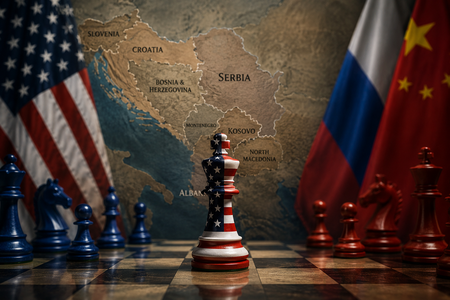
But perhaps the biggest reason why the negotiations have stalled is not just about the US and Iran. The current crisis has long transcended the bilateral dimension. It has become a nexus of interests involving Israel, the Gulf Arab states, Russia, China, and other powers that are closely following every development.
Any possible agreement would not only affect relations between Washington and Tehran, but would also reshape the balance of power in the entire region. For this reason, negotiations do not take place in a diplomatic vacuum. They take place under pressure from actors who often have conflicting interests and who do not necessarily see compromise as the most favorable solution.
Meanwhile, the dynamics on the ground are creating a dangerous paradox. No one seems to want a major regional war. The political, economic, and military costs would be enormous for everyone. Yet each side is taking actions that are bringing the region ever closer to a conflict scenario.
The history of international relations is filled with conflicts that started not because anyone wanted them, but because no one managed to stop them in time.
This is why the current moment must be viewed with particular seriousness. We are not simply dealing with a temporary deadlock in negotiations. We are witnessing a crisis of confidence that has eroded the foundations on which any lasting agreement can be built. The more the rhetoric of force replaces the language of diplomacy, the more difficult it becomes to return to the negotiating table with a minimum of mutual trust.
In the end, the negotiations have not stalled because there are no diplomats, no mediators, no proposals. They have stalled because the parties have not yet come to the conclusion that any military alternative is worse than compromise. Until that conviction becomes clear in Washington, Tehran, and other capitals that influence this crisis, diplomacy will continue to move slowly, while tensions will continue to rise rapidly.
And this is the greatest danger of our time: not the absence of dialogue, but the gradual loss of faith that dialogue can still produce solutions. If this happens, negotiations will not only have failed as a diplomatic process. They will have lost their political meaning. And when diplomacy loses its meaning, history usually begins to be written by events, not by agreements./ Pamphlet




Lini një Përgjigje