


 Shkruar nga Gjergj Zefi
The Western Balkans in the new American filter: Less emotions, more interests...
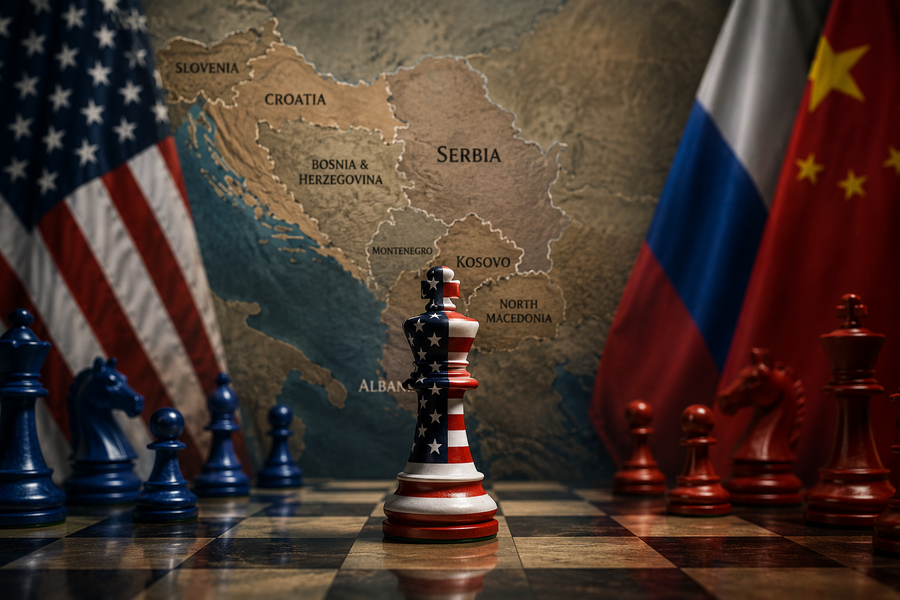
The war in Ukraine and rivalry with Russia and China are pushing Washington towards a tougher and more pragmatic policy towards the Western Balkans...
The American approach to the Western Balkans is entering a new phase, cooler, more pragmatic, and significantly less emotional than the one the region experienced after the wars of the 1990s.
For more than two decades, the United States treated the Balkans as an unfinished project of the Euro-Atlantic order: a space in which political, military, and diplomatic investment was needed to prevent the return of ethnic conflicts and the influence of rival powers. Today, that logic is changing.
Washington is not retreating from the Balkans, but it is changing the way it views the region. Instead of the democratic idealism that dominated the period after the interventions in Bosnia and Kosovo, the US administration is adopting a new strategic realism. In the language of modern American diplomacy, the Balkans are no longer seen as a “historic mission” but as part of a global competition with Russia and China.
This shift is not merely theoretical. Recent reports from the US State Department and discussions in Congress clearly show that the American priority is no longer the “democratic transformation” of the region at all costs, but strategic stability and the control of rival influences.
In practice, this means that the US will support partners that guarantee a clear Euro-Atlantic orientation, energy security, and military cooperation, while tolerance for double standards is significantly reduced.
The war in Ukraine has accelerated this transformation. For Washington, the Balkans are no longer a peripheral European issue, but a sensitive front of global rivalry. Any political vacuum in the region is seen as an opportunity for Russian, Chinese, or even Turkish penetration. Precisely for this reason, the US administration is shifting its focus from traditional political mediation to strategic control of energy corridors, critical infrastructure, and security cooperation.
This means that the era when Balkan leaders could play both East and West simultaneously without real consequences is coming to an end. Today's America no longer has the political and economic luxury to invest endlessly in local stabilocracies that promise European integration while nurturing domestic nationalism and keeping the door open to Moscow or Beijing.
In this new climate, the European Union is also being directly influenced by the American pace. Brussels is realizing that enlargement is no longer just a technical bureaucratic process, but a geopolitical instrument. This is why Western rhetoric towards the Balkans has become harsher, more direct, and less tolerant of the artificial crises that are periodically produced in the region.
But this change also carries a warning for the region itself. The Western Balkans will no longer have the privilege of unconditional American attention. If previously the US invested to preserve peace at any cost, now it demands concrete results: functional institutions, clear strategic orientation and reliable partners. Whoever does not adapt to this new reality risks remaining on the periphery of Western interests.
In essence, America is sending the Balkans a cold diplomatic message: the era of transition is over. The region must clearly choose its strategic direction, because in the new global architecture there is no more room for hybrid neutralities, political maneuvering, and double-dealing.
The Balkans are entering an era where geopolitics will outweigh rhetoric, as Western patience with cyclical crises wears thin. And this could be the biggest American shift in the region since the end of the Kosovo war./ Pamphlet




Lini një Përgjigje