


 Shkruar nga Daniela Ranieri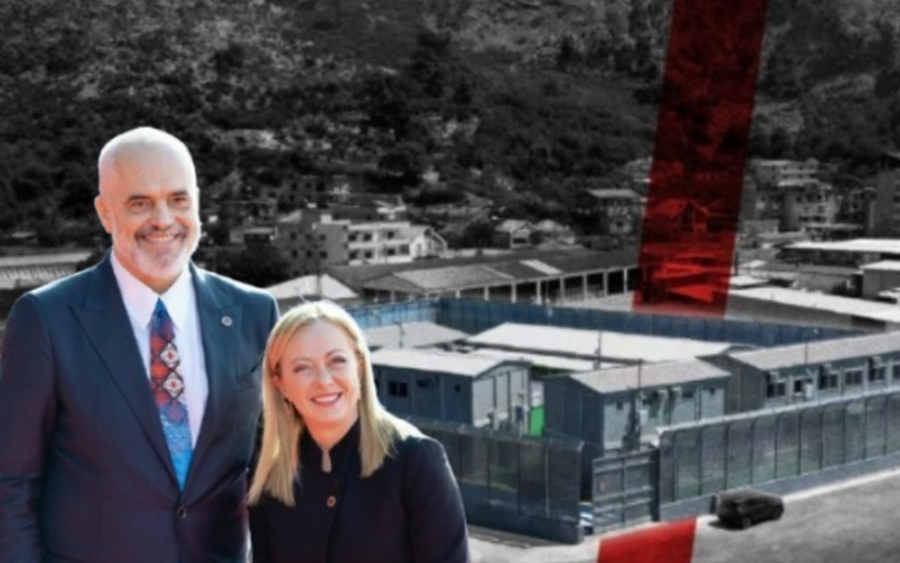
203 guards for only 25 immigrants; 670 million euros for a political scenography. How the 'Albanian model' is failing amid staggering costs and legal deadlock...
While the Italian government is busy campaigning for a "Yes" vote in the referendum on career separation in the justice system - a battle played with low blows and mystifications that not even Minister Nordio would consider himself capable of - we have been trying to verify whether the migrant reception centers in Albania are really functioning.
This was what Prime Minister Georgia Meloni assured us when she signed the memorandum of understanding with Albania in October 2024, at a time when the propaganda was all focused on success in managing illegal migration.
The government at the time set an ambitious target of approximately 3,000 transfers per month, or 39,000 migrants per year. However, currently, according to our local sources, the Gjadri center hosts only 25 “guests” of various nationalities, mainly Egyptians and North Africans.
The cost of this operation is estimated at approximately 670 million euros over 5 years (2024-2028), which means around 134 million euros per year. Over 250 million euros have been spent on travel costs alone, to transport migrants to Albania and repatriate them to their countries, or in many cases, to return them back to Italy.
In fact, almost all of those transferred in the first rounds (66 people in total) have been returned to Italy. In October 2024, 4 of the 16 people transferred were returned immediately because they were found to be vulnerable or minors.
The remaining 12 were returned a few days later due to the failure of the Rome Court to confirm their detention. Then, in February 2025, 43 migrants were returned to Bari because judges declared their detentions illegal. In April of the same year, 7 more people were returned by court order or for medical reasons.
This constant exchange at our expense - where each return costs an average of 80,000 euros - was portrayed by the government as a sabotage by the "red squads". On the social networks of the FdI, Meloni's party, it was written: "Absurd! The judiciary is coming to the aid of the parliamentary left".
However, it is a fact that migrants from countries with which Italy has not signed repatriation agreements (such as Sub-Saharan Africa, some Asian countries or Syria) are being held in Gjadra for a month and then returned to Italy, where they are simply released with an order to leave the country within 30 days.
Architecturally, the center of Gjadri is a trio of small forts surrounded by a high reinforced concrete and metal fence. Inside is a pavilion where migrants sleep in temporary modules.
They are free to move within the fenced area, but cannot leave the facility, which is surrounded only by mountains and bushes. There is also a prison, which has so far remained almost empty, except for one prisoner who was later returned to Italy.
The management of food and cleaning has been entrusted to the Italian company Medihospes, which won the 133 million euro tender for Gjadra and Shëngjin. In Gjadra there are doctors, nurses (one on rotation) and psychologists as needed.
At the moment, migrants do not show any special needs, apart from a toothache, and there have been no epidemic outbreaks of disease. Those who are weak or sick are legally returned to Italy.
But what stands out is the security force: 183 Italian police, carabinieri and Guardia di Finanza officers, plus 20 prison guards. Although some new migrants are expected over the weekend, the police force is expected to double as the election campaign approaches.
The average salary for a guard is 2,000 euros per month, plus a daily allowance of 100 euros and another 80 euros for hotel and meals. Their work includes guarding detainees and managing logistics such as fuel and repairs, with 6-hour shifts.
There are also stray dogs inside the facility, 4 of which have been “adopted” by officers. So far, there have been no disturbances, except for one instance when a guest attempted to create a cutting tool from the module frame.
From time to time, members of the government appear there accompanied by photographers, receiving senior officials in the "welfare room", while more often left-wing MEPs are seen on inspection visits.
The cost comparison is painful. A basic CT scanner costs around 200,000 euros. With the cost of “Operation Albania,” the Italian government could have purchased 620 scanners per year, or 29 for each region, significantly reducing waiting lists in the public health system.
Despite the new decrees on “safe countries,” sending migrants to Gjadra remains a process that is constantly blocked by the European Court of Justice. This impasse turns the center into a “legal island” where money flows without stopping, but no deportations are finalized.
Under these conditions, this structure is simply serving as an expensive political scenography, as an ideological model that is clashing with the reality of international laws, leaving Italy with a hefty bill and no solution to the problem of illegal immigration./ Pamphlet adapted from "Il Fatto Quotidiano"





Qeshni ju qeshni por Gjadri do jete gozhte Nastradini o të mjere.