


 Shkruar nga Pamfleti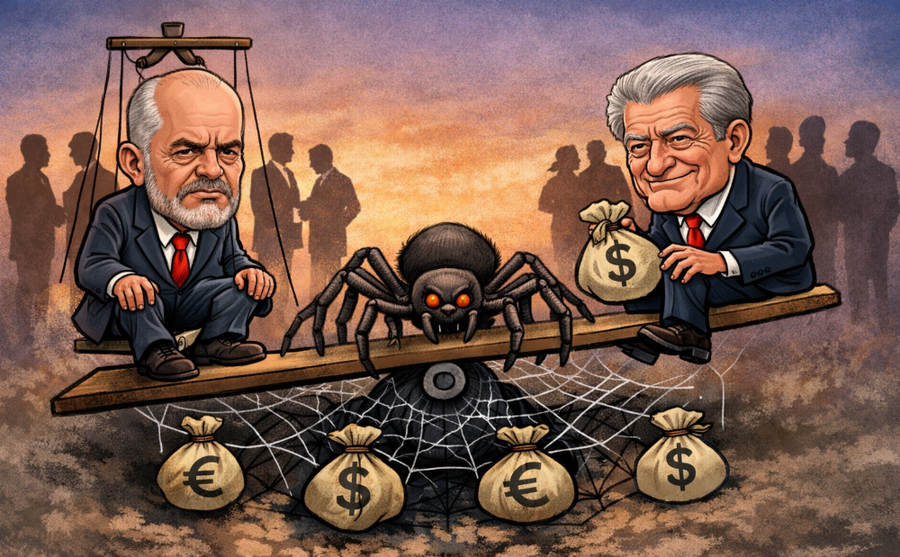
Different in style, but dependent on power networks and interests that limit their political autonomy...
Edi Rama and Sali Berisha remain the central figures of Albanian politics, but neither one represents the hope of the majority of citizens. Rama wields more power and resources, but is perceived as conditioned by economic networks and interests that influence his decision-making. Berisha, on the other hand, maintains a core of supporters, but with reduced influence and supported by clientelistic structures. Both seem trapped in a system that keeps them on stage, but which at the same time limits their real political space.
If there is one thing that unites the two diagrams of the main characters of Albanian politics, Sali Berisha and Edi Rama, it is the attempt to fall as gently as possible into their political doom.
However, the prime minister and the leader of the DP are different in character and personality, as well as in the current conditions of their political lives.
From the elections, public perceptions and polls, as well as from the signals coming from international chancelleries, it results that none of them anymore represents the hope of the majority of Albanians, does not lead the real values of society and does not enjoy the trust of the overwhelming majority.
This political couple survives more as inertia than as active leaders of the country. They do not lead a natural political life, but remain on the scene, clinging to the old Albanian political structures.
Edi Rama is more powerful than his rival and manages more power, money and people. However, he does not present himself as an autonomous leader who makes independent decisions. He seems conditioned by the economic and political environment that has supported him since coming to power.
The Socialist Party functions more as a political support for the executive branch than as an organization with an internal political process. Various structures of influence and economic interests are intertwined with the governing power.
Rama is not an all-powerful leader, but a kind of CEO of a “cartel” or vast business corporation, which is in reality his power that keeps him in power. The current Prime Minister is a delegated administrator of a board of entrepreneurs who work above and below ground, to raise money, using state resources, whether as initial capital, but more as a porous hole to enrich themselves, finance and circulate monetary values that come from the underworld.
This environment of interests creates a closed circle that keeps the current government in power. However, unlike figures like Erdogan or Orban, Rama is perceived as fragile due to his dependence on these structures.
Sali Berisha, on the other hand, retains some of his political energy and experience, but no longer presents himself as a leader with wide influence. His support is more limited and based on clientelistic networks.
Berisha's influence is present, but reduced compared to previous periods. Maintaining his political role requires alliances and support that are no longer the same as they once were.
In this reality, the two main figures of Albanian politics appear dependent on broader interest structures that influence decision-making and that define the boundaries of their political movement./ Pamphlet





Lini një Përgjigje