


 Shkruar nga Pamfleti
Amid fears of defections, international isolation, and protests that are growing every day, the prime minister is looking for a rescue formula before the crisis reaches the point of no return...
Edi Rama is reported to have suspended the public appearances of socialist politicians until after the Parliamentary Group meeting, thereby maximally limiting political communication.
The incident with Ardit Bido has created anxiety among the majority that the physical lynching of its officials could become a repeated practice by certain groups of protesters, which risks sending the situation into a spiral of chaos.
Meanwhile, Sunday's protest is expected to have a much larger turnout, also as a result of a long convoy of vehicles that has left from Germany and is expected to arrive in Tirana in the morning.
The preliminary scenario foresees that the mass protest will continue throughout the night in front of the Prime Minister's Office, creating a space of time for a political solution without tensions.
According to sources, the organizers are expected to announce a platform with several concrete points, as well as a set deadline to give the government time to react.
On the other hand, Edi Rama seems willing to consider a political solution, but the spaces at his disposal are increasingly narrowing.
For several days now, there has been a limited corridor of communication, not of direct negotiations, but of indirect talks, where the only factors communicating with the protest are the embassies of European Union countries.
It is learned that it was precisely European diplomatic circles that informed Edi Rama that leading the country to early elections, with the same legal and political framework, is considered a provocation.
A provocation that, if realized, could prove even more politically costly for Rama himself.
Because there is a risk that the product of those elections, namely the parliament that emerged from them, will be called into question for its legitimacy, plunging the country into an even deeper crisis.
Meanwhile, another hope of Edi Rama was support from the United States of America and Israel.
But so far there has been no concrete movement from his allies or the circles with which he communicates.
Edi Rama's surprise visit to Berlin was aimed precisely at creating a communication channel with the German government, through powerful intermediaries from the world of business and lobbying.
Found in a deep impasse and, above all, left almost alone in relation to international partners, Edi Rama seems to be asking the Socialist Party MPs for a common platform to overcome the crisis.
A platform that would then be politically approved and made public.
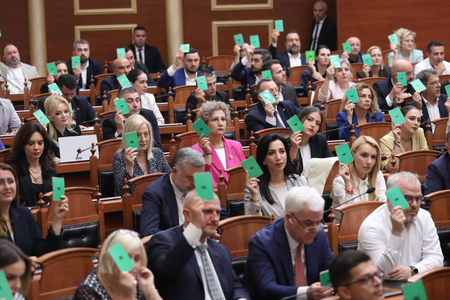
Taking the opportunity from the "neo-mountaineer" case, the prime minister is reportedly seeking political confirmation from his MPs, forcing them all to indicate whether they are still with him or if they are pursuing other political paths.
The fear of a domino effect of MPs leaving, under the pressure of protests, international isolation and SPAK investigations, is already visibly present.
According to sources, Rama will ask MPs to approve a political package to manage the situation and reduce tensions.
Even to the maximum possible extent.
Because his main concern is that Sunday's large protest could bring the situation to a boiling point, from which there will be no turning back.
And this is precisely the scenario that is scaring the prime minister more today than the protest itself./ Pamphlet


Lini një Përgjigje