


 Shkruar nga Diplomatico | Pamfleti.net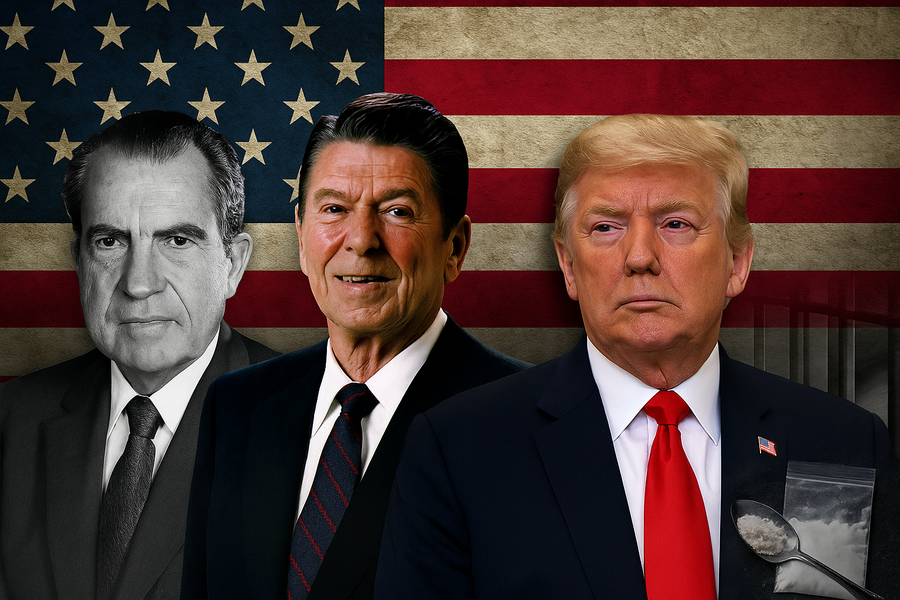
For 50 years, the US "war on drugs" has produced only mass incarceration, systemic racism, and destabilization in Latin America. Trump is returning to the rhetoric that began as a political deception...
In 1971, President Richard Nixon declared the “war on drugs” a national priority for the United States, calling drug addiction “public enemy number one.” Nearly half a century later, this war has become one of the greatest failures of American domestic and foreign policy, with consequences that go beyond US borders and directly affect the stability of regions such as Latin America and beyond.
Against this backdrop, Donald Trump's recent statements to reinstate the war on drugs, including threats of military intervention in Venezuela, show that old narratives are returning with the same goal: domestic political gain and strategic control in insecure regions.
Beyond the rhetoric, the data is shocking: over $1 trillion has been spent on this “war,” without significantly reducing either the demand or the supply of drugs. On the contrary, the US is facing a historic crisis of opioid and fentanyl addiction, with over 100,000 deaths per year from overdoses. American prisons are filled with millions of people, the vast majority from poor and racialized communities, for minor offenses related to possession or use of substances.
Documents and evidence uncovered over the years confirm that this war was never really about drugs. Former Nixon adviser John Ehrlichman has publicly acknowledged that the real objective was to politically attack progressive movements and African-American communities by criminalizing them under the pretext of drugs. This covert strategy was reinforced in the 1980s with the Reagan administration's laws, which imposed disproportionate penalties for the same substance, depending on the form consumed and the race of the user.
Meanwhile, the US has exported this war beyond its borders, particularly to Latin America, where military interventions, funding of corrupt governments and intelligence operations have produced deep destabilisation, permanent violence and mass migration. Countries like Colombia, Mexico and Venezuela have paid the highest price for a war that has benefited only the security structures and contractors of the US prison industry.
Donald Trump's recent statements about possible military intervention against drug trafficking routes in the waters near Venezuela, without presenting any concrete evidence, revive the ghosts of a failed policy and extend its danger to a new global context, where hybrid wars, social crises and extreme poverty are once again being used as justifications for geopolitical interventions.
Instead of a thorough review of strategic mistakes, political rhetoric in the US continues to focus on force and fear. But after 50 years, the world no longer has the luxury of believing in fiction. The "war on drugs" has been a huge failure with human, moral and strategic costs. If Trump brings it back, the consequences will not only be felt by America, but also by all the regions that have been victims of the "exports" of its political failures. / Pamphlet





Lini një Përgjigje