


 Shkruar nga Pamfleti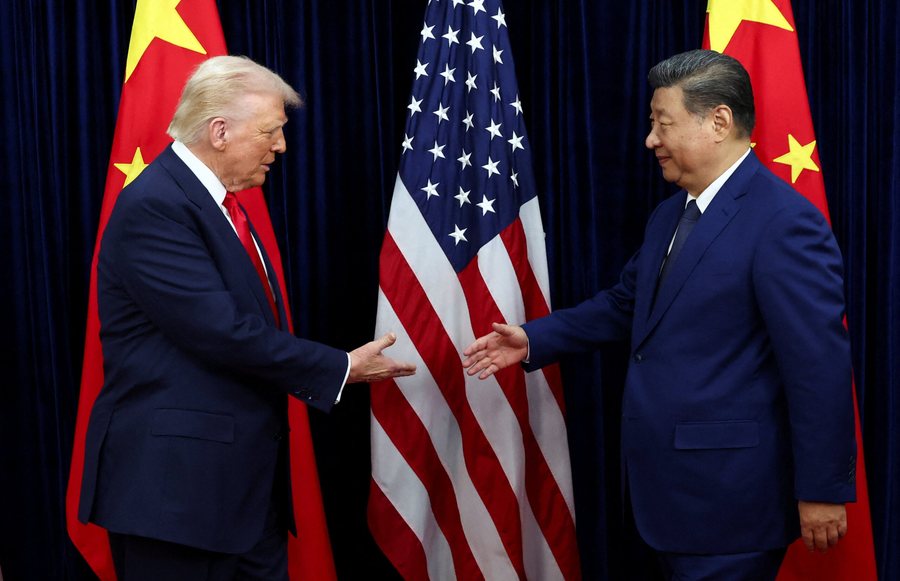
No word on the Taiwan issue...
On the eve of US President Donald Trump's meeting with his Chinese counterpart Xi Jinping in South Korea, the international press proposed two main topics for discussion between the two sides: the first and most important concerned tariffs and export controls, and the second with Taiwan, which is an early point of friction between Beijing and Washington.
Beijing considers Taiwan an integral part of China since the founding of the People's Republic of China in 1949. China believes that the island will eventually return to the Chinese state, whether by peaceful means or by force, and rejects any idea of "independence" for Taipei. Most countries, including the United States and the West in general, do not recognize Taiwan as an independent state. However, Washington opposes any attempt to overthrow the status quo on the island and has long provided military support and equipment to the local government in this context.
-No word on the Taiwan issue
So, on a topic that has been a significant part of the agenda for decades in meetings between top American and Chinese officials, Trump declared after his conversation with Xi that "Taiwan was not mentioned." This statement takes on even more weight in light of the fact that this was the first meeting between the two presidents since Donald Trump took office in the White House.
Meanwhile, the Chinese statement on the meeting, published by the state-run Xinhua news agency, did not mention Taiwan. Analysts say this is a highly unusual development, given that Beijing has previously expressed its positions on the issue at similar meetings.
However, ahead of the talks in South Korea, the state-run Xinhua news agency had heavily emphasized the Taiwan issue, publishing three opinion pieces by government officials. These texts presented nothing new, but they reiterated Beijing's view that "reunification" would be good for Taiwan and ultimately historically inevitable.
-Return to "strategic ambiguity"?
According to analysts, the Trump administration during its second term has pursued an ambivalent policy towards Taiwan, compared to that of Joe Biden. At the same time, in bilateral relations between Washington and Beijing, securing a trade agreement has become a key issue almost from the beginning.
So Thursday's meeting focused largely on economic issues, rather than the ever-sensitive issues such as the South China Sea disputes and human rights issues that Washington has repeatedly raised in recent years. Like Taiwan, both of these issues were absent from the agenda.
Publicly, Trump seems reluctant to support Taipei in the same way his predecessors did.
The Trump administration's apparent change of course is all the more striking in contrast to the foreign policy of the Biden era. Both the Biden-Xi meetings and their phone calls included references to the Taiwan issue. Moreover, Biden had explicitly stated that the United States would come to Taiwan's aid if it were attacked.
There is no such clear position on Trump's part, despite statements from US officials. In fact, in September, he refused to approve more than $400 million in military aid intended for Taiwan.
"Publicly, Trump seems reluctant to support Taipei in the same way his predecessors did," comments the South China Morning Post, while CNN asks whether Washington is returning to "strategic ambiguity" regarding Taiwan, or is essentially "downgrading" its relations with the island.
"If you look at Obama, and before him Bush, they've always followed a somewhat indifferent approach, trying to keep Taiwan at a distance and being very careful with the messages they send to China. So we're going back to this new normal," Dmitry Alperovich, president of the think tank Silverado Policy Accelerator, told the American network.
-Charm Campaign from Taiwan
However, as expected, this underestimation of the Taiwan issue is said to have increased skepticism in Taipei, mainly regarding the current US administration's commitment to defending the island.
"The island is actively reconsidering how it can act to bring the Trump administration to its side. Taipei has also launched an unprecedented allurement campaign targeting conservative media figures and influential people who support Trump," sources told CNN.
But why a charm offensive against conservative circles in the US? Beyond Trump's own obvious stances, these circles typically support American isolationism, and a "strategic ambiguity" approach to the Taiwan issue better serves this position.
Deputy Secretary of Defense Elvridge Colby himself stated in March during his Senate confirmation hearing that "the fall of Taiwan would be catastrophic for American interests" and that "Taiwan is very important," but added that "it is not an existential interest" for the United States./ Adapted by "Pamphlet" from "Kathimerini"




Yes, they didn’t talk about Taiwan and Satan.