


 Shkruar nga Pamfleti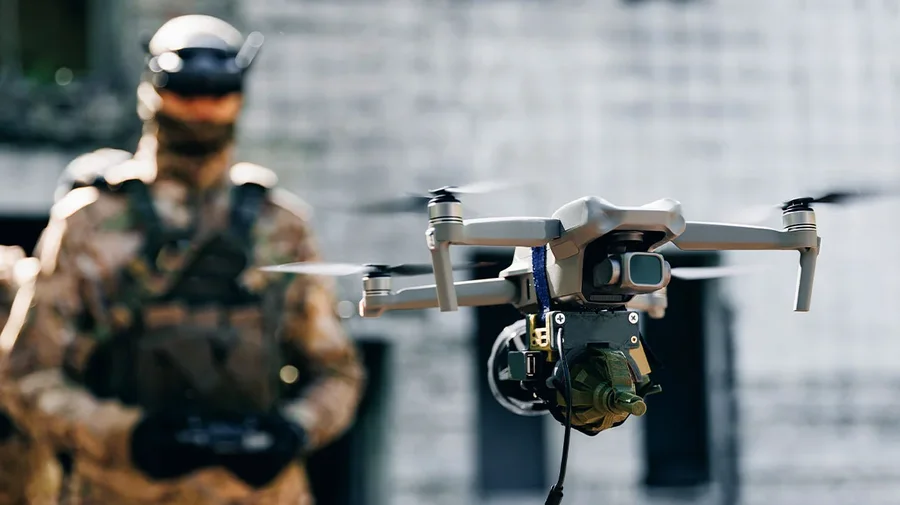
The picture that is forming on the Lebanese front is much more complicated than the classic interpretation of Israeli military superiority facing an adversary the shape and size of Hezbollah.
Israel entered this round of clashes with Hezbollah with a seemingly clear objective: to change the security conditions on its northern border, push the organization away from the border line, and create a security zone that would allow displaced northern residents to return to their homes.
In practice, however, this strategy has begun to resemble less a decisive operation and more a protracted process of attrition. What worries Israel most is that this attrition is not coming from a high-tech strategic weapon, but from something much simpler, cheaper, and harder to neutralize: Hezbollah’s FPV drones. In a not-inappropriate comparison, Tel Aviv could face the same “headache” that Moscow has experienced.
The Israeli Dilemma: Pressure from Within, Restriction from Washington
The warning by Benjamin Netanyahu and the defense minister that Israeli aircraft could strike the southern suburbs of Beirut was not just a threat of escalation. It was also an indication of the difficulties facing the Israeli government. When the threat was withdrawn just a few hours later, the main problem became apparent: Israel is caught between two pressures that are not easily reconciled.
On the one hand, there is the domestic political demand for a decisive blow to Hezbollah. Thousands of Israeli citizens in the north remain displaced or live under daily threat from rockets, anti-tank weapons and now drones. For Netanyahu, who is moving towards an election cycle that by law must be held no later than October – the inability to restore security in the north is a political burden.
On the other side is the pressure from the United States. Washington does not want an uncontrolled war in Lebanon, especially at a time when it is trying to maintain a broader framework of de-escalation with Iran. Thus, Israel has military power, but not complete freedom to use it.
Israel knows what it cannot accept: a Hezbollah entrenched on its borders. However, it has not yet given a convincing answer as to what it can realistically impose without sinking into a new and long-term commitment in Lebanon.
Drones changed the geometry of this front
Hezbollah is not winning the war in the classical sense. It does not have the capacity to confront the Israeli army symmetrically. It cannot stop the Israeli air force or prevent the destruction of its infrastructure in southern Lebanon.
However, the organization has achieved something else, of strategic importance: it has increased the cost of Israel's stay within the security zone.
Fiber-optic FPV drones are a key factor in this change. They do not rely on traditional radio signals that can be easily jammed. They are not expensive and do not require large infrastructure. They strike small units, soldiers, commanders, vehicles and military posts.
Equally important is the propaganda dimension. Every strike can be turned into a video and every video into a message. Hezbollah does not only aim for a military result. It also seeks psychological and political consumption.
Israel had calculated that a weakened Hezbollah, battered by Israeli operations and the broader clash with Iran, could retreat. Instead, it is facing an adversary that may not have the overall strength of the past but has adapted to the new realities of the battlefield.
The result is paradoxical: Israel maintains military superiority, but Hezbollah is proving more resilient than Tel Aviv had anticipated.
The safety zone trap
The most dangerous element for Israel is not just the casualties. It is the nature of the mission itself.
The longer the Israeli army maintains static positions in southern Lebanon, the more the situation resembles the historical precedents of the period 1982–2000. Then Israel entered Lebanon with the promise of a temporary presence. It stayed for 18 years. It was during that period that Hezbollah took shape, gained legitimacy, and grew stronger.
This is the historical weight that is being restored today.
A security zone may seem militarily logical. It creates defensive depth, removes some immediate threats, and allows Israel to tell its northern citizens that Hezbollah is no longer near the border. But the moment the zone requires a permanent presence, it becomes a magnet for attacks.
Retired Brigadier General Asaf Orion argues that the static presence runs counter to the lessons Israel learned from its experience in Lebanon. Politically, it gives Hezbollah the excuse to revive the narrative of “resistance.” Operationally, it turns Israeli forces into targets.
Thus, the measure intended to increase security may produce the opposite effect: continued exposure, loss, and political pressure.
Hezbollah is buying time
Hezbollah doesn't need a spectacular victory. It just needs to show that it hasn't been defeated.
This is the logic of asymmetric warfare. For a state army, failure to achieve initial objectives is perceived as failure. For an organization like Hezbollah, survival, continued attacks, and maintaining the image of resistance can be presented as success.
Drones serve precisely this strategy. They do not overturn the balance of power, but they make it more ambiguous. They force Israel to pay a daily cost for every day it is in Lebanon, they reinforce the narrative that Hezbollah is still fighting, and they limit Netanyahu’s ability to present the operation as a clear military success.
The organization is also playing with time. The more the US pushes Israel not to fully extend its front towards Beirut, the more space Hezbollah gains. The more the US-Iran dialogue acts as a diplomatic brake, the more time the organization gains.
The Beirut problem
Within the Israeli military establishment there is a clear trend: the belief that without striking at Hezbollah's "heart" - in Beirut, in the Bekaa Valley, in the smuggling routes, in weapons production facilities and in the leadership structures - the war will remain an endless game of attrition.
This argument has a military basis. If the adversary maintains strategic depth, networks, command, and supply, clearing the front line is not enough.
But there is another side to the argument. A full-scale attack on Beirut could destroy any efforts at de-escalation, cause massive civilian casualties, pit Israel against Washington, and unleash a war that would hardly be geographically limited.
Herein lies the crux of the dilemma. Israel may feel it needs more leeway with Hezbollah. The US believes that this leeway could undermine the broader framework it is trying to build with Iran. And Lebanon, once again, becomes the arena where military necessity, political calculations, and international crisis management collide.
Agreement as a possible way out
An interesting interpretation sees a US-Iran deal not as a constraint on Israel, but as an opportunity for a way out of this difficult situation.
If such an agreement included a real ceasefire in Lebanon, commitments from Hezbollah, and partial Israeli withdrawal from the security zone, it could reduce costs without being perceived as a full withdrawal.
However, this requires a credible implementation mechanism. Hezbollah does not disarm with declarations. The Lebanese army has not shown that it can establish control in the south on its own. Meanwhile, Iran does not easily give up one of its most important regional instruments.
Therefore, the diplomatic path exists, but it is not clear. It passes through gray areas, guarantees, monitoring mechanisms, and mutual ambiguities.
The Israeli strategy in Lebanon has not collapsed. But it has lost the simplicity with which it was initially presented. The idea that Hezbollah could be pushed back with a powerful operation, removed from the border and allow northern Israel to quickly return to normality proved overly optimistic.
Drones didn't just change the tactical picture. They also changed the political cost of the operation. They made the static presence more dangerous, gave Hezbollah a new means of consumption, and reminded Israel that in Lebanon, military superiority does not automatically translate into strategic solutions.
Israel now faces three difficult alternatives: remain in the security zone and face continued attrition; escalate operations toward Beirut and risk a wider war and a clash with Washington; or accept a diplomatic solution that would limit Hezbollah but not eliminate it.
This is the real dilemma. Not whether Israel can strike Hezbollah. It can. The question is whether it can do so in a way that ends the war, and not one that paves the way for the next conflict.






Lini një Përgjigje