


 Shkruar nga Federico Rampini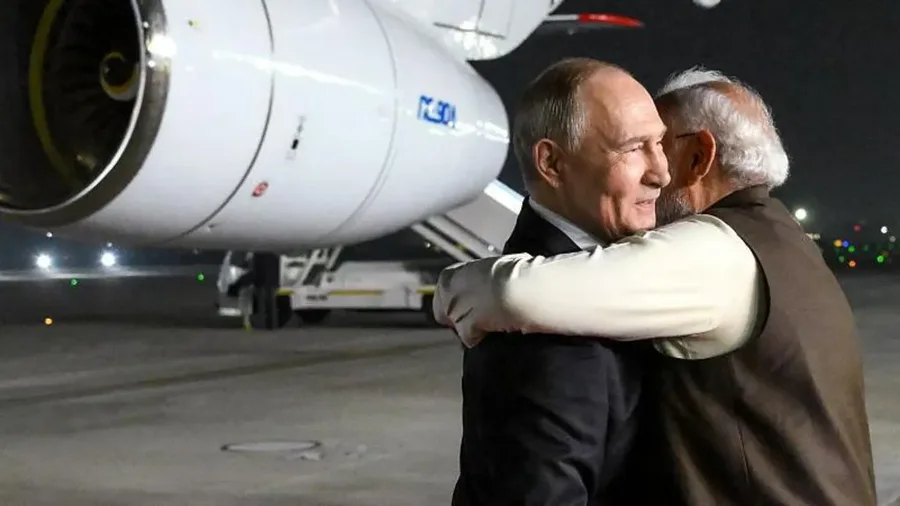
Moscow has sold India vast quantities of raw materials and pocketed the rupee. Meanwhile, Europe is pressuring Delhi to ask Putin to stop the war in Ukraine.
Mainstream media in India write about the history of India-Russia relations: from the Cold War to the energy-military partnership, which still makes Moscow the main arms supplier and a pillar of India's energy security.
They recall Putin's first visits in 2000 and 2001, old photos with the young Modi, and the ritual of the annual summit.
At the same time, analyses highlight that the relationship is no longer the "exclusive" it once was: India is also buying much more weapons from France, the United States and Israel and is suspicious of the strategic symbiosis between Russia and China, even though Delhi has failed to overcome the tensions caused by recent border clashes with Beijing's soldiers in the Himalayas.
The key word in the comments of “The Print”, “Mint” and “The Wire” is “balance”: the difficulty of maintaining a special relationship with Moscow, precisely when relations with Washington have become more strained, due to new American tariffs and the dispute over Russian oil.
On the one hand, US sanctions and pressure have already reduced India's room for maneuver in energy, on the other, Delhi cannot afford to break away from a partner that has guaranteed it discounted oil and continuous military supplies.
On the eve of Putin's arrival, several European ambassadors issued an appeal for India to "put pressure" on the Russian leader to end the war.
Sources in the Indian Foreign Ministry called the move unacceptable. This is an India that asserts its strategic autonomy, perhaps willing to leverage its historic relationship with Moscow to mediate in the Ukraine issue, but rejects lectures from the West, reiterating that its energy and security choices cannot be dictated by Washington or Brussels.
Essentially, Indian media analyses focus on three main issues: defense, energy, and trade imbalances.
They highlight the possible resumption of high-profile projects: from discussions on the Su-57 fifth-generation fighter to cooperation on next-generation air defense systems.
On the energy front, India has benefited enormously from Russian oil (negotiating deep discounts, well below world prices) after 2022, but now must manage stricter sanctions, payment controls, and the risk of American retaliation.
Putin has gone to Delhi just as US tariffs and restrictions on shipping companies are making the flow of Russian crude more expensive.
This is where the issue known as the “rupee trap” comes into play. Due to the trade imbalance, India imports large amounts of oil and fertilizer, but exports few to Russia—large quantities that have difficulty converting or spending.
Analysts quoted by India Today call this the "biggest problem" in bilateral relations.
Another issue that has attracted the attention of the press is the use of the visit by Moscow as a media showcase. The Indian Express devotes a long article to the launch of RT India, an English-language channel with an editorial office based in Delhi and a staff of about 100 people, presented as the frontline of a new Russian information offensive in South Asia.
The launch of RT India is well-timed for Putin's arrival, and the newspaper interprets it as a sign of the Kremlin's desire to consolidate its narrative in a country where Western media still has considerable influence.
Internationally, some media outlets are highlighting the reputational costs of the visit: hosting Putin in the midst of a bombing campaign in Ukrainian cities exposes the country to the risk of being perceived as too soft on Moscow, just as India is trying to present itself as a champion of a rules-based international order.
In short, the image portrayed by the Indian media of the visit is that of a two-dimensional event.
It revives a partnership that remains central to security, energy and infrastructure. It is a demonstration of strategic autonomy: India is not abandoning Moscow despite war and Western pressure, but is using the visit to present itself as a potential mediator and a "multipolar" power that will not be confined to either the American or the Russian-Chinese camps.
All the ambiguities of this positioning remain: the economic and military advantages of the relationship with Moscow, but also the risk of irritating Washington and Brussels; the language of "historical friendship" and the Modi-Putin "personal chemistry."
Contacts between India and Russia have ancient roots: as early as 1900, the then Tsarist Empire opened a consulate in India (in Mumbai, later moved to Calcutta). Diplomatic relations between the newly formed Republic of India and the Soviet Union were established in April 1947, a few months before India's formal independence from British rule.
This historical legacy has returned to the forefront after the invasion of Ukraine: by seeking alliances in the Greater Global South to ease US-EU sanctions, Putin has revived the anti-Western and anti-colonial language that was fashionable at the time when the Third World was the target of Soviet propaganda campaigns. / Adapted from "Pamphlet" taken from "Corriere della sera"



Lini një Përgjigje