


 Shkruar nga Pamfleti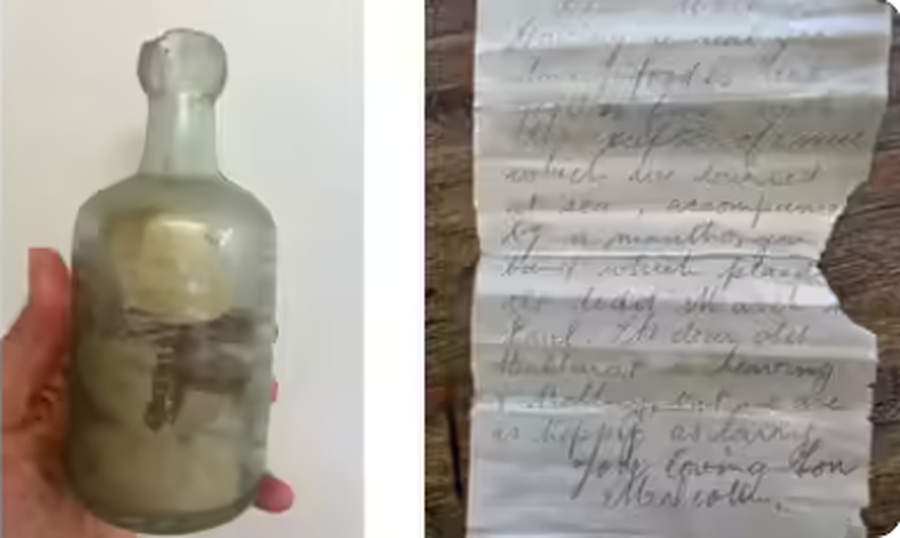
A message from World War I that survived time, salt and oblivion...
A small glass bottle, covered in sand on the shore of Wharton Beach in Western Australia, carried inside a piece of history that no one expected to find: a letter written on August 15, 1916 by a World War I soldier, which today, after more than a century, has come to light again.
The message, placed in a bottle during the voyage of the ship HMAT Ballarat, was sent by Malcolm Alexander Neville, 28, and his comrade William Kirk Harley, as they sailed from Adelaide to Europe to join Australian troops on the Western Front. In the letter, Neville wrote to his mother in a calm, lively tone: “The food is very good – except for one meal we threw overboard.”
Little did anyone know that simple sentence would become a final testament to his life. Neville was killed in France in 1917, while Harley survived. Their letter, preserved in a bottle for 109 years, was discovered last month by a family cleaning up the coast, and was immediately sent to the Australian National Archives.
The bottle was so tightly sealed and buried so deep in the wet sand that the letters remained almost intact. Experts said it was “a historical and natural miracle” because such an object could not have survived for decades at sea if it had not become embedded in the ground immediately after being thrown.
A memory that even time cannot erase
This discovery, beyond archaeological curiosity, is a powerful reminder of the human dimension of war. Behind every date in the history books, there is a man with a voice, with fears, with humor, with dreams. Neville's letter is the testimony of a generation that went to war without knowing why, for empire, for honor, or simply because their time offered them no choice.
In Australia, the event has sparked strong emotions. The descendants of the two soldiers have been contacted by authorities, and an exhibition is being prepared to show not only the letter, but also its journey across the ocean and through the centuries. For many Australians, this bottle has become a metaphor for national memory: a memory that neither time nor sea salt can erase.
A mirror for us, Albanians
For the Albanian reader, this story is more than a distant anecdote. It is a reminder that the history of humanity is not only what happens on the great fronts, but also what is preserved in silence – in a letter, in a photo, in a family memory. Albania has hundreds of similar stories lost in archives, in the suitcases of emigrants or in villages that no one has documented.
At a time when memory is being replaced by everyday noise, a letter from 1916 reaching us in 2025 is a gentle but profound slap: history lives only if we remember it. And perhaps, like this bottle, every forgotten truth awaits its day to be washed ashore. / Pamphlet




Tamamcdo komb ka historine e vet