


 Shkruar nga Pamfleti
Trump declared that he had no choice but to update and renew the American arsenal.
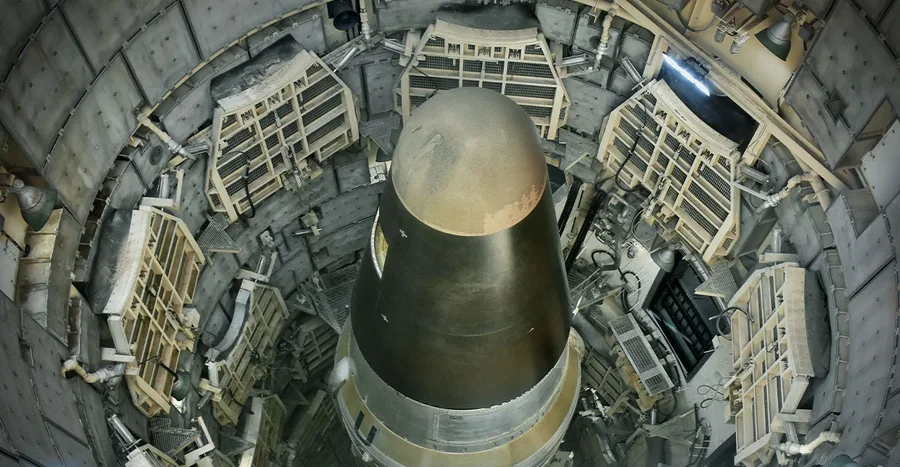
Donald Trump's public announcement that he had asked the US Department of War to immediately resume nuclear weapons testing caused global concern, for the first time in 33 years, as the last time something like this happened in America was in 1992.
"Due to the testing programs of other countries, I have instructed the Department of Defense to begin testing our nuclear weapons on a level playing field," the US president wrote in Truth Social, with the New York Times interpreting the term "on a level playing field" as meaning that Trump would demonstrate the power of US missiles or submarine-launched nuclear weapons and not proceed with a nuclear test.
Anger for Russia
Although it is still unclear what prompted Trump to act this way, as he was flying to meet Chinese President Xi Jinping, it is considered highly likely, as the NYT points out, that the US president "was angered by recent demonstrations of such weapons systems by Russia."
Recall that just 24 hours ago, Putin announced that Russia had successfully tested the Burevestnik nuclear missile, which according to Moscow is designed to travel over the Pacific and eastern Russia to hit the West Coast of the United States. At the same time, on Wednesday, he declared that "yesterday we conducted another test, of another very promising system, an underwater drone, Poseidon."
The US president criticized Moscow's action, telling reporters that his Russian counterpart should be working to end the war in Ukraine "instead of testing missiles."
In his reaction to the order, Trump stated that he had no choice but to update and renew the American arsenal.
???????? Unlimited-range Burevestnik joins Russia's elite missile club — after flying 14K km
— Sputnik India (@Sputnik_India) October 26, 2025
A glimpse inside Russia's top-tier arsenal ???????? https://t.co/IjcrJRWJp5 pic.twitter.com/fABARGFVJs
China's turn under Xi Jinping
At the same time, China poses a “particularly difficult nuclear conundrum” for Trump, as the New York Times notes, as it has never signed a nuclear arms control treaty.
While during the Cold War, its "minimum deterrent," numbering only a few hundred nuclear weapons compared to the thousands possessed by Russia and the United States, seemed too small to cause concern, under Xi Jinping, this policy has been abandoned.
At first covertly and then openly, China has been building new missile silos in plain sight of American spy satellites. The Pentagon estimates that Beijing will have about 1,000 weapons by 2030 and 1,500 by 2035, a number that would bring China on par with the current arsenals of the United States and Russia.
Until then, however, China does not appear to have any interest in participating in nuclear arms control talks, with Trump stating that he believes he can convince Xi to participate in such negotiations.
The world's nuclear arsenals
According to the latest report from the Stockholm International Peace Research Institute (SIPRI), the United States has 5,117 nuclear warheads and Russia has 5,489.
In total, SIPRI estimates that nine countries have more than 12,200 nuclear warheads: Russia, the United States, China, France, Britain, Pakistan, India, Israel and North Korea.
For years, American nuclear weapons engineers have said that more nuclear tests were unnecessary, as they could simulate tests on computers rather than risk explosions that once occurred in the Pacific or underground in Nevada. However, in recent years, as the United States began to modernize its aging arsenal, there have been calls for such tests to resume.
The New York Times' assessment is that "if Trump tests a nuclear weapon, perhaps in the area outside Las Vegas, it would likely provoke similar moves by other nuclear-armed states, such as Britain, France and Israel, which has an undeclared arsenal of nearly 100 weapons. India, Pakistan and North Korea also have growing stockpiles of nuclear weapons."
Bilateral agreements
Washington and Moscow remain bound by the New START disarmament treaty, which limits each country to 1,550 deployed nuclear warheads and provides for a verification mechanism, but this has been suspended for two years.
With the treaty set to expire in February, Putin proposed in early October to extend it for a year, but did not mention the possibility of resuming inspections of arsenals.
In 2019, during Trump's first term, the US withdrew from another important treaty it had signed with Russia in 1987, on intermediate-range nuclear weapons (INF).
In 2020, the American press reported on an alleged plan by Trump to resume nuclear testing as a warning to Russia and China.
From the first American nuclear test in July 1945 in the New Mexico desert to the moratorium imposed by President George H.W. Bush in 1992, the US has conducted 1,054 nuclear tests and bombed the Japanese cities of Hiroshima and Nagasaki in 1945./ The New York Times




Lini një Përgjigje