


 Shkruar nga Gideon Rachman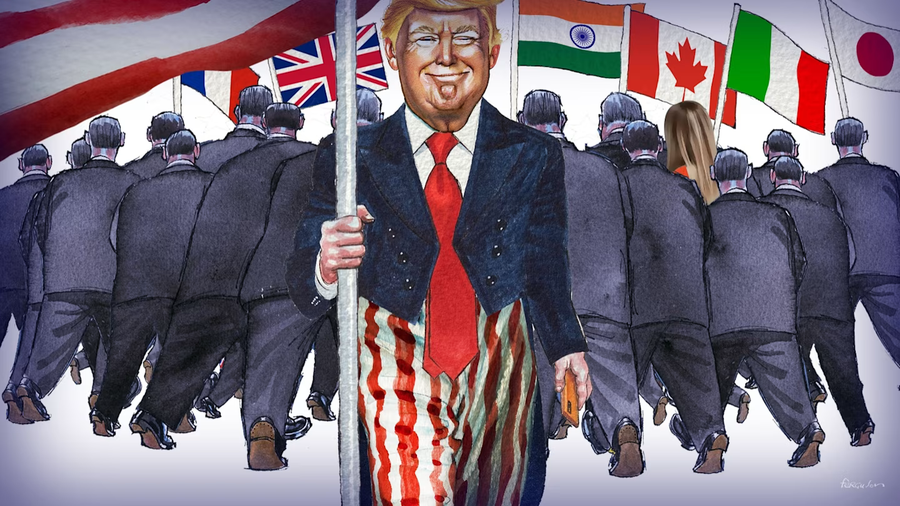
This is the world that Donald Trump has created...
When the United States celebrates the 250th anniversary of the Declaration of Independence next month, its friends and allies will join in the festivities. But behind the scenes, many of these countries are trying to increase their independence from America.
Washington's traditional partners have come to realize that longstanding ties with the US will not guarantee them immunity from the Trump administration's pressures and coercive tactics. Giorgia Meloni, Italy's prime minister, expressed a concern shared by many when she complained that the US president often treats democratic allies worse than authoritarian rivals.
In this new climate, close ties with America, once considered a major asset, are increasingly seen as a potential weakness. The strongest signal came last year, when Donald Trump imposed harsh tariffs on both friends and adversaries. His administration raised new concerns this month with its decision to restrict access to all foreign nationals to Anthropic's artificial intelligence models, Mythos 5 and Fable 5.
The Trump administration may change this policy. However, the message seems to have become clear. The Mythos case seems to have reinforced an argument made earlier this year by Arthur Mensch, the chief executive of Mistral, the most prominent French artificial intelligence company in Europe. He declared on a panel discussion that, as artificial intelligence becomes increasingly essential to the functioning of the global economy: "The biggest risk for Europe is that our entire industry relies on a technology that could be disabled if the US decides to do so."
Concerned by this prospect, European governments are increasingly talking about the need for "sovereignty in artificial intelligence," reducing dependence on American companies and models. Mistral itself is expected to benefit from this trend.
Concerns about potential US disruptions are not limited to artificial intelligence. Trump's threats to annex Greenland earlier this year reminded Europeans of their dependence on American weapons. The big American defense companies, which dominate the market, are already worried that they could lose sales as a result.
These concerns extend beyond Europe. The tariffs on India and Trump's meeting with Pakistan have been sharply criticized in New Delhi. The Observer Research Foundation, an Indian organization that often reflects government positions, recently published a paper arguing that the "Trump factor" had significantly influenced India's decision to buy French fighter jets.
The country that may have thought most systematically about ways to reduce its dependence on both the US and China is Canada, which Trump has repeatedly suggested as a candidate to become America's 51st state.
In internal analysis, the Canadian government has identified nine economic sectors that it considers critical to national sovereignty. These sectors include artificial intelligence, semiconductors, energy, payment systems, and financial settlements.
The desire to avoid dependence on both America and China in these areas is understandable. But is this feasible? Canada, for example, conducts about 70 percent of its trade with its giant neighbor to the south. The Mistral remains much smaller than its American rivals in the field of artificial intelligence. Meanwhile, the entire Western world, including the US itself, has become aware of its dependence on critical minerals coming from China.
These addictions are deeply rooted and cannot be completely eliminated. However, they can be reduced.
Some Asian countries see the Comprehensive and Progressive Agreement for Trans-Pacific Partnership (CPTPP) as a model and an important foundation. It currently includes 12 countries, including Japan, Canada, Chile, Australia, the United Kingdom and Singapore. The European Union and the CPTPP have begun discussions on a deal between the two blocs, which could cut tariffs in many sectors. There is also a serious debate in New Delhi about whether India should seek membership in the pact.
A trade agreement among the middle powers, which would include the European Union, India, Japan and the United Kingdom but exclude China and the United States, could have a significant impact. However, the idea of achieving full economic sovereignty vis-à-vis China and America, the world's two largest economies and the two global leaders in artificial intelligence, remains unattainable.
However, there are other ways to approach the problem of over-reliance on the political will of Trump or his successors. The answer to the risk of a disruption of American supplies, whether in artificial intelligence, weapons, or energy, probably does not lie in striving for complete independence from American technology or resources. Such a policy would be costly, inefficient, and, ultimately, unrealistic.
An alternative strategy is one that China has already demonstrated: having a pressure mechanism of its own. Xi Jinping’s government responded to the extremely high US tariffs by severely restricting exports of critical minerals. This proved an effective tactic, forcing the US to ease the tariffs.
Other world powers need to identify their own means of economic influence, in case they ever need them. For India, it could be its crucial role as a producer of generic drugs. For Canada, it could be potash, a key ingredient in the fertilizers on which American farms depend. For Europe, it could be the unique technology of the Dutch company ASML or its position as an exporter of uranium and turbines.
It is unfortunate that the world's democracies are being forced to prepare for a possible economic confrontation with each other. But this is the world that, in this view, Donald Trump has created. / Adapted from "Pamphlet" by "Financial Times"




Lini një Përgjigje