


 Shkruar nga Pamfleti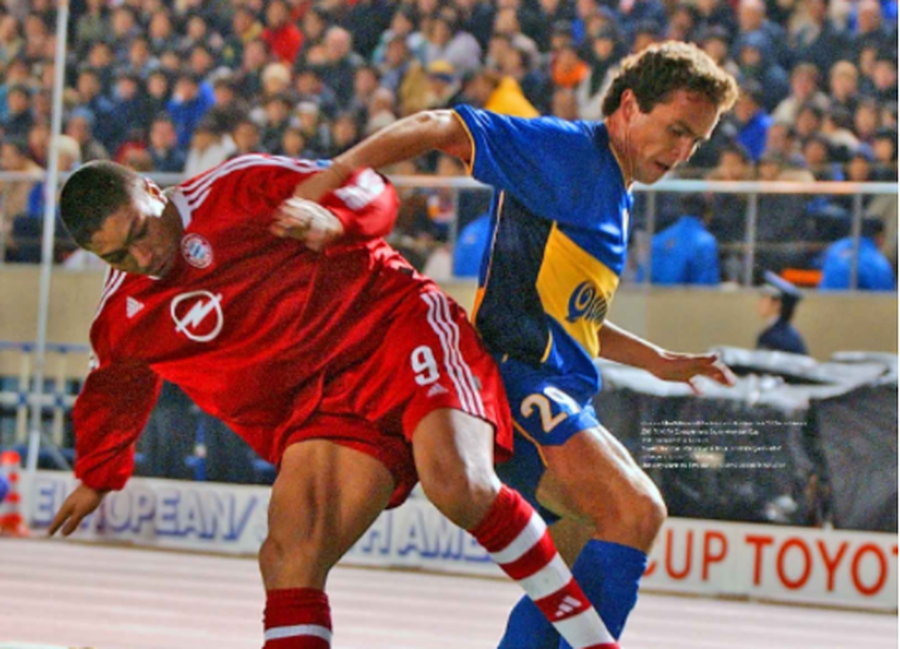
Bayern Munich vs Boca Juniors is the highlight of the second leg of the Club World Cup in the USA. A clash of titans from Europe and South America. A duel that is characterized by a long tradition and has its roots 100 years ago in Munich!
Bayern, who started the Club World Cup strongly with a crushing 10-0 victory over Oceania champions Auckland City, can secure qualification for the round of 16 with a victory over traditional Argentinian club Boca Juniors in their second match of the tournament. In this context, Bayern's slightly older fans will probably remember the Intercontinental Cup match between the two clubs in November 2001 in Tokyo (Japan), which the then Champions League winners (Bayern) won this trophy 1-0 thanks to a goal from Sami Kufur in extra time.
But while there are eyewitnesses to the duel of 24 years ago, the same cannot be said for the first confrontation between the two clubs. This happened exactly 100 years ago in Munich's Oberwiesenfeld stadium. World football at that time (at the Summer Olympics) was dominated by the South American national teams, Uruguay and Argentina. Intercontinental club duels had never existed before.
Boca’s European Tour – In 1925, the Boca Juniors team traveled to Europe by ship for three weeks: with 17 players, no coach, but at least one fan who also worked as a masseur. After a series of matches in Spain, in which they defeated Real Madrid and Atletico Madrid, the Argentines arrived in Munich. There, they were welcomed by the Bayern Munich players with a tour of the city, as noted by a journalist traveling with them. On May 9, 1925, the visitors and the locals met in front of 5,000 spectators at the Teutonia-Platz in Munich’s Oberwiesenfeld, drawing 1-1. The journalist spoke enthusiastically about the order in the stands, as well as the playing style of the team led by goalkeeper Alfred Bernstein and striker Josef Pöttinger. That same day, he sent a telegram home: “If the Germans had more composure at the end, they would be one of the best teams in Europe.” In their 14th match (out of 19) of the European tournament, Boca Juniors dropped just two points.
Strange football times – A hundred years ago, football was different, of course. Those were different times. If we refer to today's perspective, the football of that time would be considered strange to say the least. Just a day later, Bayern played Kickers Offenbach in the 1/8 finals of the South German Cup and even won 4-1. Today, playing two days in a row is unthinkable!
Location “Teutonia-Platz” – In those years, Bayern played most of its home games at the “FC Teutonia” stadium, which had been inaugurated in 1921. The official capacity was 12,000 spectators, but in a match between Munich and Berlin on May 22, 1921, around 20,000 football fans gathered in the hopelessly overcrowded stands.
The sports facility was located between the NymphenburgBiederstein ('Canaletto') canal, Lerchenauerstrasse and Winzererstrasse. The former site is now occupied by the Olympiaberg, a mountain of rubble recovered from World War II. FC Teutonia was forced to abandon its facility in 1936, because the Nazis were increasingly using the Oberwiesenfeld for military purposes (as had been the case in the 19th century), specifically as an airfield.







Lini një Përgjigje