


 Shkruar nga Pamfleti
The Venice Commission calls for a thorough review of the draft law on the financing of political parties in Albania, with an emphasis on transparency, control of secret donations and strengthening the role of the CEC. Council of Europe experts warn that without these improvements, the legal framework remains vulnerable to abuses and lack of accountability.
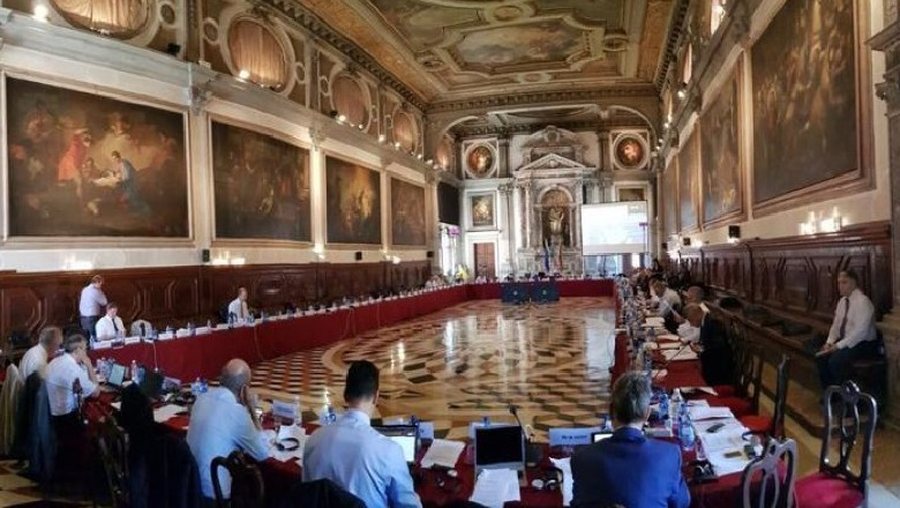
The Venice Commission has given its opinion on the draft law regulating the financing of political parties in Albania, drafted with the agreement of the Socialist Party and the Democratic Party.
Council of Europe experts are calling for a series of improvements before the draft is finally approved in the Assembly.
In the opinion adopted during the plenary session held on 12 and 13 June, the Commission considers the initiative as an important step towards improving the legal framework, increasing transparency and strengthening control over the financial resources and expenditures of political entities.
Despite this assessment, the document includes six main recommendations aimed at addressing the gaps identified in the draft. One of the concerns raised is the need for stronger oversight of secret funding and donations coming from abroad. The Commission also calls for the expansion of the powers and capacities of the Central Election Commission.
According to the recommendations, the rules related to the daily financing of political parties and those applied during election campaigns should be harmonized and not create contradictions between them.
Experts also call for the main provisions to be set out directly in the law, while secondary legislation should be limited to technical matters. At the same time, any regulation adopted by the CEC or the Council of Ministers should be based on clear, objective and predictable criteria.
Another recommendation relates to indirect and secret funding. The Commission suggests more comprehensive regulation of cases where funds pass through third parties, affiliated organizations, or entities controlled by political parties.
The report also calls for more detailed financial statements for parties. They should include all sources of income, expenses, assets, financial liabilities, credits, loans, debts, guarantees, in-kind contributions, services provided below market value, transactions with related entities, in-kind public support, media and digital communication expenditures, as well as funds dedicated to gender equality and youth representation.
The Commission suggests that financial reporting should not be limited to certain periods, but should be conducted more frequently, especially during election years.
A significant part of the opinion focuses on the role of the Central Election Commission. According to Venice, clear mechanisms of cooperation between the CEC and other state institutions should be established. Also, the institution should be provided with a clear mandate, full powers and sufficient resources to actively monitor political financing.
The experts demand that the CEC be able to investigate suspected violations of financing rules, while the special structure that is envisaged to be created within it for monitoring and controlling party finances should have sufficient guarantees for its independent functioning. It is also recommended to strengthen the independence of accounting experts who audit party financial reports.
Regarding punitive measures, the Venice Commission proposes a review of the sanctions system. According to the opinion, the law should provide for penalties for any violation of the obligations and prohibitions set out, while the authorities should have at their disposal a wider range of measures that are effective, proportionate and dissuasive.
The document also suggests increasing some administrative fines. Meanwhile, banning a party from participating in elections should only be used in serious cases, as a last resort, after the political entity has been given the opportunity to correct the violation and only after a full judicial review process.
The opinion of the Venice Commission is expected to be taken into consideration during the further consideration of the draft law in the Assembly.




Perse duhet te financohen partite politike?, dhe perse nga buxheti i shtetit?. kjo eshte e padrejte. Partite te vendosin kuotizacione anetaresise se tyre dhe te punojne me rrjetet sociale. keto fonde shteti ti perdore atje ku populli apo shtresat vulnerabel, kane me shume nevoje. Sidomos me keto listat e mbyllura nuk ka nevoje fare te dalin ne fushate, ndersa ata ne listat e hapura te ecin me shpenzimet e veta, donacion te deklaruara, etj, neqoftese duan te behen deputete.