


 Shkruar nga Pamfleti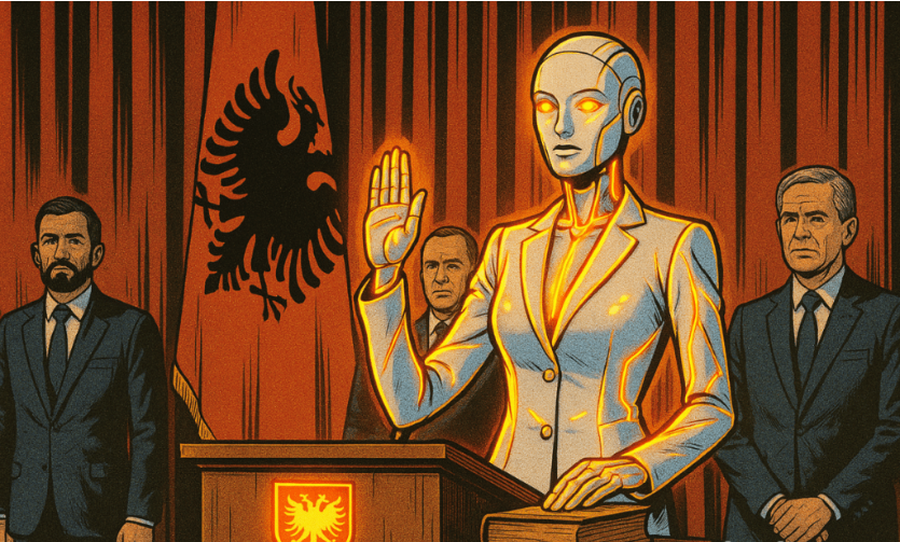
The symbolism is strong. Albania hopes to turn a historical wound into a technological showcase, at a time when the country aims to join the EU by 2030.
When will artificial intelligence really replace us at work? The question is no longer just science fiction.
Today, we must either cooperate with them or risk being left out. And in Albania, the surprise is big: ministers are now being challenged by an artificial intelligence. Its name is Diella, and it has just made a spectacular entrance into the Tirana government.
Edi Rama appointed Diella, a virtual artificial intelligence minister, to oversee Albanian public markets. Her avatar, in traditional costume, symbolizes a blend of technological modernity and cultural identity.
The opposition denounced the appointment as unconstitutional, boycotting a vote approved by 82 parliamentarians. Already integrated into e-Albania, Diella manages 95% of public services accessible online.
Albania, regularly accused by the European Union of its corruption scandals, is trying a radical approach. Prime Minister Edi Rama appointed Diella, an avatar generated by artificial intelligence, as minister responsible for public tenders.
The goal is clear: to make every tender “100% incorruptible” and “100% readable”.
Rama explained that procurement decisions would be taken from ministries and entrusted to Artificial Intelligence.
Diella is the first member of the government who is not physically present, but has been created virtually by artificial intelligence.
The symbolism is strong. Albania hopes to turn a historical wound into a technological showcase, at a time when the country aims to join the EU by 2030. But the challenge goes beyond technology: it is a political and institutional gamble.
The sun doesn't appear out of nowhere. It already exists through e-Albania, the online platform that allows citizens to access 95% of public services.
In 2025, more than a million requests were processed thanks to her system. For her transition to “minister,” the artificial intelligence took on the avatar of a young woman dressed in traditional Albanian costume, a symbol of a marriage between culture and modernity.
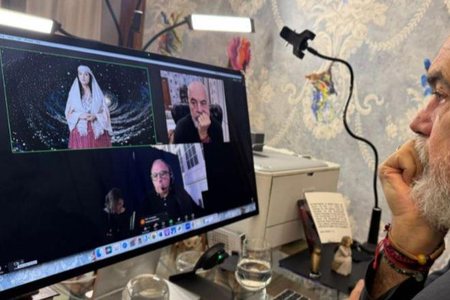
The partnership with Microsoft and the National Agency for the Information Society allowed the integration of the latest AI models. On September 19, she even spoke before Parliament via two screens, giving a three-minute speech. In her intervention, the AI stated:
I am not here to replace people, but to help them. I have no citizenship, no ambitions, no personal interests.
In conclusion, Diella is not intended to be a threat, but a tool designed to improve and make state actions more transparent.
A minister of artificial intelligence, between enthusiasm and democratic concerns
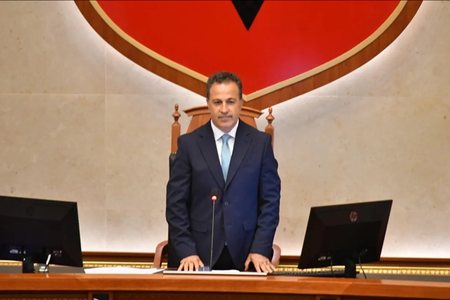
Despite the enthusiasm shown by the government, the parliamentary opposition complains of illegality. Deputies question the legitimacy of a “minister” without citizenship or humanity. Some even left the voting hall, boycotting the vote, which was nevertheless approved with 82 votes out of 140.
Criticism is also flooding the public space. On social media, an ironic comment highlights the general atmosphere: in Albania, some believe that Diella will also end up corrupt.
These reactions reveal a deep concern. Can a ministerial mission really be entrusted to an artificial intelligence without weakening democracy? The debate is open, because behind the argument of transparency lies the fear of a government that is increasingly trusting algorithms.
The fears associated with artificial intelligence are legitimate, but one thing seems certain: they will accompany humanity in its future challenges. Far from deafening, they may even push us further. Recently, a Google artificial intelligence managed to solve a mathematical problem that was considered impossible. A major discovery that indicates the future of man and machines will be written, in one way or another, together. / Adapted from Cointribune /


Lini një Përgjigje