


 Shkruar nga Irena Beqiraj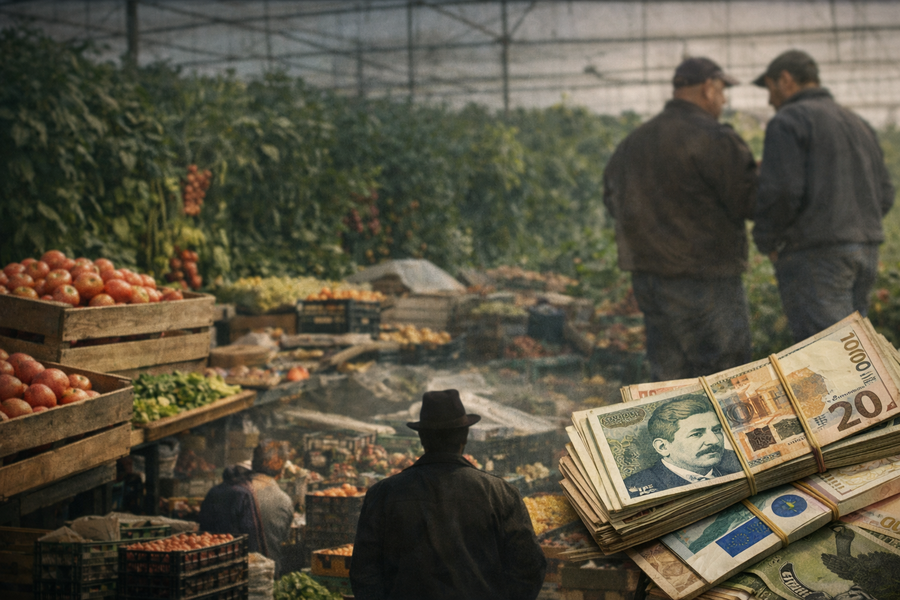
The sudden increase in the price of fruits and vegetables by almost 50% requires a detailed analysis that should focus on collectors.
The "Federation" of fruit and vegetable collectors, and a reminder of the nullity of taxation as a means against the price reduction determined by the cartel.
The sudden increase in the price of fruits and vegetables by almost 50% requires a detailed analysis that should focus on collectors.
From the data, but also from the fact that the government is very sensitive about agricultural products sold on the sidewalks, it appears that fruit and vegetable pickers operate like the maple syrup federation in Quebec, Canada, a province that produces more than 70 percent of the world's maple syrup.
The Quebec Maple Syrup Federation is a cartel as greedy as OPEC. By decision of the Canadian government, all small producers must sell their production to the Federation.
Every spring, the province's 7,400 producers send their produce to the federation.
Regardless of whether production is abundant or scarce, the federation controls the quantities it puts on the market to maintain high market prices.
When the federation suspects that farmers are producing and selling outside the system, it, with the help of the government, imposes fines and seizes production.
The same thing happens in Albania. The farmer, lacking the capacity to sell his products himself, hands over the products to 2 or 3 collectors who function as a cartel. They buy the farmer's tomatoes at a price of 60 lek/kg, (often with lek in hand) and sell them for 350 lek. Any rebellious farmer who goes out on the street to sell his products, as the only opportunity to benefit from his sweat, is crushed by the government in the name of food security.
Moreover, as a reminder of the debate taking place today, the experience in the fruit and vegetable market shows that taxation does not stabilize the structure of markets, much less reduce prices. In 2014, the government used taxation techniques as a way to secure markets for local farmers with the aim of increasing competition in the market and reducing prices, by allowing farmers to sell their products to collectors at the full price including VAT but without forcing them to be included in the VAT scheme. The government allowed collectors to self-invoice for products purchased from farmers, reducing the fiscal burden on them with the aim of reducing the final price. But the concentration of the market to only a limited number of collectors, despite the government's fiscal lenience, did not lower prices; on the contrary, they helped create and strengthen the "federation" of fruit and vegetable collectors, who became the exclusive beneficiaries of the self-invoiced VAT, leaving the farmers that this taxation scheme theoretically claimed to help empty-handed.
Working in government taught me the difference between good and bad economists. What distinguishes a bad economist from a good one is that a bad economist can only see what is visible, while a good economist sees the yet unseen consequences that will follow the visible effect of an action. A good economist weighs the merits of a proposal, a policy, or an institution by considering both the effects that he and others can see, as well as the future consequences that he foresees but others do not.








Lini një Përgjigje