


 Shkruar nga Pamfleti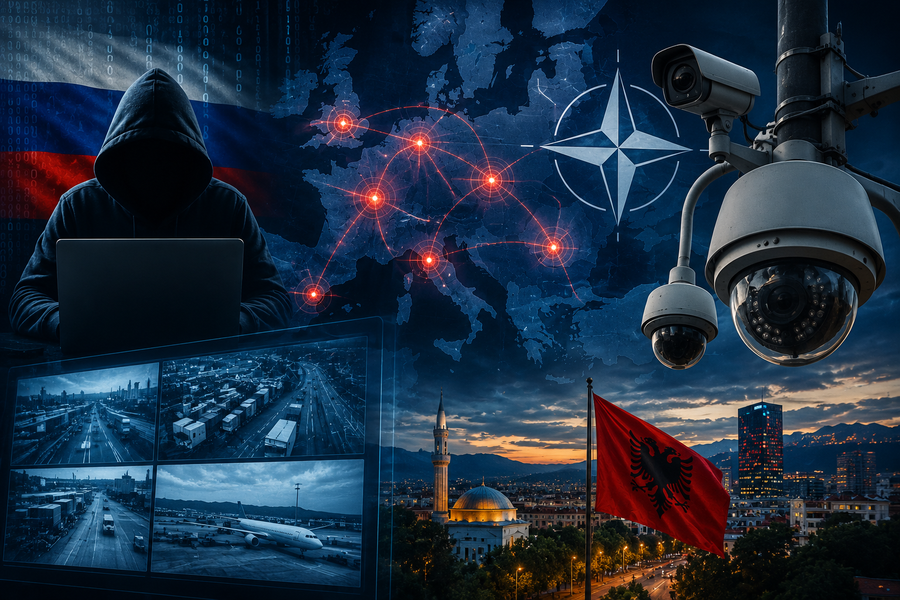
A wide-ranging Russian military intelligence operation has targeted 13 NATO countries and Ukraine, hacking security cameras, logistics companies and technology systems to monitor the movement of weapons. The discovery comes at a time when Albania is also expanding its network of smart cameras with the "Smart City" project, while still bearing the consequences of cyberattacks in 2022.
A joint report by intelligence and cybersecurity agencies from the United States, the Netherlands and several European countries has revealed one of the largest cyber espionage operations in recent years, organized by the Russian military intelligence service GRU.
According to the report, GRU unit 26165, also known in the cybersecurity world by the names APT28, Fancy Bear, Forest Blizzard or BlueDelta, has conducted a coordinated campaign of attacks against civilian and technological infrastructure in NATO countries since the beginning of the war in Ukraine.
The target was not just government servers or military networks.
Russian hackers have penetrated logistics companies, ports, airports, technology companies, air traffic control systems, maritime and rail transport operators, but also security cameras and smart doorbells installed in private homes and businesses.
The goal was to collect information on the movement of military equipment, weapons, and aid that NATO countries were sending to Ukraine.
The report mentions that the operation had targets in Bulgaria, the Czech Republic, France, Germany, Greece, Italy, Moldova, Poland, Romania, Slovakia, the Netherlands, the United States and Ukraine, while investigations continue for other Alliance partner countries.
According to Western agencies, hackers used a combination of techniques such as password spraying, spear-phishing, infected emails, and the compromise of Microsoft Exchange accounts to take control of computer networks.
An important part of the operation was taking control of IP cameras connected to the internet.
Dutch intelligence services confirmed that a number of cameras located along military corridors in the Netherlands had been hacked and used to watch the movement of military convoys and equipment in real time. In most cases, the camera owners were unaware that their devices had been compromised.
According to the investigation, most of the hacked cameras were cheap devices made in China, mainly Hikvision and Dahua brands, which still used factory passwords or old versions of security software.
The report notes that after the failure of the rapid military offensive in Ukraine and the increase in Western aid to Kiev, the GRU expanded its operations from military targets to civilian infrastructure that supported NATO logistics. Through cameras and monitoring systems, Russian intelligence sought to identify the type of weapons being transported, their routes of movement and the time of their arrival.
Edi Rama's Smart City
This development is also important for Albania.
Although our country is not mentioned in the list of countries hit in this operation, Albania has been a NATO member since 2009 and in recent years has become part of the Alliance's common infrastructure. Military exercises are held on Albanian territory, NATO bases operate and logistical systems important for regional security pass through.
At the same time, the Albanian government has launched the implementation of the "Smart City" project, which envisages the installation of around 5,000 smart cameras connected to a single monitoring center. The system will use artificial intelligence to read license plates, identify wanted vehicles, monitor traffic and analyze various situations in public spaces in real time.

These monitoring systems have become the subject of discussion in many European countries after the publication of the report on the Russian operation. Cybersecurity experts emphasize that the greater the number of devices connected to the Internet, the greater the need for constant protection from cyberattacks.
For Albania, this issue takes on particular importance also due to the experience of 2022, when the country was hit by a series of cyberattacks that temporarily paralyzed part of the public administration. The attacks, attributed by Albanian authorities to actors linked to Iran, disabled the e-Albania platform, hit state servers and then affected the TIMS system, leading to the publication of thousands of documents online.
The events of 2022 showed that digital infrastructure can become a target for state espionage and sabotage operations. The latest report on the activity of the GRU adds another dimension to this threat, showing that in modern warfare, not only government servers are no longer targeted, but also ordinary devices that citizens use every day to secure their homes and businesses.
For a NATO member country like Albania, which is investing in expanding intelligent monitoring networks, the revelations published by Western partners put even more into focus the importance of protecting cyber infrastructure and the systems that will manage thousands of internet-connected cameras. / Pamphlet








Lini një Përgjigje