


 Shkruar nga Pamfleti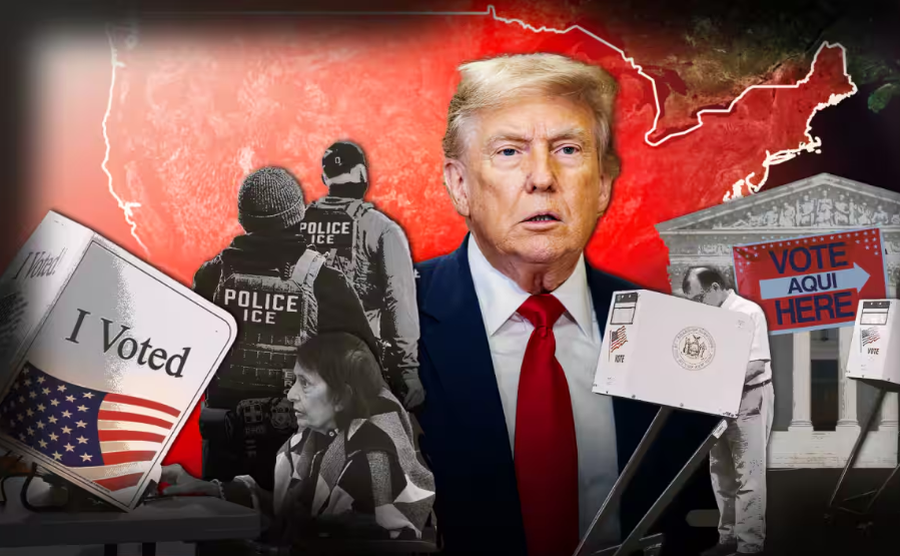
Trump opens new front against US elections, targeting Congress and federal states
Those who, although shaken by Donald Trump's attacks on the institutions that guarantee the balance of powers, continue to believe in the integrity of the American electoral system do so on solid grounds. The Constitution of the United States is clear: the administration of elections is the exclusive competence of the federal states, precisely to avoid interference by the central government. While any law with national effect that could affect the outcome of the elections can only be approved by Congress.
With the speech given the night before, which marks only the beginning of a presidential campaign of interference and pressure on the electoral process, Trump launched a series of attacks, from the secret services to journalists, whom he now accuses of being paid by Beijing, but the main objective was to strike at the two constitutional pillars that prevent him from exercising the absolute power he seeks: the federal states and Congress.
The first target was Congress, where, although Republicans have a majority in both the House of Representatives and the Senate, Trump failed to pass the SAVE Act, the bill that provides for much stricter rules on the documents that must be presented during voter registration.
Such a measure may seem reasonable from a European perspective, but not in the United States, where there is no national identity card and passports are only available to those traveling abroad. For this reason, voters' identities have traditionally been verified with other documents.
Trump believes that, with the new rules, many poor, African-American and Hispanic citizens will give up on providing the necessary documents to vote. However, the Save Act is not only opposed by Democrats. Many Republicans, especially those representing rural areas, are also against the bill, as many farmers could be left without the right to vote due to lack of documentation. For married women, another problem arises: in the US they take their husband's surname, while in many documents they still appear with their maiden surname.
Trump has been pressuring Republicans in Congress for months. Now he has taken an even more aggressive approach, declaring that anyone who doesn't vote for the Save the Children Act is a fraud and is deceiving America. He has called on his MAGA supporters to pressure senators and representatives in their constituencies. For years, in many cases, activists from this movement have been accused of using intimidation methods against politicians and even their families.
As for his interventions in the electoral system, blocked by the courts because they infringed on the powers of the federal states – such as presidential orders against voting by mail or to influence the distribution of ballots by the Postal Service – Trump now uses China as an argument to claim extraordinary powers. According to him, when faced with a threat to national security, the autonomy of states like Oklahoma or Nebraska loses its importance. “Without a fair electoral system, there is no more America,” he declared.
But did China really change the outcome of the US election? Many analysts believe that the first person to not believe this is Trump himself. He has repeatedly scoffed at accusations of Russian interference in the US election and, if he were truly convinced of Chinese interference, he would have to take much tougher measures against Beijing.
Claiming that China has obtained the personal data of 220 million Americans, Trump failed to mention that much of this data is public. Many US states publish voter lists for transparency reasons, and in some cases they are also available online. Other data can be legally purchased from commercial databases.
Trump also forgot another episode. Shortly after returning to the White House, he blocked the implementation of a law that would have banned the Chinese social network TikTok, despite concerns that the data of American users could end up in Beijing. The reason he gave at the time was simple: "I like TikTok. It helped me win the votes of a lot of young people."
Long accustomed to imposing what is convenient for him at any given moment, leaving his own contradictions in the shadows, Trump gave only a taste of how he will bombard American public opinion with the issue of the elections over the next three months.
Now it's the turn of the people he has put in charge of investigations within the secret services, the FBI and the Department of Justice. After the departure of Pam Bondi and Tulsi Gabbard, who he said did not find evidence and did not hit his opponents hard enough, the president has chosen more aggressive people, willing to magnify even the smallest problems, if necessary.
America will vote, but it will do so in a chaotic climate. And there is a risk of a partial paralysis of the electoral process if Trump manages to block the use of electronic vote-counting machines, which he considers rigged. His people have already taken on the task of proving that these systems are vulnerable. / Adapted from "Corriere Della Sera"






Lini një Përgjigje