


 Shkruar nga Pamfleti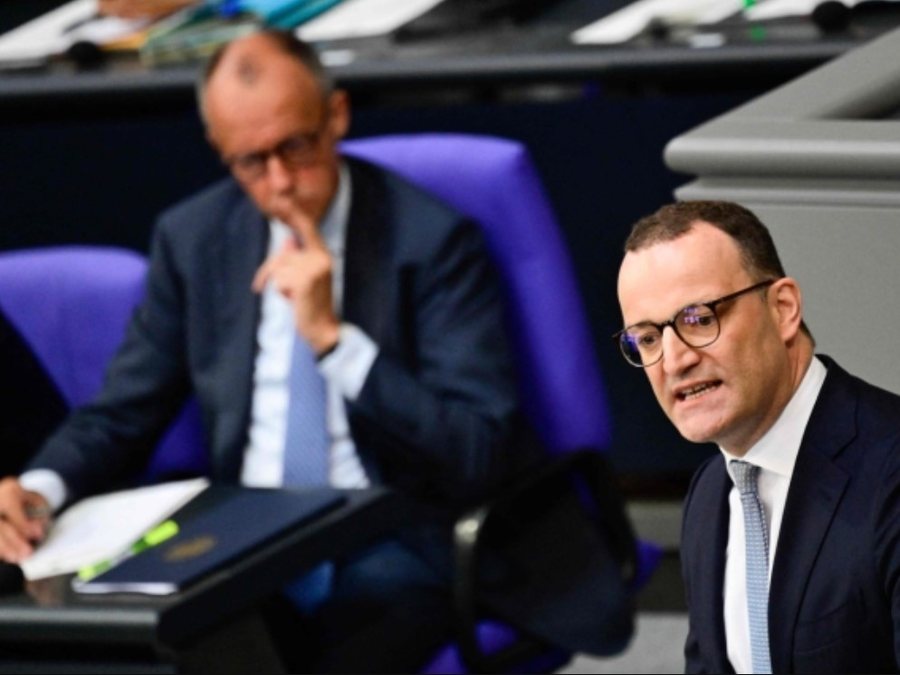
Former German Health Minister and one of the leading figures of the Christian Democratic Union (CDU), Jens Spahn, has resigned from his position as chairman of the CDU-CSU parliamentary group in the Bundestag, following strong controversy that erupted when he announced that he had become a father together with his husband, Daniel Funke, through a surrogate mother in the United States.
According to the Bild newspaper, Spahn announced the decision in a letter to Union deputies, explaining that he had previously informed Chancellor Friedrich Merz and CSU chairman Markus Söder.
"I realized that my personal happiness, the fact that I have created a family and become a father together with my husband, can no longer be reconciled with my political duty," he wrote.
Spahn admitted that the gap between his private choice and the expectations of the parliamentary group leader "has become larger than he had imagined," emphasizing that family remains his priority.
The resignation comes after days of strong criticism after it was revealed that he and his husband had become parents to a son through surrogacy in the US. The practice is banned in Germany under the 1990 Embryo Protection Act, which provides for fines or up to three years in prison for arranging surrogacy within the country.

Although German law does not prohibit citizens from raising a child born to a surrogate mother abroad, Spahn's case raised questions about his political credibility, as he had consistently supported banning the practice.
In 2020, when he was health minister, Spahn rejected a request from the Liberal Party (FDP) to relax the surrogacy ban. In 2015, he wrote publicly that, “as a gay man and as a Christian,” he found it “personally very difficult to come to terms with the idea of a rented womb.”
Surrogacy is a procedure where a woman agrees to carry and give birth to a child on behalf of a couple or another person, then relinquishing her parental rights. Due to ethical and moral debates and the risk of its commercialization, Germany and several other European countries ban this practice.
The strongest criticism of Spahn came from within the CDU itself. Daniel Peters, the party leader in Mecklenburg-Vorpommern, told Bild that Spahn's position was no longer sustainable, as a politician cannot act differently in private life than he defends in parliament.
Faced with growing pressure, Chancellor Friedrich Merz had announced that the issue would be discussed by the CDU leadership, emphasizing that the topic touches on human, legal, social and ethical dimensions, but that the party's stance on banning surrogacy would not change.
After resigning, Merz welcomed Spahn's decision.
"Jens Spahn has just informed me of his resignation as chairman of the CDU-CSU parliamentary group. This decision is right and inevitable," the chancellor declared.
He added that "credibility is essential in politics," thanking Spahn for his contribution to leading the parliamentary group and the Union's transition from opposition to government, as well as for his role in drafting the reforms of recent weeks.
The debate over surrogacy remains open in other European countries: France legally recognizes children born through surrogacy abroad, while Italy has declared it illegal for its citizens to resort to this procedure even outside the country's borders.








Lini një Përgjigje