


 Shkruar nga Pamfleti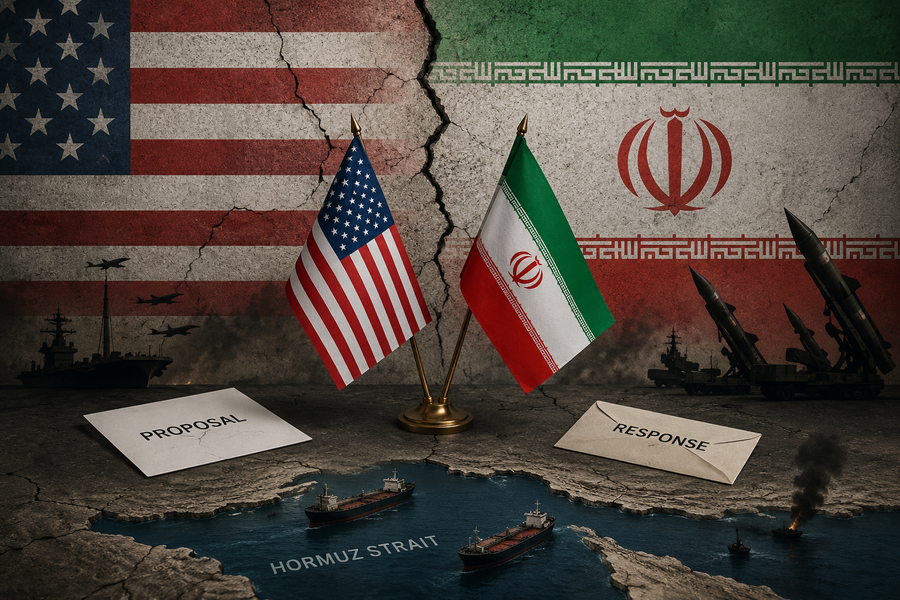
Tehran's main demands are an immediate ceasefire and guaranteeing maritime security in the Strait of Hormuz.
Iran has officially sent the United States its response to the American proposal to stop the war, while Iranian media have revealed details of the conditions and demands that Tehran has presented to Washington as part of the latest diplomatic negotiations.
According to the Iranian state news agency IRNA, the Iranian response was delivered to the Pakistani mediator, who is playing a key role in indirect communications between Tehran and Washington, at a time when tensions in the Middle East remain high.
"The Islamic Republic of Iran's response to the latest text proposed by the United States to end the war was sent to the Pakistani mediator today," IRNA reported.
According to Iranian media, Tehran has placed two main conditions at the center of its diplomatic response. The first demand is related to the "immediate cessation of the war," while the second is related to the "restoration of maritime security" in the Persian Gulf and the strategic Strait of Hormuz.
The ISNA agency reported that the Iranian response focuses exclusively on mechanisms for stopping hostilities and managing the current regional crisis, leaving out, at least at this stage, other political and military issues.
Iranian sources emphasize that Tehran considers security in Hormuz as an essential element for any possible agreement. The Strait of Hormuz remains one of the most strategic energy corridors in the world, as a significant portion of global oil and gas exports pass through it.
Any destabilization in this area has an immediate impact on international energy markets and the global economy. For this reason, Iran's demand for "maritime security" is seen not only as a military issue, but also as a political and economic message to the West and countries in the region.
Pakistan is acting as a conduit between the two sides, while regional diplomacy is trying to avoid further escalation of the conflict. Islamabad's role has become increasingly important following recent tensions in the Persian Gulf and the growing risk of direct confrontation between Iran and the US.
Earlier, the Iranian Foreign Ministry spokesman had stated that Tehran's "observations and considerations" would be communicated only after a full analysis of the American proposal.
On the other hand, Washington continues to publicly state that it prefers a diplomatic solution to the conflict, although it warns that the military option still remains on the table.
US Ambassador to the United Nations, Mike Waltz, stated in an interview with ABC that the US administration is giving "every possible opportunity to diplomacy."
"Negotiations with Iran and diplomacy are ongoing, so we'll see what they offer us," Waltz said.
He added that President Donald Trump is ready to resume military operations if diplomatic efforts fail.
The clarification of Iranian demands comes at a critical moment for the Middle East, as the international community is following with concern diplomatic and military developments that could determine the direction of the conflict in the coming days and weeks./Pamphlet



Kjo po, asht e gje shume e mire. Asnjera pale nuk ka humbe dhe asnjera pale nuk ka fitu. JANE BARAZIM SHBA-IRAN!!!BRAVO Po IZRALESHI ku ne p….l te s’emes do te shkoje?!