


 Shkruar nga Pamfleti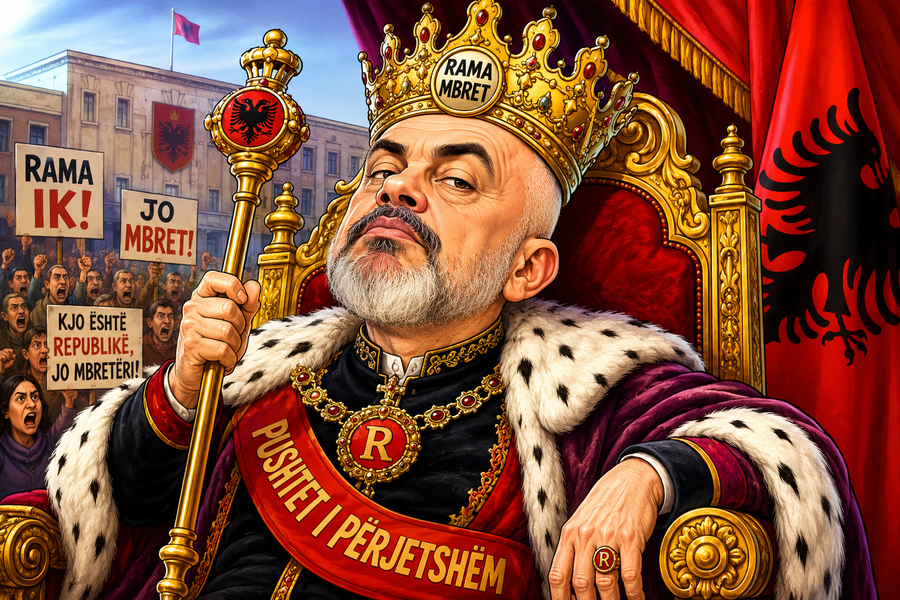
A letter published in the book The Albania Files raises questions that go beyond architecture: is the idea of "Rama the King" a provocation, an irony or a reflection of the ambition of power? Amid the debate about autocracy and the presidential model, the civic revolt of recent weeks is challenging the narrative of eternal power.
When a world-renowned architect writes that the elections would probably be better to be canceled and that, after a fifth term, a prime minister could become "president for life, maybe even king," we are no longer dealing with a passing sentence in an architecture book. We are dealing with a text that deserves to be read carefully.
This is precisely why Reinier de Graaf's letter, published in the book "The Albania Files", cannot pass as a folkloric episode. It raises two possibilities, and both are equally significant.
The first possibility is that the author is serious.
If so, then we are dealing with an alarm bell. An architect who has worked for years in Albania and has seen firsthand how power is constructed, concludes that the stability of the Albanian model is linked to the continuity of a single man. He even goes so far as to suggest canceling the elections and imagining a leader who governs forever.
Such a sentence is not just a provocation. It is a test. A "checkerboard" thrown at public opinion to see how acceptable the idea of permanent power might sound.
But there is also a second possibility.
That Reinier de Graaf used irony.
If so, the irony is even more poignant. Because it does not mock Albanian democracy. It mocks the ambition of power. With the idea that a leader is never satisfied with mandates and always seeks a higher level. From prime minister to president. From president to irreplaceable figure. From political leader to state symbol. Until, in the end, only the metaphor remains: the king.
Modern history has shown that autocrats do not stop on their own.
First they ask for one more mandate. Then they change the institutions. Then they change the constitution. They limit the checks and balances, weaken the parliament, centralize power, and build a system where the state is identified with one person.
It's a model that Europe has already seen.
Viktor Orbán in Hungary.
Aleksandar Vučić in Serbia.
Recep Tayyip Erdogan in Turkey.
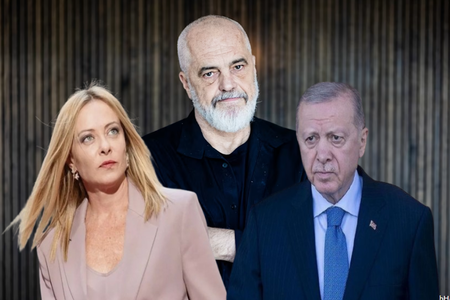
In many analyses and international media, Edi Rama has been involved in the same debate on the concentration of power in the Balkans, alongside these leaders. Not because the systems are identical, but because the question is the same: how far can one man's power extend?
In Albania, this question is not theoretical.
For years, the possibility of Edi Rama following the Serbian model has been discussed. Moving from a parliamentary republic to a system with much greater presidential powers. The idea itself has been constantly discussed in political circles.
Therefore, De Graaf's letter takes on a different meaning.
When he writes about a "lifelong president," he touches on a debate that has existed in Albania for a long time. Even if he wrote it as humor, he touches a real nerve in Albanian politics.
And here the paradox arises.
A book that was supposed to be about architecture, is actually about power.
Because buildings are built.
But regimes are also built.
The cult of the individual is also built.
Even the conviction that without a single person, the state cannot function is being built.
This is why the letter is not only interesting for what it says. It is interesting because it shows how part of the international elite perceives Albania: as a country where development is linked to the continuity of the same leader.
But history has a habit.
The greater the power, the greater the fear of losing it.
And that's where the newest development comes in.
While an international book is throwing out scenarios for Rama as president for life or even "king", the opposite is happening on the streets of Tirana. The civic revolt has entered its 28th day today. Every evening, thousands of citizens take to the streets, not to increase the prime minister's power, but to limit it.
The great irony is that while some imagine a Rama with eternal power, the political reality is going in the opposite direction.
Today, Edi Rama no longer looks like a leader ascending to the throne of a president or a "king." For the first time in many years, he faces a revolt that does not demand another mandate for him, but the end of his political era.
Perhaps this is the best response to Reinier de Graaf's letter.
There are no kings in a democracy.
And when citizens decide to rise up, even autocrats step down from the throne. / Pamphlet


Kjo dihete do behete brete. JANE DY GJERA1PARTIA SOCIALISTEENERIK MEHMETI NAPOLON BREGU .KURSE ME. KETA KA BERE MARVESHJE MARIN MEMA DHE LEGA ZOGU DHEALFRET MOISIU