


 Shkruar nga Pamfleti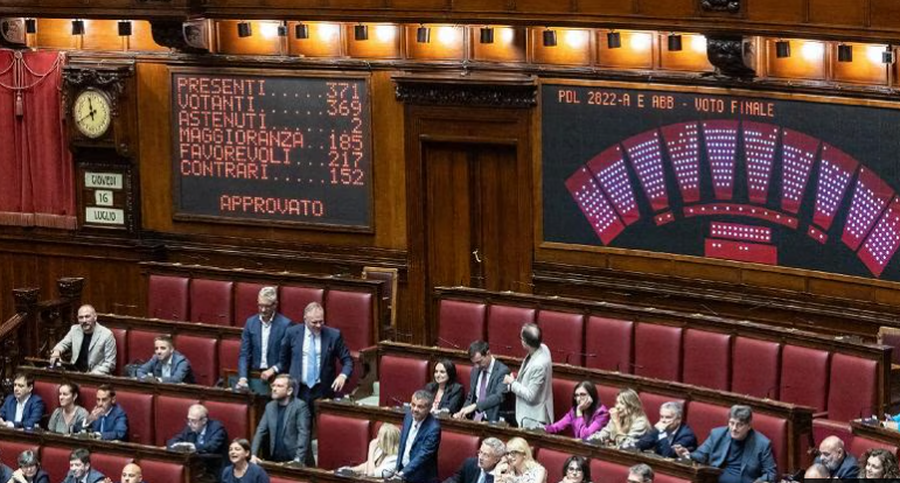
The reform, known as the Bignami law, significantly changes the Italian electoral system less than ten years after the entry into force of the current law, known as the Rosatellum...
The Italian Chamber of Deputies has approved the new electoral law reform with 217 votes in favor, 152 against and 2 abstentions, after a secret ballot. The bill now goes to the Senate for consideration.
The reform, known as the Bignami law, significantly changes the Italian electoral system less than ten years after the entry into force of the current law, known as Rosatellum.
The new system relies on proportional representation, but provides for a majority bonus for the winning list or coalition, if it reaches at least 42% of the votes in both houses of Parliament.
In this case, the winner gains 70 additional seats in the Chamber of Deputies and 35 seats in the Senate. However, the law sets a maximum limit of 220 deputies and 113 senators for the winning majority. If this limit is exceeded, the additional seats are subtracted from those won proportionally. This calculation does not include deputies and senators elected in the electoral zone abroad, respectively 8 deputies and 4 senators.
If the winning coalition or list does not reach the 42% threshold, even if this happens only in one of the two chambers, the bonus is not applied in either of them and all mandates are distributed according to the proportional system.
-Single-member districts and preferential votes are abolished.
The reform abolishes single-member constituencies and eliminates preferential voting. Voters will only have closed lists on the ballot, with no option to choose individual candidates.
Each list can present up to six candidates, while in the case of a coalition there will also be a joint list for the majority bonus. The composition of this list will be determined by the internal agreements of the coalition parties.
A majority amendment that would have allowed voters to choose three candidates from a list of six names in addition to the main candidate blocked was defeated during a secret ballot in the Chamber of Deputies. However, the issue could be brought back up for consideration in the Senate.
-Election threshold and measures against fragmentation
The law maintains the 10% threshold for coalitions and 3% for individual parties, with the exception of the first party below the threshold within a coalition, which can benefit from re-election rules.
Also, votes from affiliated parties that do not reach the 3% threshold and are not the largest losing list will not be counted in the coalition's national result. This provision aims to limit political fragmentation.
-Candidate for Prime Minister
Political parties will be required to indicate in their election programs the name of the candidate for prime minister. In the case of a coalition, the candidate must be the same for all participating parties.
However, the name of the candidate for prime minister will not appear on the ballot. His failure to appear in the election program will lead to the inadmissibility of the list, just as in the case where the election program is not presented.
The law emphasizes that this provision respects the constitutional powers of the President of the Republic to appoint the Prime Minister and the principle according to which deputies and senators exercise their mandate without political obligation.
-New rules for candidacies
The draft law requires parties to submit lists in at least one-third of the electoral districts to participate in the elections. Additionally, candidates included in the majority bonus lists must also run in at least one multi-member district of the same electoral district.
-Collection of signatures
Parties that had a parliamentary group in at least one of the two chambers of Parliament by 31 December 2025 are exempt from the obligation to collect signatures. This provision favors the parties Azione, Alleanza Verdi e Sinistra (Avs) and Noi Moderati, while excluding Roberto Vannacci's Futuro Nazionale, Più Europa and Luigi Marattin's Liberal Democratic Party. A proposal to allow electronic signature collection, following the referendum model, was rejected.
-Changes for Italians abroad
The law obliges the government, within three months of the reform's entry into force, to update the implementing regulations of the Tremaglia Law, with the aim of strengthening the freedom, security and secrecy of voting for Italians living abroad.
The reform also reduces the electoral districts outside Italy. For the Chamber of Deputies they go from four to two – Europe and America, as well as Asia, Oceania and Antarctica – while for the Senate the electoral district outside the country is reduced from four to one.
-Voting of residents outside the residence
The draft law creates a special list of out-of-town voters, which will be maintained by each municipality. Citizens who, for work or study reasons, temporarily reside in another region for at least nine months may request until December 31 to be registered on this list in order to vote in the municipality where they temporarily reside in the following year’s elections. Those who meet the nine-month requirement after this date may submit a request within 30 days of meeting the criteria and no later than 45 days before the elections.
Special rules are also foreseen for citizens who are away from their place of residence for health reasons. Persons receiving medical treatment in another region for at least three months during the period when the elections are held may register on the voter list outside their place of residence up to 45 days before the vote, in order to exercise the right to vote in the municipality where they are temporarily staying.








Lini një Përgjigje