


 Shkruar nga Alison Mutler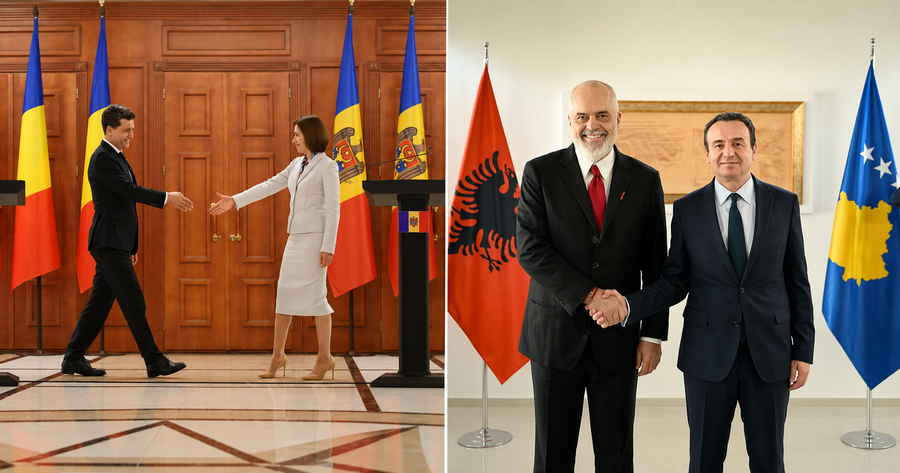
For the first time since Moldova's declaration of independence, reunification with Romania is being openly supported by the leaders of both countries, while public opinion is gradually warming up. The scenario opens up new perspectives in the Balkans, including the reunification of Albania with Kosovo...
The idea, once considered completely unthinkable, is now being actively discussed not only in Chisinau and Bucharest, but also in Brussels, which defends the principle that both nations should decide their own fate.
For Moscow, however, this scenario represents a real geopolitical nightmare. Moldova was part of Romania from 1918 to 1940, when it was annexed by the Soviet Union as a result of Moscow's infamous pact with Nazi Germany, only to declare independence in 1991, with the dissolution of the USSR.
Today, with a population of 2.3 million, Moldova is geographically positioned between Ukraine and Romania - the latter a member of the European Union and NATO.
A possible unification would require referendums in both countries and is significantly complicated by frozen conflicts in the separatist republic of Transnistria and the autonomous region of Gagauzia, which have strong ties to Russia and fiercely oppose the process.
According to Armand Goșu, associate professor at the Faculty of Political Science of the University of Bucharest, this discussion has been reactivated precisely because of the war in Ukraine and the new geopolitical realignment.
Although the chances remain slim, they are real. Tensions have escalated significantly since the large-scale Russian invasion in 2022. Moscow has intensified hybrid warfare and propaganda since Moldova launched formal EU accession negotiations in 2024, opening the first chapter in June in the hope of an accelerated process.
It is worth noting that about 80 percent of the population speaks Romanian - a language that the Soviets deliberately labeled "Moldavian" to erase any sense of a shared history and identity with Romania.
Although direct EU membership remains "Plan A," many believe that the country, which remains one of the poorest in Europe, will find it difficult to survive on its own as a sovereign state and should seriously consider the possibility of merging with Romania, with which it shares the same language, culture, and history.
This has been acknowledged by Moldovan President Maia Sandu herself, saying that it has become extremely difficult for such a small state to maintain democracy and resist Russian aggression without such support.
By 2024, more than 850,000 Moldovan citizens, including President Sandu herself, had obtained Romanian citizenship. Sandu is also the first female leader of the state to publicly declare that in a hypothetical referendum she would vote for unification with Romania, as a quick alternative to European integration.
In the same vein, Moldova's Deputy Prime Minister, Eugen Osmochescu, has suggested the union as a backup plan if the country fails to join the EU by 2028, warning that delays in negotiations would only strengthen Moscow's efforts to undermine public support for the West. He also acknowledged that Moldova is much more vulnerable than Ukraine, lacking both the defense industry and the high military capacity demonstrated by Kiev.
Bucharest-based political scientist Ileana Racheru also emphasizes that the fate of this union depends closely on the end of the war in Ukraine, as if Russia takes control of southern Ukraine and borders Moldova, the authorities in Chisinau will have to choose between a Russian dictatorship and an emergency union with Romania.
On the other hand, Romanian politicians, citing a 2018 declaration by their parliament, have expressed full readiness for this union, with the only condition that it be supported by the majority of Moldovan citizens.
If this unification were to occur, Moldova would automatically become a member of the EU and NATO, following the example of East Germany after the fall of the Berlin Wall in 1990.
Recent polls show overwhelming support among Romanians for this reunification, at 72 percent. While opinions in Moldova are more divided, a historic turn is again being observed: 44 percent of citizens are in favor and 39 percent are against, compared to 21 percent in 2015 when only 21 percent supported the idea.
Support is even higher among the Moldovan diaspora, where about 61 percent are in favor of unification. This reality has alarmed Moscow. Russian Foreign Ministry spokeswoman Maria Zakharova has accused Bucharest of annexation plans.
Although Russia's true intentions were revealed at the beginning of the 2022 invasion, when their plan was to penetrate into Transnistria to deploy Russian troops on the borders of Moldova.
Having failed militarily, the Kremlin launched well-organized campaigns of destabilization and political corruption, especially in the Gagauzia region. Despite this, Brussels is providing extraordinary financial and political support to Chisinau, allocating 1.9 billion euros for the period 2025-2027 and guaranteeing that the Transnistrian issue will not become an obstacle to the country’s integration.
Today, 35 years after Romania became the first state to recognize Moldova’s independence, the early dream of a common identity and state seems closer to realization than ever before.
What about Albania and Kosovo?
If the unification project between Moldova and Romania were to be successfully implemented under the umbrella of the European security architecture, it would serve as a powerful precedent that could create a domino effect throughout the Balkans.
This scenario would demonstrate to the world that the state borders established after the Cold War are not immutable, giving an extraordinary impetus and new legitimacy to the movement for national unification between Albania and Kosovo. However, although the historical aspiration and cultural, linguistic and spiritual ties are indisputable, the path towards such a union in the Albanian space faces much more complex geopolitical and structural challenges.
Unlike the case of Moldova and Romania, where the latter is already a full member of the EU and NATO, the status of Kosovo still remains an unresolved issue internationally.
The main obstacles come from external factors: five EU member states still do not recognize Kosovo's independence, while Kosovo's own Constitution (Article 1.3) expressly prohibits unification with any other state.
Key Western allies, especially the United States and major powers
of the EU, take a firm stance against changing borders in the Western Balkans.
They fear that a formal Albanian unification would open a "Pandora's Box", fueling similar separatist claims in Bosnia and Herzegovina (through Republika Srpska) or North Macedonia, which would risk reigniting armed conflicts in the region.
But beyond international diplomatic walls, an equally great obstacle emanates from within our societies themselves, and specifically from the ruling political elites and their narrow power interests.
For decades, politicians in Tirana and Pristina have used the national unity charter more as patriotic rhetoric for internal electoral consumption, rather than as a genuine state-building project.
In reality, the creation of a common state would require the merger of two bureaucratic apparatuses, two different customs, educational, and fiscal systems, as well as the transfer of exclusive power into the hands of a single central administration.
Many of the current leaders and interest groups that control economic and media monopolies are not willing to sacrifice their local influence and the privileges of sovereign power for the sake of a common Albanian governance.
Under these conditions, the expected scenarios for the future of Albania-Kosovo relations do not foresee an immediate legal or declarative union, but a long process of indirect and functional integration.
The most realistic scenario remains that of "de facto unification" through the creation of a common economic, trade and cultural space, the unification of energy systems and the complete elimination of border barriers.
A formal and full institutional unification of the two states can only become feasible in two extreme circumstances: either through a synchronized integration of Albania and Kosovo within the European Union where physical borders lose their geopolitical meaning, or in the case of a total failure of the current security architecture in the Balkans, which would force Albanians to reorganize for survival as a single state./ CEPA


Nuk ka as bashkime dhe as ndarje pa u dakortësuar Tramp dhe Putin dhe pa u zgjidhur konflikti Rusi- Ukrahinë. Ballkani hynë në radarët e Tramp- Putin vetëm nëse të dy dakortësohen për krjimin e Shqipërisë Natyrale për mos të përdorur termin Shqipëri Etnike. Dhe krijimin e Serbisë së Bashkuar me SRBCKA plus një pjesë të Malit të Zi minus pjesën Shqiptare. Pra, ndarje e Malit të Zi. Ndarje e Maqedonisë së Veriut midis Shqipërisë dhe Bullgarisë. Ndarje e Bosnjë Hercegovinës. Katër Vilajetet e kohës osmane plus dhe minus do jetë pazari ku popujt do shprehen. Në konfigurimin e Ballkanit do kenë rol edhe BE dhe veçanërisht Franca, Gjermania ,Anglia dhe Turqia.Unë besoj se ky rikonfigurim i gadishullit Ballkanik(Ilirik) do ndodh brënda mandatit të Donald Tramp.