


 Shkruar nga Pamfleti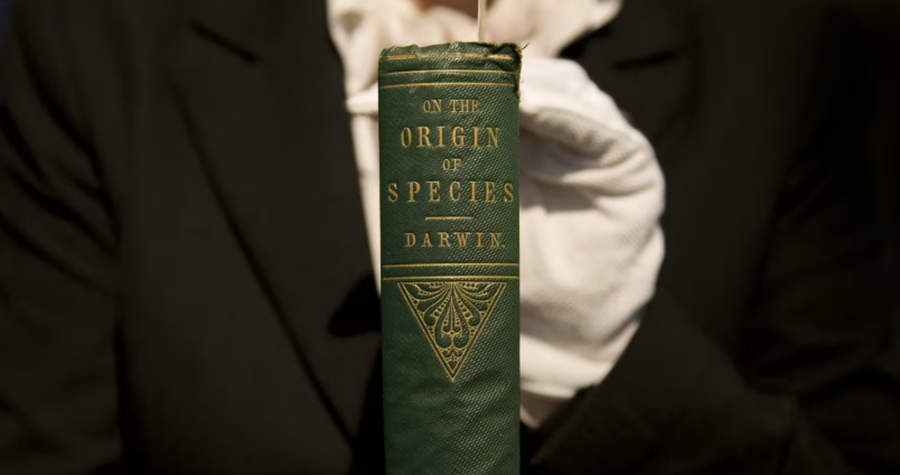
November 24, 1859 - The Theory of Evolution is first published in England
The book "On the Origin of Species by Means of Natural Selection" was a groundbreaking scientific work by British naturalist Charles Darwin. His theory argues that organisms gradually evolve through a process he called "natural selection."
In the process of natural selection, organisms with genetic variations that adapt to their environment tend to reproduce more offspring than organisms of the same species that lack variation, thus affecting the overall genetic makeup of the species.
Darwin, who was influenced by the work of French naturalist Jean-Baptiste de Lamarck and English economist Thomas Malthus, obtained most of the evidence for his theory during a five-year research expedition aboard the HMS Beagle in the 1830s.
Visiting places as diverse as the Galapagos Islands and New Zealand, Darwin accumulated a wealth of knowledge about the flora, fauna, and geology of many territories. This information, along with his studies of variation and interbreeding after his return to England, was invaluable in developing his theory of the evolution of life on Earth.
In fact, this idea was not new. It had been suggested before by others, including Darwin's own grandfather, Erasmus Darwin, himself a prominent English scientist. But also Lamarck, who in the early 19th century drew the first evolutionary diagram, a ladder leading from single-celled organisms to man.
But it was only with Charles Darwin that science presented a practical explanation for the phenomenon of evolution. Darwin had formulated his theory of natural selection as early as 1844, but was cautious and reluctant to reveal his thesis to the public, as it clearly contradicted the biblical account of creation.
In 1858, while Darwin was still silent about his findings, the British naturalist Alfred Russel Wallace independently published a paper that essentially summarized his theory. Darwin and Wallace delivered a joint lecture on evolution to the Society of London in July 1858, as Darwin was preparing his book On the Origin of Species by Means of Natural Selection for publication.
Published on November 24, 1859, the book sold out immediately. Most scientists quickly embraced the theory that solved so many puzzles of biological science. But hard-line Christians condemned the work as heresy.
The controversy over Darwin's ideas deepened with the publication of his next book, The Descent of Man and Selection in Relation to Sex, in 1871, in which he presented evidence for the evolution of man from apes. By the time of Darwin's death in 1882, his theory of evolution had become widely accepted.
In honor of his scientific work, he was buried in Westminster Abbey alongside kings, queens, and other prominent figures of British history. Later developments in genetics and molecular biology brought some modifications to the accepted theory of evolution, but Darwin's ideas remain central to the field.
Other important events
November 24, 380 - Byzantine Emperor Theodosius I makes his adventus, or first official entry into Constantinople, today Istanbul.
November 24, 1639 - English astronomers Jeremiah Horrocks and William Crabtree make the first recorded observations of the trajectory of Venus, accurately predicting its path, based on the methods of Johannes Kepler.
November 24, 1642 - Dutch explorer Abel Tazman becomes the first European to discover Van Diemen's Land (present-day Tasmania).
November 24, 1863 - During the American Civil War, Union troops took control of Mount Lucaute near Chattanooga in a battle known as the "Battle of the Clouds." This victory was a key moment that helped break the Confederate blockade of the city and influenced further developments in the war in the southeastern United States.
November 24, 1947 - The so-called "Hollywood Ten," a group of screenwriters and producers, were charged with insubordination for failing to cooperate with the Committee for Anti-Communist Activities in the Motion Picture Industry. The case deepened political and social tensions in the Cold War-era United States, greatly affecting their careers, but also starting what was denounced by the media as a "witch hunt."
November 24, 1971 - Robber DB Cooper parachuted out of a plane after receiving a $200,000 bounty and was never found. This was one of the most mysterious unsolved crimes in modern U.S. history.
November 24, 1974 - The skeleton of an early human ancestor, named "Lucy," was discovered in Ethiopia, showing that humans had begun to walk upright over 3 million years ago. This discovery was a key moment in the study of human evolution and changed our understanding of the origins of humanity./ Pamphlet








Lini një Përgjigje