


 Shkruar nga Pamfleti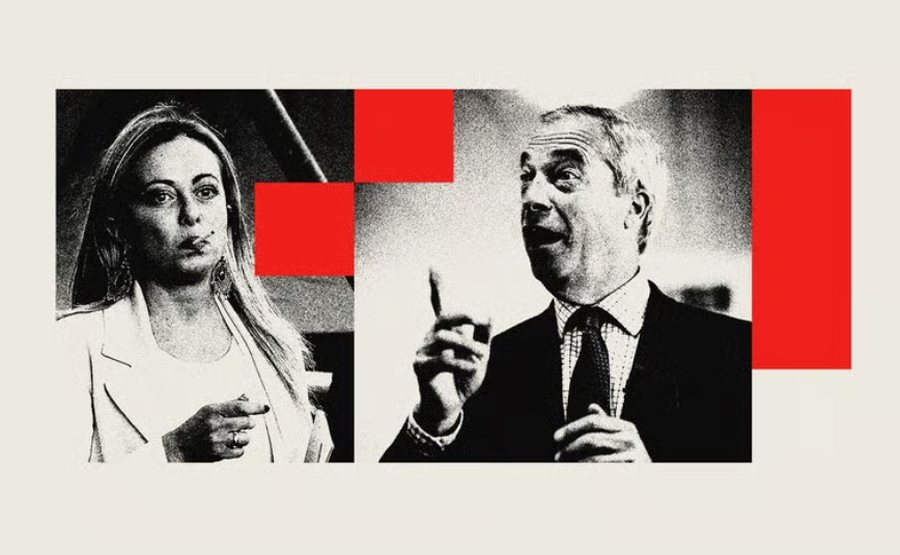
Two right-wing figures using immigration: one with Albania, the other with Brexit!
In London, the Britannia International Hotel, once a popular hangout for businessmen and tourists, has been turned into a shelter for asylum seekers. Its grim appearance, with drawn curtains and entrances blocked by metal barriers, has led many to compare it to a communist-era hotel in Eastern Europe. The irony is obvious, but the British Home Office doesn’t seem to have noticed.
In Italy, Giorgia Meloni would never do such a thing. For her, asylum seekers should be kept "out of sight and out of mind" of the public. For this reason, she created a detention center for immigrants in Albania, a project that is failing, after the Italian judiciary opposed it, but most voters do not seem to mind this detail.
Meloni, leader of the Fratelli d'Italia party, the successor to the neo-fascist MSI movement, has led the party from 4% in 2018 to 26% in the 2022 elections, becoming one of the strongest figures on the populist right in Europe. Although once a Eurosceptic and opponent of sanctions against Russia, as prime minister she has emerged as a reliable ally of the EU and Ukraine, except on one issue: immigration.
In this respect, her stance is very close to that of Nigel Farage, the founder of the Reform UK movement and the symbol of Brexit. Both use harsh language against immigrants to mobilize their electoral base. But the difference is clear: she is in power and he is not.
Farage still sells Brexit with the old slogans of “taking control,” even though the promises of the past have failed. His supporters, between disappointment and nostalgia, believe that “next time it will be different.” He doesn’t need concrete policies, only feelings of anger that sell well with the public.
Meloni, on the other hand, must produce real results. Italy is on the front lines of migration from the Mediterranean; boats arrive every day, detention centers fill up. She must deal with agreements with Tunisia and Libya, with budgets and laws, while keeping the anti-immigration rhetoric alive so as not to lose voters.
At the same time, her government has announced that it will allow half a million foreign workers on temporary visas between 2026 and 2028 to fill labor shortages. Meloni thus walks a fine line between populism and pragmatism, being both critical of immigrants and dependent on them.
Today, Italians talk about "two Meloni":
one, a modern leader who meets world leaders and talks about “European cooperation”;
the other, a fiery politician who talks to voters about “border protection” and “national identity.”
Nigel Farage, on the other hand, remains unchanged, a politician who seeks confrontation, not solutions. He lives off the rhetoric of fear and provocative images, like the infamous rows of immigrants posters during the Brexit campaign.
Meloni tries to turn slogans into concrete policies, sometimes unrealistic but nevertheless workable. Farage, as a "merchant of anger", uses immigration only as a political weapon.
If Farage were to one day come to power, he would have to “melonize” himself: learn to walk the fine line between reality and populism. But for now, she is the acrobat who balances carefully, while he is the knife-thrower who seeks spectacle. / Adapted from “The Economist”




Lini një Përgjigje