


 Shkruar nga Pamfleti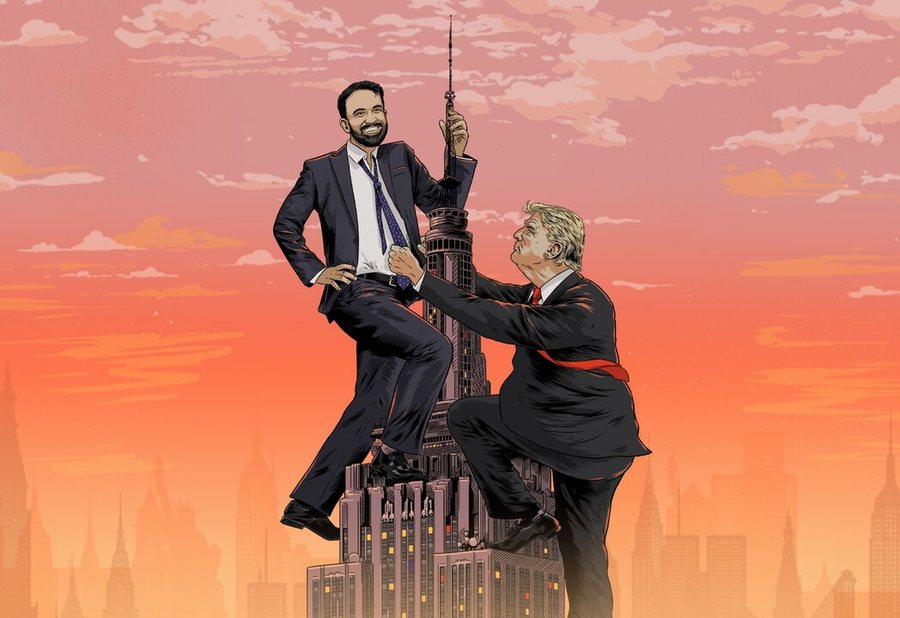
Is New York at risk of a downturn from the Mamdani & Trump war?
Two skilled politicians, but with radical ideas, are preparing to upend the political scene of America's largest city.
On November 4, Zohran Mamdani, a 34-year-old leftist, is expected to easily win the New York mayoral election, promising new social programs that will be funded by taxing the wealthy.
Meanwhile, Donald Trump, the 79-year-old US president, has warned that he will "bring order" to his hometown, threatening to send more federal agents and suspend funding for New York.
Mamdani's plans are considered by analysts to be politically unrealistic, while Trump's pose a direct threat to the city, and perhaps even to the rule of law. The president has talked about expanding his crackdown on immigration, bringing to New York the same aggressive tactics he has used in Chicago and other Democratic-run cities. The clash between these two figures is expected to be dramatic, with New York as both the stage and the victim of the political battle.
New York City has an importance that extends far beyond its borders. It is America's economic engine, with a metropolitan economy worth over $2.3 trillion, more than Canada's, and accounting for about 9% of the national economy. It is the center of finance, professional services, media, and increasingly, technology and medical research.
Politically, the city is an irreplaceable center of influence. Although Manhattan remains a Democratic stronghold, its donors contribute more to federal campaigns than any other city after Washington. The White House, for the first time since Franklin D. Roosevelt, is run by a network of figures originally from New York, including Trump himself, his peace envoy Steve Witkoff, and Commerce Secretary Howard Lutnick. Chuck Schumer and Hakeem Jeffries, also from New York, lead the Democrats in the Senate and the House of Representatives.
But New York’s economic model is fracturing. The top 1 percent of its citizens collect more than 40 percent of its income tax revenue, while many of the wealthy are leaving and high-paying jobs are shrinking. Meanwhile, life for ordinary citizens has become unaffordable: median rents are more than double the national average; the price of child care has reached $26,000 a year, 40 percent more than five years ago. With this fragile tax base, New York State will struggle to maintain social and educational programs, which cost 72 percent more per capita than Texas.
In the collective memory, the last effective mayor remains Michael Bloomberg, technocratic and capable, but without political charisma. Today, citizens are looking for something else, politics with emotion and popular language. Trump received a higher percentage of the vote in the last election than any other Republican in decades, while Mamdani, with his communication skills and “anti-establishment” tone, won convincingly against former governor Andrew Cuomo in the Democratic primaries. His criticism of Israel would once have disqualified him, today they give him an image of authenticity for many voters.
But both, observers say, risk making the city worse. Mamdani promises free childcare, free public transportation, a $30-an-hour minimum wage by 2030, and a four-year rent freeze for 2 million residents. The goal of making the city more affordable is laudable, but his means are economically damaging. Free transportation would lead to worse service; high wages would scare off employers; freezing rents for some would raise costs for others.
To fund these programs, Mamdani would have to work with the state to raise taxes on the wealthy, which would accelerate their departure and could send the city into a self-destructive fiscal spiral. Meanwhile, the real problems—bloated bureaucracy, public unions, and excessive regulations—would remain untouched.
Trump represents a more direct and authoritarian risk. He has threatened to withhold federal funding that makes up 6.4% of New York City’s budget. Legally, he cannot do so without congressional approval, but he has shown that he is not averse to acting outside the law, as he did by freezing $18 billion in infrastructure funding during the government shutdown. A new crackdown on immigrants could spark unrest and give him justification to send the National Guard into the city’s streets.
While Mamdani's victory seems certain, he is trying to tone down his tone and appear more moderate. New York must hope that this is not just an electoral tactic and that Trump will realize that clashing with his city could cost him more than he will gain.
In the end, New York and the US would have more to gain if the city became a laboratory for pragmatic politics, not left-wing extremism or right-wing authoritarianism. In such a complex metropolis, only a wise leader can unleash urban development, simplify rules, and foster new opportunities: from public transportation to education.
The fear is that New York is becoming the arena of a clash between two men with bad ideas. /Adapted from “ The Economist ”



Nuk fiton me e djadha por emajta.