


 Shkruar nga Pamfleti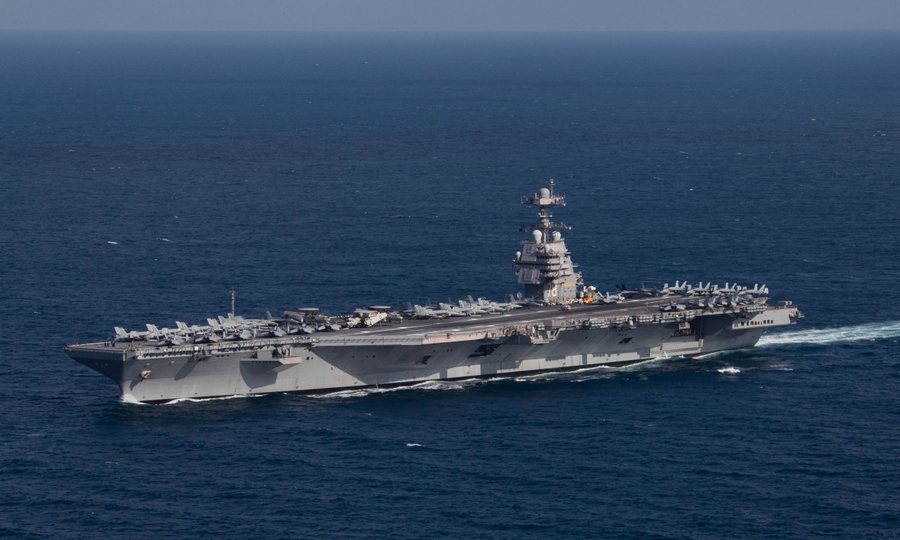
The US fleet under the command of the aircraft carrier "Gerald R. Ford" is rapidly crossing the Atlantic, having sailed from Split in the Adriatic towards Venezuela.
Within the next week, it is expected to arrive in Caribbean waters, where the concentration of the strongest military force deployed in the region since the Cuban Missile Crisis in 1961 will be completed.
According to the Wall Street Journal, the American deployment includes fifty Ford fighter jets, ten F-35 jets, and a squadron of Reaper drones in Puerto Rico.
Fifteen warships operate with them, including cruisers, destroyers, and a nuclear-powered submarine with an arsenal of over 200 cruise missiles, as well as a force of 2,200 marines with their assault vehicles.
Alongside them is the MV Ocean Trader, which outwardly resembles a civilian ship but acts as a floating base for 159 elite commandos specially trained for operations in South America. The concentration of this force is already considered many times larger than that mobilized for the Cuban Missile Crisis, according to La Repubblica.
Washington has already closed the airspace over Puerto Rico, where the Pentagon's operations center for the region is located. Despite favorable weather after Hurricane Melissa, staff are recommending waiting until mid-November before any offensive action.
The Wall Street Journal reveals that the US military has already presented the White House with lists of targets and a plan for a long military campaign. The first phase will target airports and military ports that, according to US intelligence, are used by drug cartels under the protection of the Maduro regime. As US Secretary of State Marco Rubio stated, "Venezuela is a narco-state, run by cartels. This is an operation against narco-terrorists, the Al Qaeda of the Western Hemisphere."
Nicolas Maduro, who has been formally charged by the US Department of Justice with narcoterrorism since Trump's first presidency, now sees his bounty increase to $50 million. The recent US bombings of 15 ships suspected of belonging to drug traffickers, with 61 unidentified dead, are already causing reactions regarding their legality and morality. The commander of the Southern Command, Admiral Alvin Holsey, submitted his resignation in defiance of the White House's strategy.
The information indicates that the CIA has been given complete operational freedom on Venezuelan soil, seeking to provoke a rebellion within the army or even the arrest of Maduro himself. The flights of B-1 and B-52 bombers that reach the borders of Caracas are aimed at increasing pressure and accelerating the overthrow of the regime without direct involvement in the war.
Maduro's military has few tools to resist: Russian S-300 air defense systems, Su-30 fighter jets, and a few long-range drones. Venezuela is turning to Iran for passive radars and electronic countermeasures systems, while asking Moscow to upgrade its Sukhoi and provide new missiles. However, Russia is unlikely to provide the critical air defense units it needs on the Ukrainian front.
At the same time, Caracas is also appealing to Beijing, which has every reason to protect its oil imports. However, neither China nor Russia is expected to confront Washington directly - although the fate of the Maduro regime remains closely tied to their strategic interests.
When a reporter asked him on Air Force One on Friday if he was considering attacking Venezuela, U.S. President Donald Trump replied “No.” Just hours earlier, The Miami Herald had claimed that such an attack was imminent.
"Your 'sources' who claim to have 'knowledge of the situation' have misled you and led you to write a false article," Secretary of State Marco Rubio responded on his X account. Despite these denials, tensions remained high.



Lini një Përgjigje