


 Shkruar nga Pamfleti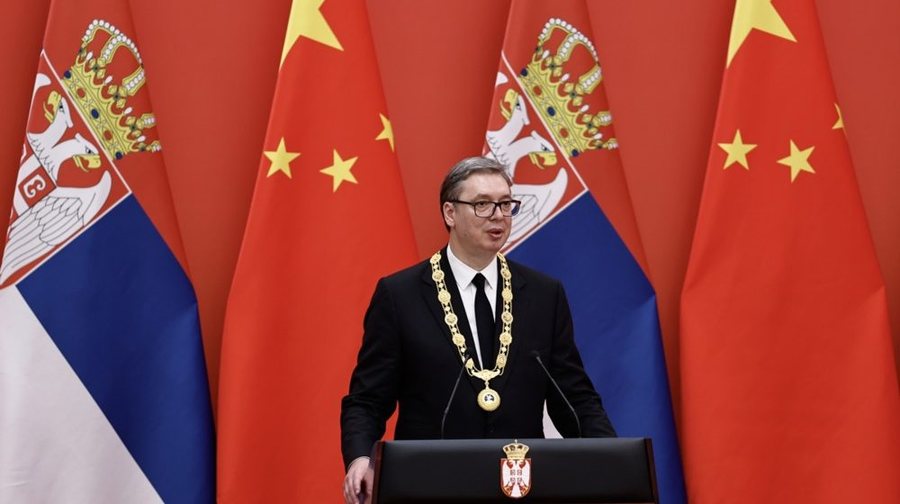
The Russian portal Ridus writes that Russia has lost its position as Belgrade's main military supplier, while China has taken its place with the most modern air defense systems.
Vučić's dealings with China have angered Moscow.
Russian media outlet Ridus has published a critical analysis of Serbia's changing course of military policy, emphasizing that Belgrade is increasingly moving away from Russian weaponry and relying on China for the modernization of its armed forces.
According to the portal, the period 2016–2021 was the "golden age" of military-technical cooperation between Russia and Serbia. During these years, Moscow supplied Belgrade with MiG-29 fighter jets, Mi-35M and Mi-17V-5 helicopters, Pantsir-S1 anti-aircraft systems, T-72MS tanks and BRDM-2MS armored vehicles. At that time, Russia covered over 30% of Serbian arms imports.
However, according to Ridus, the situation changed significantly after 2022. Western sanctions against the Russian military industry made supplies and contract implementation difficult, while Serbia began to diversify its armament sources to avoid the risk of secondary sanctions from the United States and the European Union.
The article emphasizes that China has now become the main supplier of weapons to Serbia. According to data published by Russian media, by 2025–2026, Russia's share in Serbian military imports has dropped to only 7%, while China has reached 61%. In second place is France, with 12%, after the agreement for the purchase of Rafale fighter jets.
According to the analysis, the symbol of this strategic shift is President Aleksandar Vučić's decision to purchase the Chinese long-range air defense system HQ-9. Ridus calls this a radical change in the organization of Serbian air defense, emphasizing that Serbia will become the first European operator of this modern Chinese system.
Russian media notes that Belgrade has gradually built an air defense network based almost entirely on Chinese technology. Before the HQ-9, Serbia had purchased the FK-3 and HQ-17A systems, as well as the CH-92A and CH-95 combat drones.
According to Ridus, this development shows that China is taking the place that Russia had for decades in supplying the Serbian military with modern weapons systems.
The analysis also cites Russian media outlet Insajder, which says that Serbia is currently the only European country to buy weapons from China. Cooperation between the two countries has also expanded into joint military exercises, while bilateral trade has increased significantly in recent years.
The article also highlights that Belgrade's Western partners view with concern the expansion of Chinese influence in the Balkans, raising questions about the transparency of projects, the level of Serbia's debt to Chinese financial institutions, and the increase in military cooperation between Beijing and Belgrade.






Hajde loje kurvash hajde!