


 Shkruar nga Pamfleti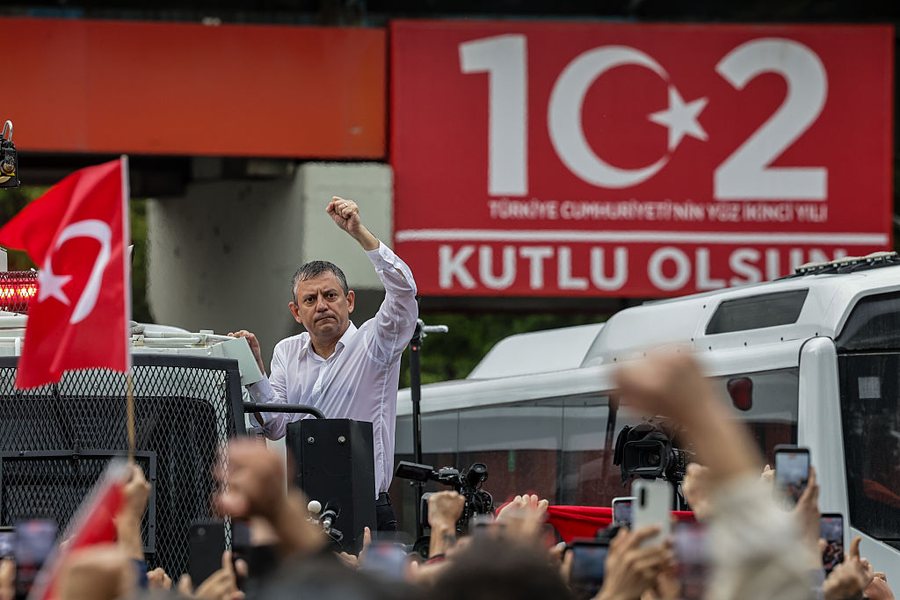
The CHP claims that judicial interventions against the party aim to weaken the opposition and create conditions for the Turkish president to run for another term...
Turkey's main opposition party, the Republican People's Party (CHP), is expressing concern that President Recep Tayyip Erdogan is preparing the ground for early elections, which would allow him to bypass constitutional restrictions and seek another presidential term.
CHP sources told Euractiv that judicial interference in the party's internal processes is part of a broader strategy by Erdogan to weaken the opposition and create the conditions for early elections.
"This is a very strong signal that Erdogan is aiming for early elections. He is paralyzing the main opposition," senior CHP figures declared.
The Turkish political scene has been gripped by tension since a court ruling on May 21 reinstated former presidential candidate Kemal Kilicdaroglu as leader of the CHP. The opposition party, affiliated with the Party of European Socialists, advocates a secular model of the state and opposes President Erdogan's conservative religious orientation.
The CHP argues that the court decision is politically motivated and was taken under pressure from the president and his ruling party, the AKP, with the aim of weakening the opposition.
At the CHP congress in November 2023, Ozgur Ozel had won the party leadership race against Kılıçdaroğlu, following the latter's loss to Erdoğan in the May 2023 presidential election. However, a court in Ankara later annulled the congress and restored Kılıçdaroğlu to the party leadership.
In March 2025, Istanbul Mayor and CHP presidential candidate Ekrem İmamoğlu was arrested, sparking massive protests across the country. The prosecution has sought a total sentence of 2,430 years in prison for him on charges that include “establishing a criminal organization.”
Kilicdaroglu said this week that the party would hold a congress to meet legal requirements and avoid internal divisions. After Özel and other CHP leaders refused to hand over the party's headquarters in Ankara, police raided the building. The European Union responded to the developments by stating that "the political opposition must be free to act, organize and participate in the political process without fear of repression."
The debate over constitutional restrictions
According to the opposition, the measures taken against the CHP show Erdogan's concern about the political situation. According to the regular election calendar, parliamentary and presidential elections in Turkey are due to be held by May 2028. The Turkish constitution does not allow Erdogan to run for a third presidential term unless the constitution is amended or early elections are called.
The latter requires the approval of the Turkish Parliament with at least 360 votes in the 600-seat Assembly, which means the president would also need support from the opposition. There is speculation in Ankara that the AKP could manage to secure the necessary votes.
Recent polls show the CHP enjoying a slight advantage over the ruling AKP, while the opposition believes this gap could widen. One of the main reasons is the economic situation, as the Turkish central government's budget deficit reached 338.7 billion Turkish liras (about 6.3 billion euros) in April 2026, almost twice as high as a year earlier.
CHP representatives argue that fiscal difficulties limit the government's ability to increase public spending before the elections.
At the same time, the opposition is concerned that the European Union may tolerate Erdoğan's actions for strategic reasons. While European Commission President Ursula von der Leyen included Turkey in April among countries exerting negative influence, some member states, such as Spain and Belgium, consider Ankara an important partner for the European defense architecture.
Erdogan is expected to host the NATO summit in July.
"The leaders will come to Ankara in July, shake hands and not say a word about these developments," a CHP source said. /Adapted from Pamphlet /




Lini një Përgjigje