


 Shkruar nga Pamfleti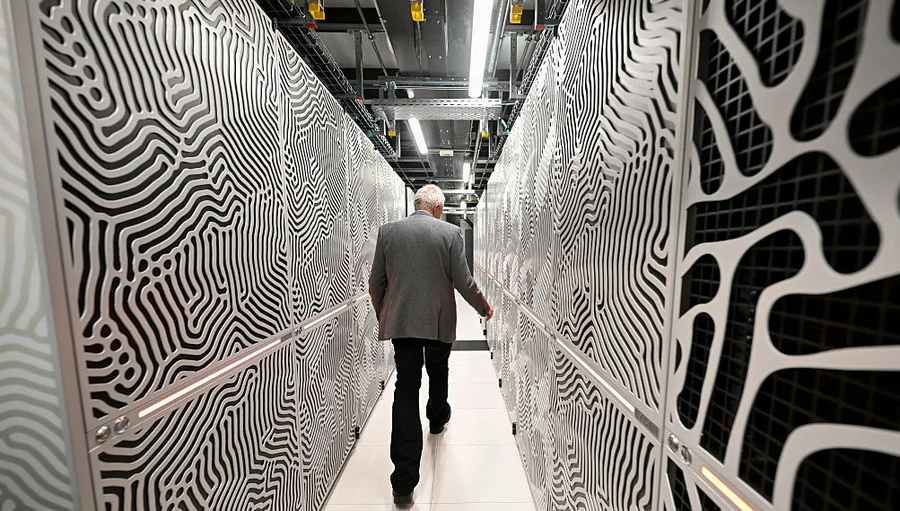
"Coatlicue" could be included in the list of the 10 most powerful supercomputers in the world, a ranking currently dominated by the United States, Europe and Japan.
Mexico recently announced that it will design “Coatlicu,” a new supercomputer capable of 314 petaflops, or the equivalent of 314 thousand trillion operations per second. The infrastructure, which is due to be completed in 2028, aims to become the most powerful computing center in Latin America.
Not only that, "Coatlicue" could be included in the list of the 10 most powerful supercomputers in the world, a ranking currently dominated by the United States, Europe and Japan. Here is the current ranking:
10. Leonardo (Italy)
Italy inaugurated Leonardo in 2022. The system reaches a capacity of 241 petaflops per second thanks to 1.8 million cores, distributed over a physical space of approximately 900 square meters. It requires 7,494 kilowatts of energy to operate. Leonardo processes data for medical, climate, economic and astrophysical applications.
9. River (Finland)
The River (Large Unified Modern Infrastructure) went into operation in 2022 in Finland, on the site of a former paper mill. Developed by the EuroHPC consortium, it achieved a performance of 379.7 petaflops per second and consumes 7,107 kilowatts of energy, supplied exclusively by a hydroelectric power plant.
The project focuses on sustainability and energy efficiency. The river has already created a digital twin of our planet, and generates highly accurate climate forecasts every year.
8. Alps (Switzerland)
Alps is one of the newest supercomputers. In operation since 2024 at the Swiss National Supercomputer Center, it achieves a performance of 434.9 petaflops per second thanks to 2.1 million cores distributed across 4 data centers.
It requires 7,124 kilowatts of power to operate. The system generates climate forecasts, trains artificial intelligence models. Meanwhile, part of its capacity is used for general scientific research.
7. Fugaku (Japan)
The Fugaku supercomputer is located at the Riken Center for Computer Science.
in Japan. Opened in 2020, it reaches a peak performance of 442 petaflops per second and consumes 29,899 kilowatts of energy.
It uses 7.6 million cores distributed across 158,976 interconnected CPUs. Researchers have used Fugaku to model proteins related to the study of Covid-19, to simulate earthquakes and tsunamis, and to train artificial intelligence systems. Fugaku is also the author of one of the most detailed representations of the cerebral cortex ever created.
6. HPC6 (Italy)
HPC6 is the supercomputer of the energy giant ENI in Italy. The system reaches a maximum speed of 477.9 petaflops per second, with operations distributed across 3.1 million cores. Its power consumption reaches 8,461 kilowatt-hours. HPC6 is used for energy resource exploration, biofuel optimization and nuclear fusion research.
5. Eagle (United States)
Microsoft's supercomputer, Eagle, debuted in 2023. According to the latest data, it reached a peak performance of 561 petaflops per second. Its unique feature is that it is a virtual supercomputer, created from several Microsoft data centers connected via the company's 'Icloud' service.
Its performance is scalable and increases with the addition of new server clusters. Eagle has been used to train artificial intelligence models such as GPT, but is primarily intended for commercial use.
4. Jupiter Booster (Germany)
With the German Jupiter, supercomputers officially entered the exaflop scale, 10 to the 18th power or 1 quintillion operations per second. At its peak capacity, the system reached one exaflop, with a power consumption of 15,794 kilowatts.
It occupies an area comparable to half a football field and is designed with a modular architecture. Today, Jupiter Booster trains large-scale artificial intelligence models, generates simulations of the Earth, produces digital twins of human organs and helps study particle physics.
3. Aurora (United States)
Aurora is the supercomputer of Argonne National Laboratory, part of the U.S. Department of Energy. With a processing power of 1.012 exaflops per second, it ranks among the most powerful supercomputers in the world.
Its power requirement is also impressive: 38,698 kilowatts. Aurora is used to analyze new materials, process biomedical data, optimize clean energy technologies, and model future scenarios related to climate change.
2. Frontier (United States)
Frontier is one of the most cited supercomputers when it comes to breakthroughs in fields such as astronomy, artificial intelligence, and medicine. Developed by the US government, it reaches a maximum speed of 1.35 exaflops per second, using 9 million cores. It occupies an area of approximately 7,000 square meters, distributed across 74 units.
1. El Capitan (United States)
El Capitan is officially the most powerful supercomputer in existence today.
It has 11.3 million cores, and in its latest test, it achieved a performance of 1.8 exaflops, with a potential maximum of 2.8 exaflops per second. Inaugurated on January 9, 2025, its main goal for the time being is to analyze the nuclear potential of the United States./ Adapted Pamphlet








Lini një Përgjigje