


 Shkruar nga Pamfleti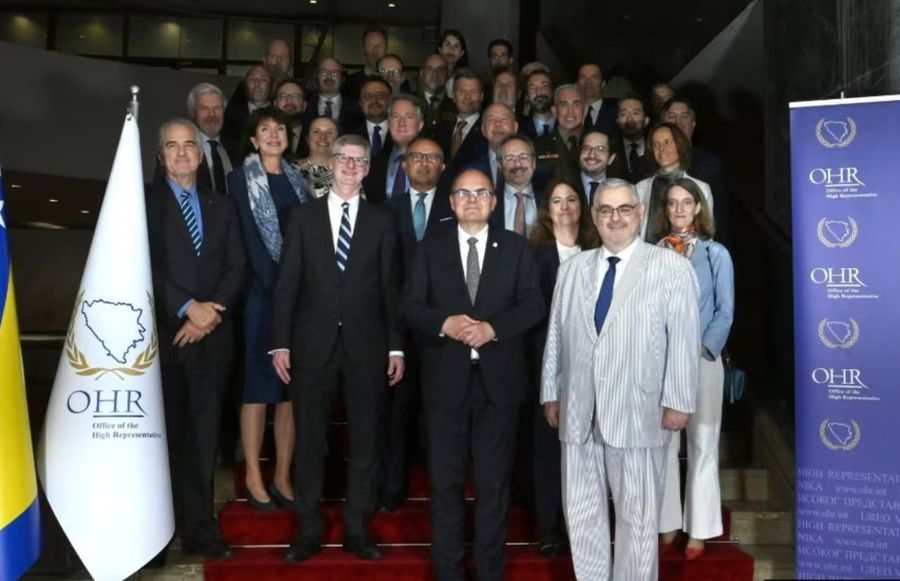
The Peace Implementation Council in Bosnia and Herzegovina (PIC) failed to reach an agreement on the election of a new high representative in Bosnia at a meeting held in Sarajevo on Thursday.
However, the outgoing High Representative in Bosnia, Christian Schmidt, said in a video address that a general consensus has been reached on the importance of the Office of the High Representative (OHR).
"These consultations will continue throughout June and all participants hope that the candidate for this position will be selected by consensus in the coming days, with the aim of handing over the task by June 30 ," he said.
According to him, the elected candidate will support the implementation of the Dayton Peace Agreement and will provide assistance to the Bosnian authorities in implementing reforms, namely the "5+2" program, which obliges the authorities to resolve the issue of the division of state and military property, implement the final decision on the Brcko District, ensure the fiscal sustainability of the state and strengthen the rule of law.
Among the conditions are also the signing of the Stabilization and Association Agreement (SAA) and a positive assessment of the political situation in the country by the Peace Implementation Council.
So far, two conditions have been met: the SAA was signed in 2008, while the status of the Brcko District was determined by constitutional amendment a year later. The other conditions have been only partially met or have not yet been realized.
" I hope to hand over the task to the newly appointed High Representative for Bosnia and Herzegovina in the coming weeks," Schmidt said.
Schmidt had announced in April that he would step down from the position he has held for five years, but only after his successor was elected, "due to the need to maintain institutional continuity" before Bosnia's general elections, scheduled for October.
Who are the candidates for the new High Representative?
Among the most mentioned candidates is Antonio Zanardi Landi, a 76-year-old Italian diplomat who has been Italy's ambassador to Russia, as well as to Serbia and Montenegro.
His appointment is supported by the United States.
Another candidate is Rene Troccaz, currently France's special envoy for the Western Balkans, who enjoys the support of France and several other countries.
Great Britain, France and Germany want to maintain the current model, which gives the high representative powers to impose laws and dismiss elected officials in the event of political or institutional blockades or violations of the Dayton Agreement.
On the other hand, the administration in Washington supports the gradual reduction of the OHR's interventionist role and greater reliance on local institutions and politicians.
What is the role of the High Representative in Bosnia?
The position of High Representative, with the status of a diplomatic mission in Bosnia, was established in accordance with the General Framework Agreement for Peace in Bosnia, known as the Dayton Peace Agreement, reached on 21 November 1995 at the US military base in Dayton and signed on 14 December 1995 in Paris. Specifically, he is defined by Annex 10 of the agreement, with the task of overseeing its implementation.
The OHR has the authority for the “final interpretation” of the agreement on civilian peace implementation.
As of July 2020, 13 foreign nationals work at the OHR, including four diplomats appointed by their governments, as well as 76 local staff members.
All eight high representatives to date have been European diplomats, while all 12 first deputies have been American diplomats.
Funding for the OHR is provided by the Peace Implementation Council (PIC).
What is the PIC?
In the time between the initiative for the Dayton Agreement on 21 November 1995 and its signing in Paris on 14 December 1995, the Peace Implementation Conference was held in London on 8 and 9 December 1995, where the Peace Implementation Council in Bosnia (PIC) was established.
The PIC is composed of 55 states, including the US, Russia, Ukraine, Saudi Arabia, Morocco and Albania, as well as various international organizations such as the International Monetary Fund (IMF), the Council of Europe, the International Committee of the Red Cross and the former International Criminal Tribunal for the former Yugoslavia (ICTY), which closed on 31 December 2017.
The London Conference also established the PIC Steering Board, which operates under the chairmanship of the High Representative, designated as the “executive arm” of the PIC.
The work of the PIC is attended by the US, the European Union, the UK, Germany, France, Japan and Canada, as well as Turkey, which represents the countries of the Organisation of Islamic Cooperation (OIC), along with several other European countries.
Russia suspended its membership in the PIC in 2022 and is demanding the closure of the OHR, a position also supported by China, as well as political representatives of the Republika Srpska entity and partly by the Federation of Bosnia and Herzegovina.
The head of the OHR cannot make decisions if the member countries of the PIC Steering Board do not agree with them.
The Steering Board of the Peace Implementation Council (PIC) appoints the new High Representative, while his appointment is immediately confirmed by the UN Security Council./ REL


Lini një Përgjigje