


 Shkruar nga Pamfleti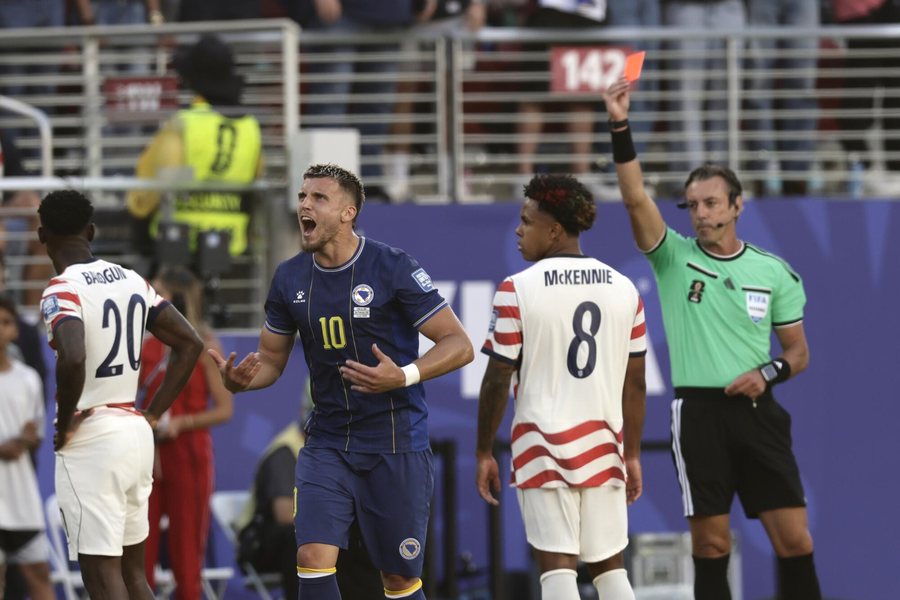
The United States' 2026 World Cup campaign took an unexpected turn after FIFA suspended striker Folarin Balogun's red card, clearing the way for his inclusion in the round of 16 match against Belgium.
The decision was made public after US President Donald Trump asked FIFA President Gianni Infantino to review the case. Balogun was sent off in the 2-0 win over Bosnia and Herzegovina, which under the rules carries an automatic one-match suspension.
The 25-year-old Monaco striker is the USA's top scorer at this World Cup with three goals.
Why was Balogun punished?
Balogun was sent off after stepping on Bosnian defender Tarik Muharemović's ankle during a duel for the ball. The referee made the decision after a VAR review.
USA coach Mauricio Pochettino said the tackle did not warrant a red card. Balogun himself said a yellow card would have been a fairer decision.
Public opinion remained divided: some considered the punishment fair, while others argued that the contact was accidental and not a deliberate intervention.
How did FIFA justify the decision?
FIFA relied on article 27 of the Disciplinary Code, which gives the disciplinary body the right to suspend the application of a punitive measure, placing the player on a probationary period of one to four years.
The U.S. Soccer Federation did not make Balogun available to the media following the decision. The player reacted only on social media, posting a photo with fans, accompanied by the song "Bad" by Michael Jackson.
Has it happened before?
According to reports, this is the first time since the 1962 World Cup that a red card at the World Cup has not been accompanied by a suspension.
The last case was that of Brazilian legend Garrincha at the World Cup in Chile, when the regulations did not provide for automatic suspension and the disciplinary committee decided to let him play in the final.
Later, FIFA has partially suspended other punishments, such as in the case of Cristiano Ronaldo before the 2026 World Cup, while in other cases, such as that of Qatari midfielder Assim Madibo, it has imposed even longer suspensions.
Harsh reactions
FIFA's decision has sparked strong reactions in the football world. The Royal Belgian Football Federation said it was "surprised" and announced it was considering all legal options to challenge the decision.
Belgium coach Rudi Garcia also mocked FIFA, saying that "it seemed like July 5 had become April 1," adding that the Belgian federation is defending the integrity of football and not just the interests of the national team.
UEFA reacted with a strong statement, calling the decision "unprecedented, incomprehensible and unjustifiable", while stressing that a "red line" had been crossed.
Former FIFA president Sepp Blatter also appeared critical of FIFA.
"Red cards are not overturned by political phone calls. They are overturned by rules, evidence and independent bodies," he wrote on the X network.
Even famous coaches and former football players expressed concern about the precedent this decision creates.
England manager Thomas Tuchel said that while he believes Balogun did not deserve a red card, the main question is who has the authority to overturn a decision made after a VAR review.
"Where does this begin and end? What happens to other cards in the future?" he stated.
Former footballers Ian Wright and Roy Keane called the decision unfair and warned that it could damage the tournament's credibility.
Donald Trump's role
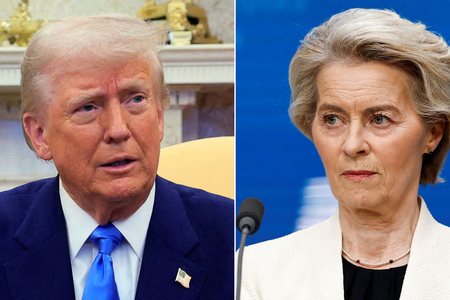
According to the Associated Press, Trump called FIFA president Gianni Infantino immediately after the match and demanded a review of the red card.
Following FIFA's decision, the US president wrote on social media: "Thank you FIFA for doing what was right and correcting a great injustice."
Coach Mauricio Pochettino also supported the decision, arguing that the US team had been punished enough by playing with one fewer player for 30 minutes against Bosnia and Herzegovina.
What do critics say about the regulation?
The Belgian federation argues that FIFA has violated its own rules. According to article 66.4 of the FIFA Disciplinary Code and article 10.5 of the 2026 World Cup Regulations, a red card automatically leads to a suspension for the next match.
Even FIFA Circular No. 16 for the 2026 World Cup confirms that a one-match suspension is mandatory after a red card.
However, FIFA has relied on Article 27 of the Disciplinary Code, which allows for the suspension of the application of a disciplinary measure in certain circumstances. It is the interpretation of this article that has become the center of debate that is expected to continue even after the conclusion of the USA-Belgium match. / Adapted from "Al Jazeera"




Lini një Përgjigje