


 Shkruar nga Pamfleti
Diego Garcia in the Indian Ocean is about 4,000 kilometers from Iran. The attempted missile strike has raised alarm about the country's missile power and increased fears that it could target large parts of Europe - theoretically including Kosovo.
The missiles were launched on March 20 towards a US and UK military base - one failed, while the other crashed. The one that managed to fly traveled about 3,000 kilometers from the launch base.
The Israeli military said Iran has launched long-range ballistic missiles towards a US target, demonstrating a range of around 4,000 kilometers - enough to target European capitals.
"These missiles are not intended to hit Israel. Their range reaches European capitals. Berlin, Paris and Rome are within the range of direct threat ," said Israeli army chief Eyal Zamir.
The Washington-based Institute for the Study of War (ISW) estimated that this was Iran's most distant attempt ever to strike a missile target.
"The attack showed that Iranian missiles can reach beyond the 2,000-kilometer limit, which the regime has long said it has set itself as a limit... The attempted attack overturns some of the assumptions about Iran's missile program, particularly regarding the threat it could pose to Europe," according to ISW.

Until now, it was believed that Iran did not have the capacity to strike at such distances, while the regime itself claimed to have set that 2,000-kilometer limit in its ballistic missile program.
According to US intelligence estimates, Iran possesses about 14 different types of such missiles - equipped with nuclear or conventional warheads.
Contacted by Radio Free Europe, NATO did not comment on the attacks on Diego Garcia and Iran's missile capabilities, referring only to its previous statement on the occasion when Turkey successfully intercepted similar attacks from Iran.
As Iran's missile capabilities continue to be scrutinized, an EU official told RFE/RL, speaking on condition of anonymity, that this is a new dimension of the war with Iran and that the continent's air defenses - four years after the start of the war in Ukraine - are severely depleted. So far, the EU has allocated more than 70 billion euros in military aid to Ukraine to fight the Russian invasion.
Mark Cancian, a retired US Navy colonel and currently a senior advisor at the Center for Strategic and International Studies in Washington, considers the threat to Europe to be "very real."
He said that based on the demonstrated range of past missile launches, Iran could strike parts of southeastern Europe. He said the United States and NATO have long anticipated this risk and have built defense systems in Poland and Romania, but warned that Europe is not yet fully prepared.
" ... because the threat is relatively new. The first steps to defend against Iran have been taken, while capacities are being developed in the east to defend against Russian missiles and drones. Poland has built a very powerful army and air defense system, while similar steps are being taken by the Baltic states ," Cancian tells Radio Free Europe 's Expose program .
More skeptical about Iran's capabilities to directly strike Europe is Gordan Akrap, a former official in the Croatian intelligence community, now a lecturer at the "Dr. Franjo Tudjman" University of Defense and Security.
"First, it must be confirmed whether Iran has missiles that can hit targets at distances of 4-5 thousand kilometers. Even if it has those capabilities - considering the large fleet in the Mediterranean and the distribution of anti-missile systems - I am convinced that they would be destroyed during the approach phase, since they would have to pass over Israel or Turkey. Most likely, they would be neutralized in those areas ," Akrap tells Expose.
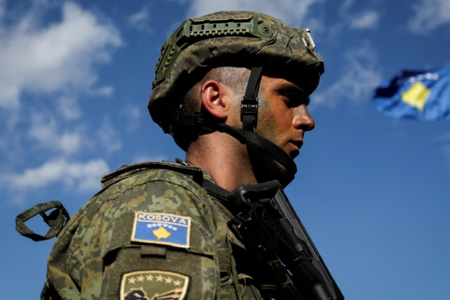
In this context, Kosovo is also included in the analysis, due to its international presence. The country hosts the NATO peacekeeping mission, KFOR, as well as the largest American base in the Balkans, Bondsteel. According to the two experts, this makes Kosovo a potential target, but not an unprotected one.
Colonel Cancian emphasizes that Kosovo is included within the coverage of NATO's anti-missile system in Romania and can strengthen its defense by cooperating closely with the alliance.
"Many countries have relationships with NATO that allow them to coordinate things like air defense. Of course, the Swedes and the Finns have had these relationships for many years before they became members. So, it is possible to put a small country under the NATO umbrella without necessarily being a member," Cancian says.





Lini një Përgjigje