


 Shkruar nga Gjergj Zefi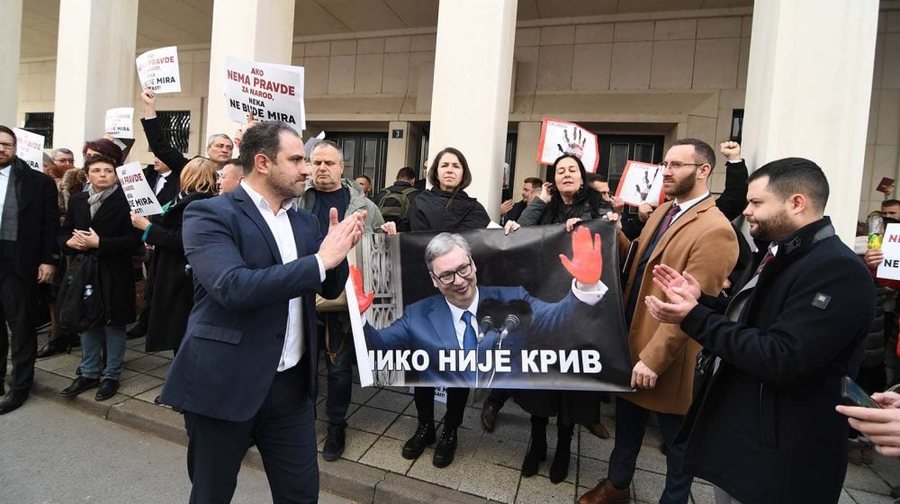
Vučić's regime is faltering, but the alternative is lacking; a Serbia in crisis is a new challenge for the entire region...
On November 1, 2025, Serbia will mark one year since the terrible tragedy in Novi Sad, where 16 citizens lost their lives when an irresponsibly built shelter collapsed. But while public opinion demands justice and reflection, President Aleksandar Vučić has warned that this day will pass without ceremony, without apology, and “like any other day.” Instead of institutional remembrance, the country is preparing for new civic and student protests, turning November 1 into a symbol of rebellion against deliberate state forgetting.
Serbia is at a critical juncture in its domestic political developments. A year after the outbreak of student protests and with the opposition struggling to reposition itself in the face of Aleksandar Vučić's regime, the most pressing question in Belgrade is: are these actors ready to take power?
If protest is the shake-up, who will be the brains and heart of change?
This is the big dilemma facing students and the Serbian opposition.
In an article published by Danas.rs, analysts and prominent figures in Serbian society emphasize that despite the increasing public influence of the student movement and calls for free elections, a clear and functional alternative to governing the country is still lacking.
Students are the moral heart of the protest, but not a political structure that can govern. Even the opposition, although more organized, suffers from fragmentation and the lack of a common platform that would convince citizens and the international community of its capacity to govern.
Analyst Dragomir Anđelković emphasizes that "we are not in a 'D-Day' type revolutionary moment where power falls overnight."
Meanwhile, CESID director Bojan Klačar notes that internationals will not take a new political force seriously without knowing who is behind it and what its plans are for the state.
Professor Jovo Bakić, an outspoken critic of the current regime, sums it up succinctly: without a broad opposition coalition that includes students and the political elite, change will remain just a slogan.
This dynamic has profound implications for Kosovo and Albania as well. A Serbia in precarious transition could be a source of tension in the region, but also an opportunity for a return to constructive politics if the new opposition is more pragmatic. However, if the change of power takes place without addressing attitudes towards Kosovo, the Albanians in the Presevo Valley, and relations with NATO, then we are not dealing with a democratic opening, but with a reformatting of Serbian nationalism with a new face.
For Tirana and Pristina, this is a call to strengthen regional diplomacy and build connections with progressive actors within Serbian society. The protests in Belgrade should not be seen solely as an internal Serbian development, but as part of a new political wave in the Balkans that could produce new approaches, positive or not, to unresolved issues.
The Serbian example is also a reminder to Albanians themselves: protest without a platform only brings emotional waves, not systemic change. Change requires organization, ideas, and responsible leadership. Serbia is at a crossroads today, and with it, the region.
If we don't know what we want after Vučić, it doesn't matter if we can overthrow him./ Pamphlet




Lini një Përgjigje