


 Shkruar nga Andi Bushati
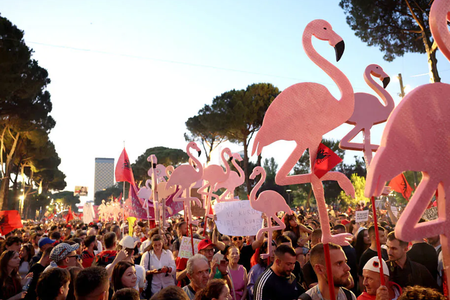
Therefore, no matter how risky it may seem, responding with street power to the systemic violence of power no longer needs to be treated as taboo. Since May 30, the flamingos have proven that they know how to be citizens, peaceful, and imaginative.
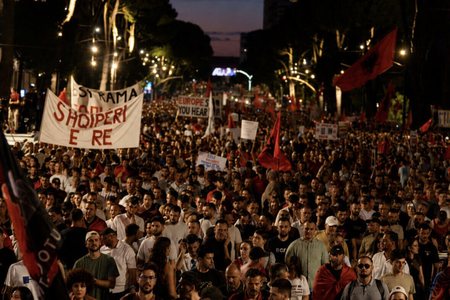
Although the most symbolic and beautiful protest that has ever taken place in this country has brought to light a great truth, that Albania is run by a gang of usurpers without legitimacy, it has so far offered no solution for how we can free ourselves from them. The simple question: “how does Edi Rama escape”, the essence of which has been expressed with all its creativity in hundreds of slogans along the boulevard, stands like the sword of Damocles over the fate of the flamingo revolution.
The options thrown out during these almost 40 days are several. There are those who believe that we still live in a democracy and hope for a moral resignation, as a sign of reflection on the sins of these 13 years. According to their logic, in a free country it is useless to linger in power, since the longer this agony lasts, the stronger and more irretrievable the fall will be.
Another group sees as a possibility a kind of awakening within the Socialist Party, as happened with Shkodra MP Mariana Koçeku, where a group of former loyalists could ask the prime minister to step down, as he is becoming an unbearable burden on the fate of his own political force.
On the other hand, those who do not believe in these solutions based on moral reflection have turned their attention to SPAK and the new justice system. For them, those Western powers that view the protest with sympathy and have stimulated participation in NGOs financed by them can use their influence on prosecutors and judges to end the autocrat's rule. They allude to the fact that a move similar to the Balluku case, where the prime minister were suspended from office, would finally solve the dilemma.
All three of these versions are united by a velvet road to the end. They envision a gentle and peaceful journey towards breaking with the autocracy, which fits perfectly with the DNA of this civic movement.
But, unfortunately, as beautiful as they are, they also seem impossible. For Edi Rama, as he himself has stated, resignation remains an unthinkable solution. Not only because for a decade he has been accustomed to traveling by private charter, to receiving guests in the evenings with whom he opens 33 thousand euro wines, but also for something much more existential.
From the way he has exercised power, he has left himself only two choices: either the armchair, or the cell. By signing "fap, fap fap", by plundering this country, by getting involved in scandals alla McGonigal, he has designed his own path. He burned the opportunity to grow old with Koço in Qeparo, or to dedicate himself to painting in a third life. If he leaves power, he loses everything, so voluntary departure is an illusion.
The possibility of a "Renaissance 2.0" in the Socialist Party also seems to be the case. The party has long since adopted the face, morals, and vices of its leader. It has become so zen-like that today it seems impossible for 13-14 people within it to rise up and vote on a motion against the leader.
The path with SPAK should not be viewed with optimism either. Even though, thanks to foreign influences, it remains the least elusive institution among all the others, the greatest sign of independence that the Special Prosecution has shown so far has been to strike without permission inside Rama's fold, but without ever imagining, not even in its wildest dreams, that it would reach him.
Although there are dozens of facts and clues, SPAK has not dared to question Rama as a person who knows about the terrible scandals, let alone go beyond them. Even the massiveness of the flamingo revolution and the possible international pressure are unlikely to embolden him to this point.
In these conditions, when all normal roads seem blocked, the only possible path may be that of a clash. An attempt to enter the prime minister's office, even in the premises of KOD, the center for communication and dialogue, which the government itself has promoted as a space for listening to critical voices, could constitute a symbol that the palace of power no longer belongs to a handful of usurpers.
Of course, choosing the option of force carries great risks. It could separate the movement from a part of it, essentially civic, that takes children to the square every afternoon to draw. It could stifle the creativity of those slogans, which in their imagination are worthy of the Nobel Prize. It could turn the celebration into tragedy.
This is so true that in some cases it has been the state apparatus itself that has provoked with violence, rubber batons, tear gas, and illegal arrests, hoping that the end of the peaceful era would disperse the protest. July 4 proved that it failed.
Therefore, no matter how risky it may seem, responding with the power of the street to the systemic violence of power no longer needs to be treated as taboo. Since May 30, the flamingos have proven that they know how to be citizens, peaceful, with imagination. They have won the moral battle with this environment. They have defamed all the slanders that they wanted to smear. Now, for them, more important than the image is the goal. Perhaps besides the beautiful face, the “new Albania” also requires a sacrifice.



Qartesisht perplasja eshte i cetmi opsion qe ka lene Rama..