


 Shkruar nga Pamfleti
In December, UKT split a single purchase for 1,000 remotely readable water meters into two separate lots, distributing about 470,000 euros across two different contracts for the same facility. Documents show that the split was approved under Skerdi Drenova’s direction, eliminated real competition and produced a unit price three to four times higher than the actual market value.
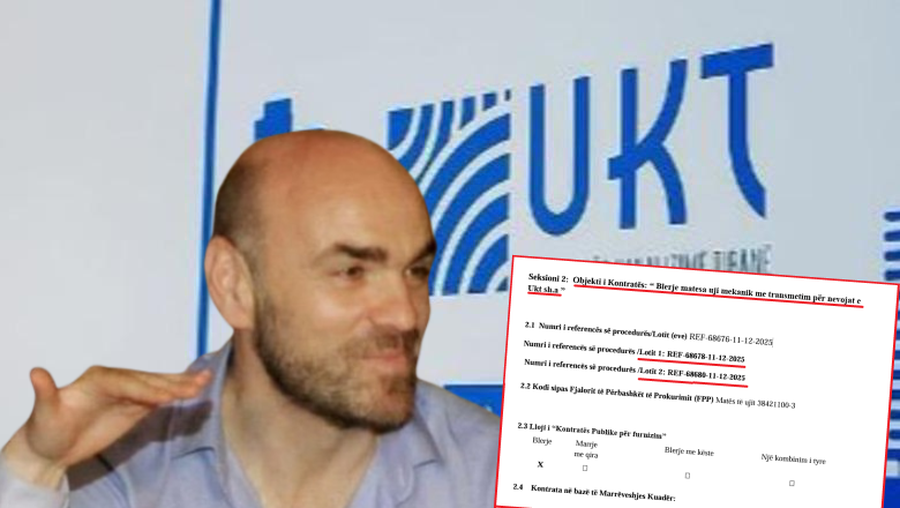
In December of last year, Tirana Water and Sewerage decided to spend around 470 thousand euros on the purchase of 1,000 remote reading water meters, a financial decision that in documents is presented as a technical purchase, but which in practice was carried out through an artificial division of the facility, splitting the tender into two different contracts for the same final product.
Official documents published in the procurement system show that on November 12, 2025, UKT approved the technical specifications and qualification criteria for the procedure entitled "purchase of mechanical water meters with transmission for the needs of UKT sh.a.", while the management of the institution was held by Skerdi Drenova, who exercised the function of general director at the moment when the tender architecture was built and its division was formalized.
Instead of announcing the purchase as a single contract for remote reading meters, UKT chose to split the facility into two lots, creating a contract for the meter body and a separate contract for the data transmission equipment, even though without the combination of the two there is no real remote metering function, making this separation not technical, but procedural.
This division resulted in two different tenders, the first with reference number REF-68678-11-12-2025 and a value of 45 million lek excluding VAT, which was won by the company HIDROFAHO sh.pk. , and the second with reference number REF-68680-11-12-2025 and a value of 4.97 million lek excluding VAT, which was won by the company Jehona Soft sh.pk. , in a procedure where the documents show that only a single bid was submitted.
The tender for meters resulted in two economic operators, but one was disqualified during the procedure, while the tender for transmission equipment was conducted without real competition, turning the announcement of the winner into a formality produced by the very way the procedure was structured.
Combining the two contracts yields the real figure for this purchase, which amounts to around 470 thousand euros for 1000 meters, or approximately 470 euros for each unit, a cost that is noticeable even without sophisticated analysis, as comparison with real market prices shows that a DN15 or DN20 mechanical meter is usually traded for values ranging from 20 to 40 euros, a transmission module for remote reading with LoRa or radio technology costs an average of 30 to 70 euros, while the installation of such a device in the field has a cost that fluctuates from 20 to 40 euros.
Even in a maximum scenario, where each component is purchased at the highest possible price, the real cost per unit does not exceed 100–150 euros, while UKT has paid around 470 euros for each meter, a difference that is three to four times higher than the normal market value and that is not explained by the technology, the installation or any exceptional features of the equipment.
After Drenova's departure, Flowers Shoshi took over the management of UKT, while the previously established contracts were not stopped and merged into a single procedure, allowing payments to continue according to the previously approved scheme.
The expenditure of 470 thousand euros on water meters does not represent a technical detail, but a financial decision with direct consequences on UKT funds, a decision that carries specific dates, figures and names and that raises direct questions about the way this tender was constructed, approved and implemented... /Pamphlet







UKT, OSHE jane bankomate per grabitje nga qeveritaret.