


 Shkruar nga Pamfleti
The 12-week war and restrictions in the Strait of Hormuz are keeping energy prices high, as markets expect a prolonged global supply deficit...
In its 12th week, the war in Iran has severely restricted traffic through the Strait of Hormuz, driving up global energy prices and inflation.
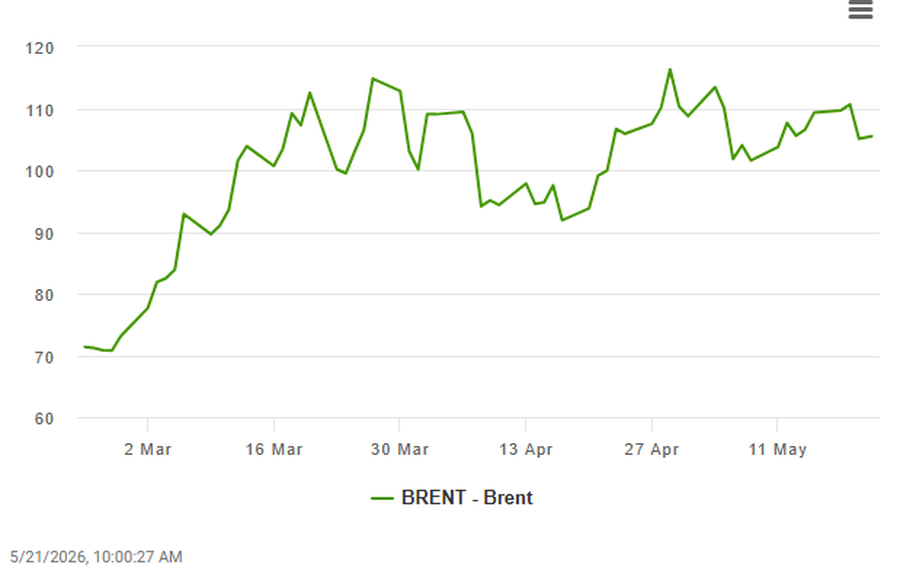
Oil market participants are increasingly including in their forecasts a price ceiling near $100 a barrel over the next year, as demand is expected to slow to offset the loss of millions of barrels of supply caused by the US-Iran war.
This is one of the conclusions of a Bloomberg Intelligence survey, which received 126 responses this month from asset managers and other energy market specialists.
Most market participants expect Brent crude to average between $81 and $100 per barrel over the next 12 months. Almost two-thirds of respondents believe oil will carry a sustainable risk premium of $5 to $15 per barrel for years to come, with few expecting it to exceed $20.
“This distribution suggests that geopolitical risks are seen as persistent, but not as a fundamental reset of the long-term price regime,” Bloomberg Intelligence analysts, including Salih Yilmaz and Will Hares, said.
“Instead, respondents seem to assume that supply and demand will gradually rebalance, keeping prices within a relatively stable range.”
The survey identified “demand destruction” as the most likely mechanism to offset supply shortages over the next year, followed by trade rebalancing, OPEC+ policy changes and the use of strategic reserves. Most respondents expect global supply disruptions to average between 3 million and 7 million barrels per day, with a few predicting shortages of over 10 million barrels.
Now in its 12th week, the war in Iran has severely restricted traffic in the Strait of Hormuz, pushing up global energy prices and inflation. However, key oil prices have remained relatively subdued, despite signs of tightening physical supplies.
The so-called “call skew” for West Texas Intermediate and Brent, the premium traders pay for options that bet on further price increases, has narrowed to its lowest level since before the conflict began in late February. Hedge funds have also cut bullish positions to their lowest levels since then.
These moves indicate that the market is less focused on profiting from rising prices and more on managing volatility. About a quarter of respondents expect increased financial hedging and risk management activity, compared to 15% who expect more opportunistic risk-taking.
U.S. shale oil is still expected to increase production, although few participants believe the increase will be strong enough to significantly rebalance the market. Most expect moderate growth over the next few years, while nearly a third think production will remain largely unchanged. Only a small minority predict either strong growth or a decline in production.
Some shale producers are already preparing to modestly increase drilling activity as prices trade near four-year highs and Washington is urging domestic companies to produce more crude. The U.S. Energy Information Administration projects that U.S. crude oil production will reach a record 14.1 million barrels per day in 2027. /Adapted from Pamphlet /




Kjo eshte pasoja e bere nga nji presidente I cmendur Trapi,nji manjake pere te sunduare.